AMD's upcoming Ryzen 7 9850X3D processor demonstrates remarkably consistent gaming performance across different DDR5 memory speeds, with benchmarks showing less than a 2% difference between DDR5-4800 and DDR5-6000 configurations. This positioning suggests the processor could be particularly valuable for gamers facing current DDR5 pricing pressures.
AMD is positioning its upcoming Ryzen 7 9850X3D processor as a solution for gamers navigating the current DDR5 memory market, with internal benchmarks showing minimal performance impact when paired with slower, more affordable DDR5-4800 RAM compared to faster DDR5-6000 kits.
What's New: The 9850X3D's Memory Sensitivity Claims
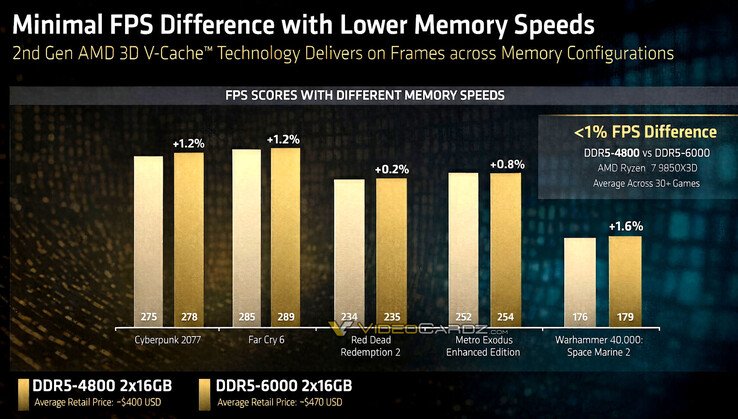
The Ryzen 7 9850X3D represents a higher-binned version of AMD's current-generation X3D processor lineup. While the company claims a 3-7% performance improvement over the existing Ryzen 7 9800X3D, the more interesting revelation comes from AMD's memory scaling tests. According to a presentation slide shared by VideoCardz, AMD tested the processor across more than 30 games and found that the performance difference between DDR5-4800 and DDR5-6000 configurations averages just 1%.
The slide specifically highlights that even in memory-sensitive titles like Far Cry 6 and Cyberpunk 2077, the performance delta doesn't exceed 2%. This is notably lower than what we typically observe with non-X3D processors, where memory speed can have a more pronounced impact on gaming performance.
How It Compares: Memory Pricing Context
AMD's presentation includes pricing data from PCPartPicker captured on January 9, 2026, showing DDR5-4800 modules averaging around $400 for a 2x16GB kit, while DDR5-6000 kits retail for approximately $470. These prices have since risen to $420 and $500 respectively, reflecting ongoing supply constraints in the memory market.
The 1-2% performance difference becomes more significant when viewed through this pricing lens. For a gamer building a new system, saving $80-100 on memory while sacrificing less than 2% gaming performance represents a compelling value proposition, especially for budget-conscious builders or those upgrading existing AM5 platforms.
Technical Context: Why X3D Processors Behave Differently
The 3D V-Cache technology that defines AMD's X3D processors fundamentally changes how these CPUs interact with system memory. The massive L3 cache (192MB in the 9850X3D) reduces the frequency of trips to main memory for game assets and instructions. When data stays in the cache, memory speed becomes less critical to overall performance.
This characteristic explains why X3D processors show flatter memory scaling curves compared to their non-3D counterparts. The cache acts as a buffer that masks the latency and bandwidth limitations of slower RAM. However, this advantage comes with trade-offs: the 3D V-Cache adds manufacturing complexity and can limit overclocking headroom, as AMD typically recommends avoiding aggressive voltage increases with the stacked cache design.
Who It's For: Target Audience Analysis
The Ryzen 7 9850X3D appears targeted at several specific user groups:
Budget-Conscious Gamers: Those looking to maximize gaming performance per dollar can opt for DDR5-4800 memory without significant performance penalty. This is particularly relevant for builders in regions where DDR5 pricing remains elevated.
Platform Upgraders: Users moving from DDR4 platforms who want to preserve their existing budget allocation can allocate more funds toward other components like GPU or storage.
Content Creators with Gaming Needs: While memory speed still matters for productivity workloads, the 9850X3D's gaming performance remains strong with slower RAM, making it a versatile choice for hybrid use cases.
Existing AM5 Owners: Those with DDR5-4800 or DDR5-5200 memory already installed can consider the 9850X3D as an upgrade path without needing to replace their RAM.
Limitations and Considerations
Several factors temper these claims:
Source of Data: All performance figures come from AMD's internal testing. Independent reviews, which will become available on January 28, 2026 (one day before launch), will provide verified benchmarks across a wider range of games and scenarios.
Workload Specificity: The 1-2% figure applies specifically to gaming. Productivity workloads like video editing, 3D rendering, and compilation tasks often show more significant scaling with memory speed, as they typically involve larger datasets that exceed cache capacity.
Platform Considerations: The AM5 platform's memory controller and motherboard designs also influence performance. Some motherboards may have better memory topology or BIOS optimizations that could affect results.
Future-Proofing: While DDR5-4800 may be sufficient for current games, future titles could become more memory-intensive, potentially widening the performance gap over time.
Market Implications
AMD's messaging around memory performance reflects a strategic response to current market conditions. With DDR5 prices still elevated compared to DDR4, and the AM5 platform requiring DDR5 adoption, the company is addressing a key barrier to entry for potential buyers.
This positioning also creates differentiation from Intel's current-generation processors, which typically show more pronounced memory scaling. For AMD, emphasizing the 9850X3D's memory efficiency could help capture budget-focused gamers who might otherwise be priced out of the AM5 ecosystem.
What to Watch
The true test will come with independent reviews on January 28. Key metrics to examine include:
- Performance across a broader game library beyond AMD's selected 30+ titles
- 1% and 0.1% low framerates, which are often more sensitive to memory latency
- Performance in CPU-bound scenarios at lower resolutions
- Comparison to Intel's competing processors with similar memory configurations
- Power consumption and thermal performance with different memory kits
Conclusion
AMD's claims about the Ryzen 7 9850X3D's memory efficiency, if verified by independent testing, could make it an attractive option for gamers navigating the current DDR5 market. The processor appears designed to deliver strong gaming performance without requiring premium memory investments, potentially lowering the total cost of ownership for AM5 platform builds.
However, as with any pre-launch claims, these figures should be treated as preliminary. The January 28 review embargo lift will provide the comprehensive data needed to assess whether the 9850X3D truly represents a more memory-agnostic gaming solution or if the performance differences become more pronounced in real-world scenarios.
For now, the processor stands as an interesting proposition: a high-performance gaming CPU that claims to be less dependent on expensive, high-speed memory—a potential answer to the current DDR5 pricing landscape that has kept many builders on the sidelines.
Sources: VideoCardz, PCPartPicker, AMD product documentation
Comments
Please log in or register to join the discussion