The FBI's 2025 Internet Crime Report reveals Americans lost nearly $21 billion to cyber-enabled crimes last year, marking a 26% increase from 2024. Investment scams, business email compromise, and cryptocurrency fraud drove the massive losses, with victims over 60 hit hardest.
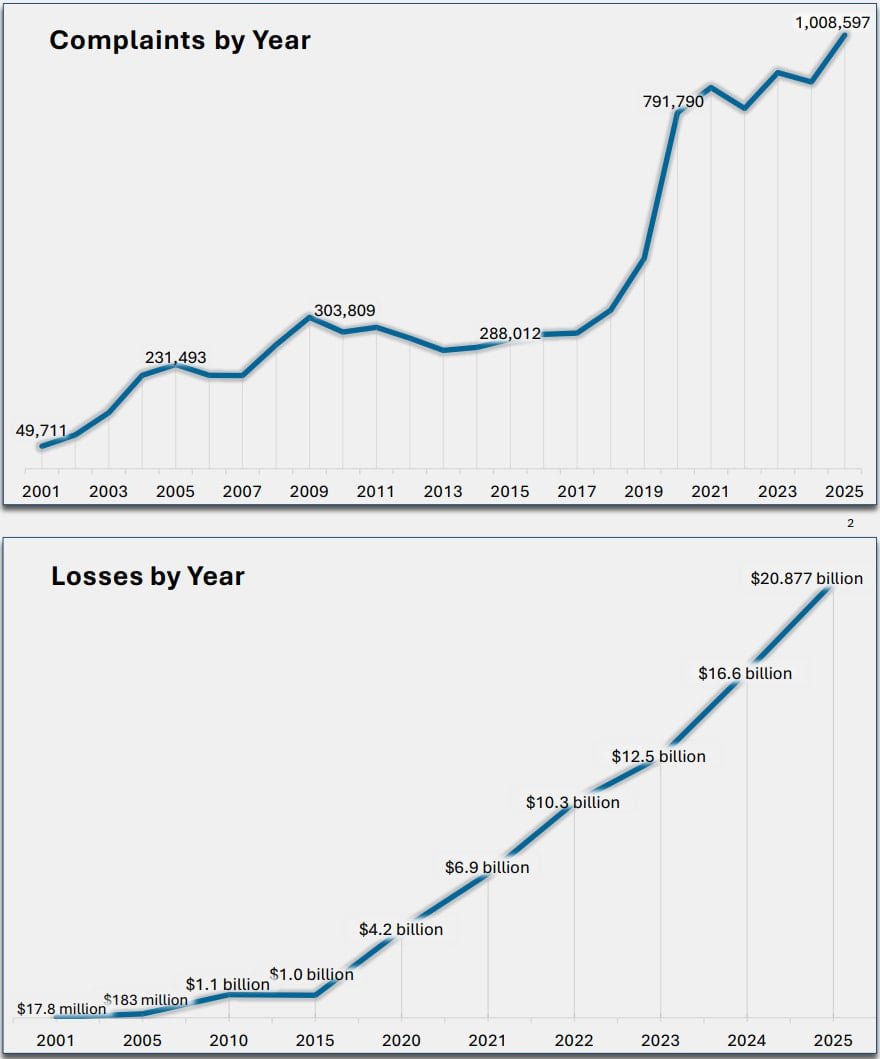
The Federal Bureau of Investigation has released its annual Internet Crime Report, revealing that Americans lost nearly $21 billion to cyber-enabled crimes in 2025, marking a 26% increase from the previous year's $16.6 billion in losses.
Record-Breaking Year for Cybercrime
The FBI's Internet Crime Complaint Center (IC3) received over 1 million complaints in 2025, up from 859,000 in 2024. This surge in reported incidents reflects both the growing prevalence of cybercrime and increased awareness among potential victims.
"The scale and sophistication of these attacks continue to evolve," said FBI Director Christopher Wray. "What we're seeing is not just more attacks, but more targeted, personalized schemes that exploit trust and urgency."
Investment Scams Dominate the Landscape
Investment fraud accounted for 49% of all scam-related incidents recorded last year, resulting in losses of $8.6 billion. These schemes typically involve promises of high returns with little risk, often using fake websites, social media influencers, and AI-generated content to appear legitimate.
Cryptocurrency-related fraud was particularly devastating, causing the largest single loss category at over $11 billion across 181,565 cases. The decentralized and often irreversible nature of cryptocurrency transactions makes them attractive targets for criminals.
Vulnerable Populations Hit Hardest
Americans over the age of 60 were disproportionately affected, suffering reported losses of $7.7 billion—a 37% increase compared to 2024. This demographic often has more accumulated wealth but may be less familiar with sophisticated digital scams.
"Older Americans are frequently targeted because they tend to have retirement savings and may be more trusting of authority figures," explains cybersecurity expert Dr. Sarah Chen. "Scammers often impersonate government officials, tech support, or family members in distress."
AI-Powered Scams Emerge as New Threat
For the first time, the FBI's report includes AI-related scams, which accounted for 22,300 complaints and $893 million in losses. These schemes leveraged:
- Voice cloning technology to impersonate family members or authority figures
- AI-generated fake profiles on social media and dating platforms
- Deepfake videos used in business email compromise attacks
- Forged documents that bypassed traditional verification systems
Critical Infrastructure Under Attack
The report identified attacks on critical infrastructure facilities, including dams and nuclear facilities, which the FBI classified as data breaches. The most targeted sectors were:
- Healthcare organizations
- Manufacturing facilities
- Financial services companies
- Information technology providers
- Government facilities
FBI's Countermeasures Show Promise
Despite the record losses, the FBI reports success in its intervention efforts. The agency initiated 3,900 Financial Fraud Kill Chain (FFKC) interventions in 2025, successfully blocking a portion of fraudulent transactions.
Of the $1.16 billion targeted by attackers, the FBI managed to freeze $679 million before it could be transferred out of reach. Additionally, the agency's "Operation Level Up" initiative proactively identified and alerted victims of cryptocurrency investment fraud.
"Of the 3,780 victims notified last year, 78% were unaware that they were being scammed," the FBI reported. This early intervention prevented millions in additional losses.
Most Common Attack Vectors
The FBI's data reveals the most frequent complaint types:
- Phishing attacks: 191,000 cases
- Extortion: 89,000 cases
- Investment scams: 72,000 cases
- Business email compromise: 24,700 cases
- Data breaches: 3,900 cases
- Ransomware attacks: 3,600 cases
- SIM swapping: 971 cases
Practical Protection Measures
The FBI recommends several strategies to protect against these evolving threats:
Verification Before Action: Never rush when receiving urgent requests. Scammers rely on creating artificial time pressure to bypass rational decision-making.
Multi-Factor Authentication: Enable MFA on all financial and email accounts to prevent unauthorized access even if passwords are compromised.
Regular Software Updates: Keep operating systems, applications, and security software current to patch known vulnerabilities.
Suspicious Communication Protocol: Independently verify any request for money or sensitive information through known, trusted channels—not those provided in the suspicious message.
Reporting Mechanism: Victims or potential victims should report incidents to ic3.gov with full details, including any communication records, transaction information, and suspected perpetrator details.
Looking Forward
Cybersecurity analysts predict that 2026 will see continued evolution in attack methods, with AI playing an increasingly central role in both attacks and defenses.
"We're entering an era where the barrier to creating sophisticated scams is lower than ever," notes cybersecurity researcher Marcus Rodriguez. "The same AI tools that can help detect fraud can also be used to create more convincing fake content."
The FBI emphasizes that public awareness and prompt reporting remain critical components in the fight against cybercrime. As attacks become more sophisticated, the combination of technological defenses and informed users represents the best defense against financial and data losses.
For more information on protecting yourself from cybercrime, visit the FBI's Internet Crime Complaint Center or the Federal Trade Commission's Consumer Advice pages.
Comments
Please log in or register to join the discussion