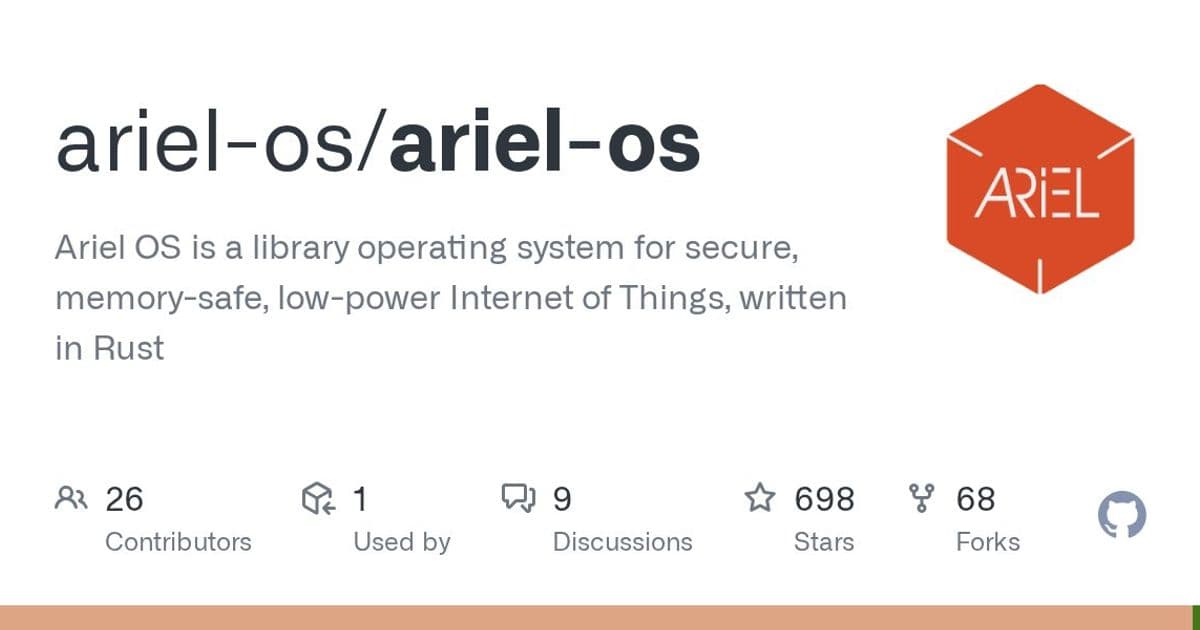
Ariel OS represents a significant advancement in embedded systems development, offering a Rust-based operating system specifically designed for secure, memory-safe IoT devices. Built on existing Embedded Rust ecosystem projects, it provides high-level integration and a batteries-included experience for developers working with 32-bit microcontroller architectures.
The Internet of Things continues to expand at an unprecedented rate, with billions of connected devices deployed across industrial, consumer, and infrastructure applications. However, this rapid growth has exposed critical security vulnerabilities inherent in traditional embedded systems development, particularly those written in C and C++. Memory safety issues, buffer overflows, and other common programming errors have led to numerous high-profile security breaches in IoT devices. Ariel OS emerges as a compelling solution to these challenges, offering a memory-safe operating system built from the ground up in Rust for secure, low-power IoT applications.
The Rust Advantage in Embedded Systems
Rust has gained significant traction in the embedded systems community due to its unique combination of performance, memory safety, and zero-cost abstractions. Unlike traditional systems programming languages that rely on runtime checks or garbage collection, Rust achieves memory safety through its ownership and borrowing system, enforced at compile time. This approach eliminates entire categories of bugs without sacrificing the low-level control and performance required for embedded applications.
Ariel OS leverages these Rust advantages to create an operating system that addresses the fundamental security challenges facing IoT deployments. By building on Rust's memory safety guarantees, Ariel OS eliminates common attack vectors such as buffer overflows, use-after-free errors, and data races that plague C-based embedded systems. This security-first approach is particularly crucial for IoT devices, which often operate in untrusted environments and handle sensitive data.
Hardware Architecture and Compatibility
Ariel OS supports a broad range of 32-bit microcontroller architectures, including ARM Cortex-M, RISC-V, and Xtensa processors. This architectural diversity ensures compatibility with a wide spectrum of IoT hardware, from low-cost consumer devices to industrial-grade sensors and controllers. The operating system's modular design allows developers to target specific hardware configurations while maintaining code portability across different platforms.
The choice of 32-bit architectures reflects the current state of the IoT market, where these processors dominate due to their balance of performance, power efficiency, and cost-effectiveness. Cortex-M processors, in particular, have become the de facto standard for many IoT applications, offering a rich ecosystem of development tools, debugging capabilities, and peripheral support.
Integration with the Embedded Rust Ecosystem
Rather than reinventing existing solutions, Ariel OS strategically builds upon established projects within the Embedded Rust ecosystem. The operating system integrates with Embassy for asynchronous programming, esp-hal for ESP32 hardware abstraction, defmt for efficient logging, probe-rs for debugging, sequential-storage for persistent data management, and embedded-test for testing infrastructure.
This integration strategy offers several advantages. First, it leverages the maturity and stability of existing projects that have undergone extensive testing and community validation. Second, it allows Ariel OS to focus on higher-level operating system functionalities rather than duplicating efforts in areas where excellent solutions already exist. Third, it ensures compatibility with the broader Embedded Rust ecosystem, enabling developers to use familiar tools and libraries.
Operating System Features and Capabilities
Ariel OS distinguishes itself from other embedded frameworks through its comprehensive feature set and high level of integration. The operating system provides a preemptive multicore scheduler, enabling efficient task management across multiple processor cores. This capability is increasingly important as IoT devices incorporate more powerful multicore processors to handle complex workloads and real-time requirements.
Portable peripheral APIs abstract hardware-specific details, allowing developers to write code that runs across different microcontroller families with minimal modifications. This portability significantly reduces development time and maintenance overhead, particularly for organizations deploying IoT solutions across diverse hardware platforms.
Network security facilities form another critical component of Ariel OS. As IoT devices increasingly connect to cloud services and communicate over public networks, robust security mechanisms become essential. Ariel OS incorporates additional network security features beyond what standard Embedded Rust libraries provide, addressing the unique security challenges of IoT deployments.
The laze meta-build system represents a novel approach to managing the complexity of embedded software development. By automating dependency management, configuration, and build processes, laze simplifies the development workflow and reduces the potential for configuration errors that can be difficult to diagnose in embedded systems.
Development Experience and Documentation
Ariel OS emphasizes developer productivity through its batteries-included approach. The operating system provides extensive documentation, including a comprehensive book that covers architecture, APIs, and best practices. Reference documentation for the API ensures developers have detailed information about available functions and data structures.
The quick start guide demonstrates the project's commitment to accessibility, promising that developers can get the hello-world example running in less than five minutes. This low barrier to entry is crucial for adoption, particularly among developers who may be new to embedded Rust development.
Examples showcase various features and use cases, helping developers understand how to leverage Ariel OS capabilities in their applications. Test cases provide verification of core functionality and serve as additional documentation for expected behavior. The roadmap offers transparency about planned features and development priorities, allowing the community to understand the project's direction.
Security-First Design Philosophy
Security is not an afterthought in Ariel OS but rather a fundamental design principle. The operating system's memory safety guarantees, combined with additional security features, create a robust foundation for IoT applications that must operate in potentially hostile environments. The project maintains a responsible disclosure policy for security vulnerabilities, encouraging private reporting through GitHub's security features.
This security-first approach addresses growing concerns about IoT device vulnerabilities, which have been exploited in numerous attacks ranging from distributed denial-of-service campaigns to privacy breaches. By providing a secure foundation, Ariel OS enables developers to build IoT solutions with confidence in their security posture.
Open Source Development and Community
Ariel OS is developed as an open source project under dual licensing (Apache 2.0 and MIT), providing flexibility for commercial and non-commercial use. The project welcomes contributions and maintains clear guidelines for community participation. This open development model fosters innovation and ensures the operating system evolves to meet real-world needs.
The project's backing by institutions like Freie Universität Berlin and Inria lends credibility and suggests ongoing research and development support. This academic-industrial collaboration often produces high-quality software that bridges theoretical advances with practical implementation considerations.
Future Directions and Impact
As IoT deployments continue to grow in scale and complexity, the need for secure, reliable, and developer-friendly operating systems becomes increasingly critical. Ariel OS positions itself at the intersection of these requirements, offering a modern alternative to traditional embedded operating systems.
The project's roadmap indicates ongoing development and feature expansion, suggesting a commitment to long-term maintenance and improvement. As the Embedded Rust ecosystem matures and hardware capabilities advance, Ariel OS is well-positioned to evolve alongside these developments.
For developers and organizations building IoT solutions, Ariel OS represents a compelling option that combines the security benefits of Rust with the integration and features expected from modern operating systems. Its focus on memory safety, comprehensive documentation, and batteries-included approach addresses many of the challenges that have historically made embedded development complex and error-prone.

The emergence of Ariel OS reflects a broader trend toward applying modern programming language features and development practices to embedded systems. As security concerns continue to dominate discussions about IoT, solutions like Ariel OS that prioritize safety without sacrificing performance or developer experience will likely play an increasingly important role in shaping the future of connected devices.

Comments
Please log in or register to join the discussion