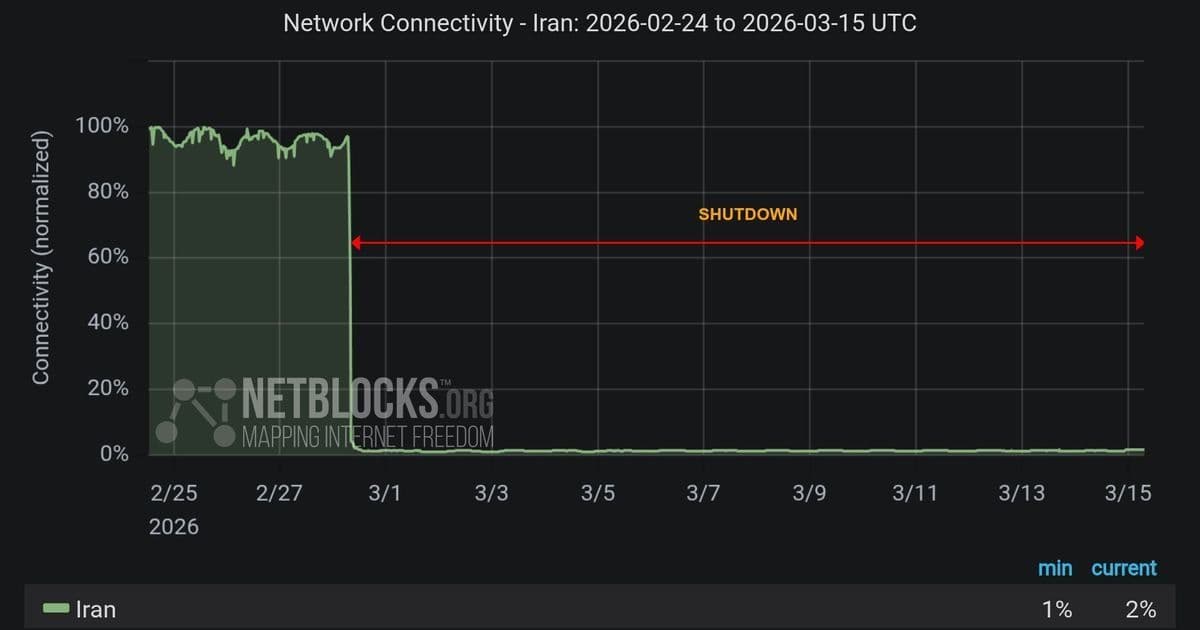
NetBlocks reports Iran's internet blackout has now lasted 16 days, with authorities arresting Starlink users while selectively whitelisting influencers and state media.
Iran's internet blackout has now entered its 16th day, according to monitoring group NetBlocks, marking 360 consecutive hours of severe restrictions that have largely cut off the Iranian public from international networks.
[IMAGE:1]
The ongoing digital blackout comes amid reports of a new wave of arrests targeting individuals using Starlink satellite internet services. NetBlocks noted that while the general population remains disconnected, selected influencers continue to receive whitelisted access, suggesting a deliberate strategy to control information flow while maintaining some channels for state-approved messaging.
This extended internet shutdown represents one of the longest and most comprehensive digital blackouts in recent Iranian history. Such measures are typically employed during periods of political unrest or when authorities seek to prevent the coordination of protests and limit the flow of information both into and out of the country.
The targeting of Starlink users is particularly significant, as satellite internet services have become increasingly popular in Iran as a means to circumvent government censorship and access unrestricted internet. The arrests suggest authorities are actively working to eliminate alternative communication channels that could undermine their control over information.
Meanwhile, Iran's Foreign Minister Abbas Araghchi has been making statements about the broader regional conflict, claiming that Iran's operations are aimed only at US bases and interests, while denying targeting civilian areas in neighboring countries. These comments come as the United States continues its military campaign against Iranian capabilities, with White House Press Secretary Karoline Leavitt reporting that Iran's ballistic missile capability has fallen by about 90% and its drone capability by around 95% since the start of the US-Israeli military operations.
The internet blackout has also affected traditional cultural celebrations, with Iran's judiciary banning the use of firecrackers during this year's Chaharshanbeh Suri, the traditional fire festival held before the Persian New Year. Authorities have urged people to avoid lighting fires or using fireworks, citing the need to keep emergency services available for "essential incidents."
This combination of digital suppression, targeted arrests, and restrictions on cultural expression points to an increasingly authoritarian approach by Iranian authorities as they attempt to maintain control during a period of significant regional tension and internal pressure. The selective whitelisting of influencers while maintaining a blackout for the general population represents a sophisticated information control strategy that allows the government to shape narratives while preventing widespread mobilization or protest coordination.
Comments
Please log in or register to join the discussion