
NimbusIQ introduces an innovative multi-agent approach to Azure drift remediation, combining deterministic rule evaluation with AI-powered reasoning to transform how organizations manage their cloud estates.
The complexity of managing large-scale Azure environments has created a significant challenge for cloud architects and operations teams. While Microsoft provides numerous tools for detecting configuration issues—Azure Advisor, Resource Graph, Cost Management, PSRule for Azure, and more—these tools generate data in silos without providing the contextual reasoning needed to prioritize and remediate issues effectively. This gap has given rise to innovative solutions like NimbusIQ, a multi-agent AI platform that bridges the divide between detection and actionable remediation.

What Changed: From Detection to Intelligent Remediation
NimbusIQ represents a fundamental shift in how organizations approach Azure configuration management. Rather than simply flagging deviations from best practices, the platform analyzes drift across multiple dimensions—cost, reliability, sustainability, and governance—and produces prioritized remediation plans with deployable infrastructure-as-code.
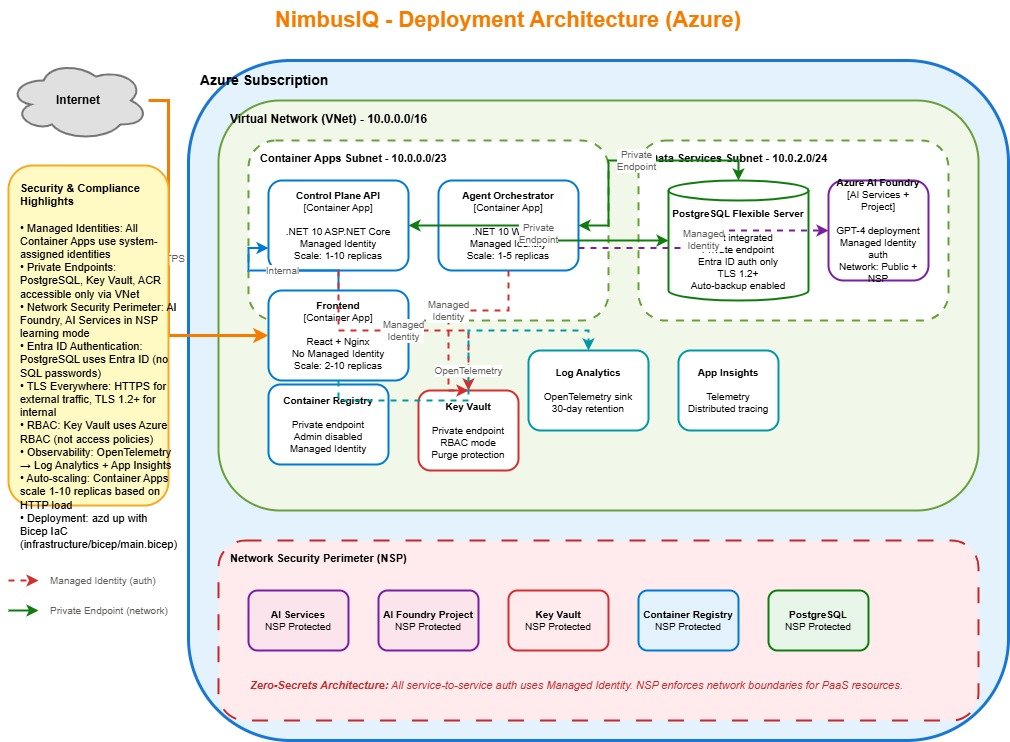
The platform's architecture consists of three core services:
- Frontend: A React application with Fluent UI v9 displaying service graphs, recommendations, and approval workflows
- Control Plane API: An ASP.NET Core (.NET 10) service managing service groups, analysis runs, and decisions
- Agent Orchestrator: A .NET 10 background worker executing the multi-agent pipeline using Microsoft Agent Framework
All components run on Azure Container Apps with managed identities, eliminating secrets management through DefaultAzureCredential and role-based access control.
Provider Comparison: Beyond Traditional Azure Tools
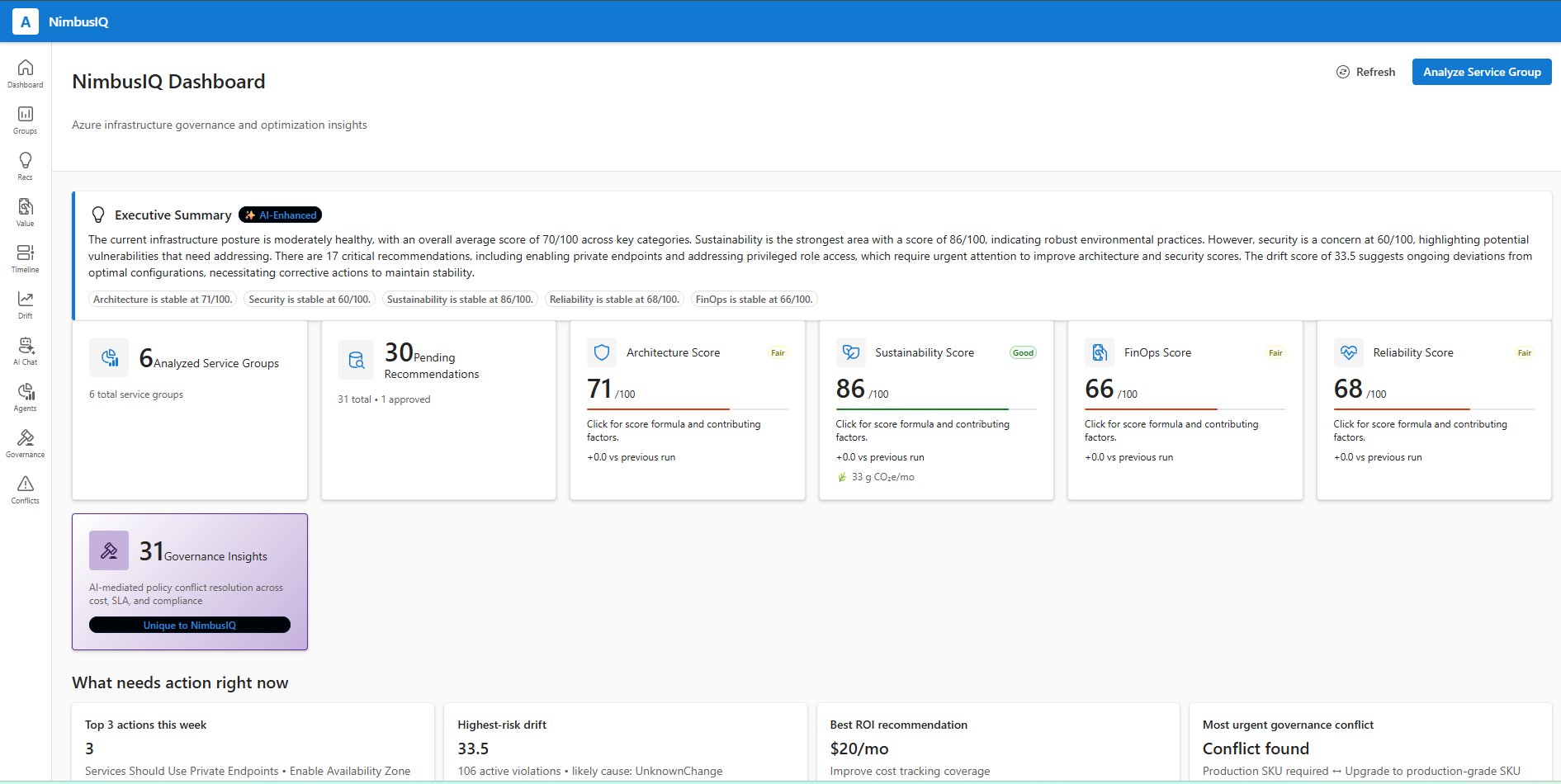
NimbusIQ doesn't replace existing Azure tools but rather enhances them by providing an intelligent orchestration layer. The platform leverages rule sets from Azure Advisor, PSRule for Azure, and Azure Quick Review while adding capabilities that traditional tools lack:
| Capability | Azure Advisor | PSRule for Azure | Azure Quick Review | NimbusIQ |
|---|---|---|---|---|
| Detect configuration violations | ✓ | ✓ | ✓ | ✓ |
| Continuous drift trending | ✗ | ✗ | ✗ | ✓ |
| AI-powered reasoning across signals | ✗ | ✗ | ✗ | ✓ (6 LLM agents) |
| Workload-scoped analysis | ✗ | ✗ | ✗ | ✓ (Azure Service Groups) |
| Generate deployable IaC | ✗ | ✗ | ✗ | ✓ |
| Dual-control approval workflow | ✗ | ✗ | ✗ | ✓ |
| Explain WHY issues exist | Basic | Pattern-based | Checklist-based | ✓ (AI narrative) |
| Track value realisation | ✗ | ✗ | ✗ | ✓ |
| Auditable agent-to-agent lineage | ✗ | ✗ | ✗ | ✓ |
The platform's ten specialized agents form a sophisticated analysis pipeline:
- ServiceIntelligenceAgent: Calculates service-group intelligence scores
- BestPracticeEngine: Evaluates 700+ rules from Azure Well-Architected Framework, PSRule, and Azure Architecture Centre
- DriftDetectionAgent: Identifies configuration drift across service resources
- WellArchitectedAssessmentAgent: Assesses workloads against Azure's Well-Architected Framework
- FinOpsOptimizerAgent: Analyzes cost optimization opportunities
- CloudNativeMaturityAgent: Evaluates cloud-native adoption patterns
- ArchitectureAgent: Reviews architectural decisions and patterns
- ReliabilityAgent: Assesses system reliability and resilience
- SustainabilityAgent: Evaluates environmental impact optimization
- GovernanceNegotiationAgent: Balances competing governance requirements
Business Impact: Transforming Cloud Operations
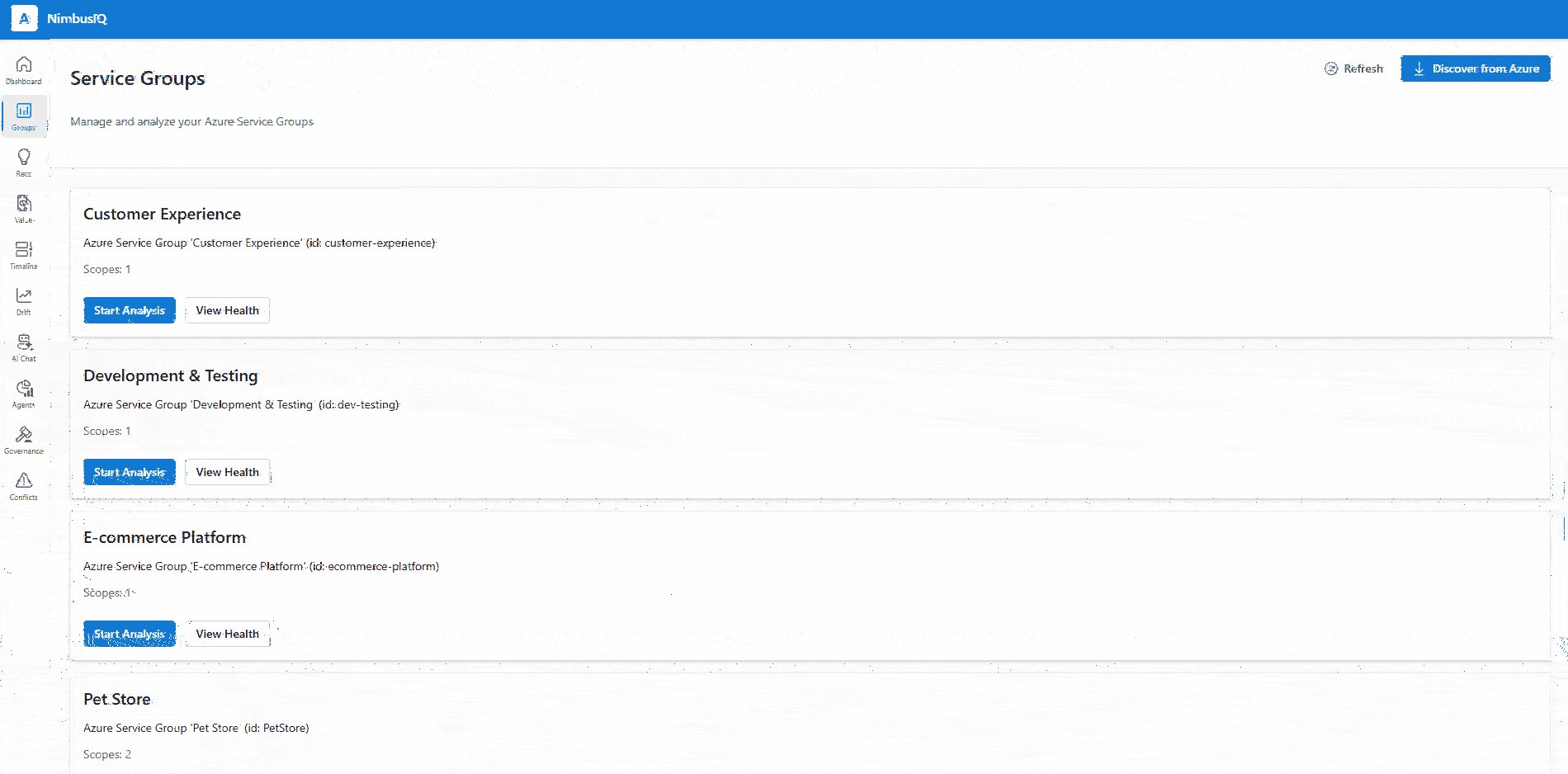
Organizations managing Azure estates at scale face a complex operational loop: gathering evidence from multiple tools, interpreting changes, deciding priorities, drafting remediation plans, routing through approvals, and verifying outcomes. This manual process is time-consuming, error-prone, and fails to scale with cloud environments.
NimbusIQ addresses this by:
1. Automated Decision Support
The platform automates the reasoning process that typically requires experienced cloud architects. By combining deterministic rule evaluation with AI-powered reasoning, it provides context-aware prioritization based on business objectives, technical constraints, and risk tolerance.
2. Continuous Drift Trending
Unlike point-in-time assessments, NimbusIQ tracks drift severity over time, enabling organizations to identify whether their Azure estate is improving or deteriorating. The drift scoring system assigns weights to different severity levels:
- Critical: 10 points
- High: 5 points
- Medium: 2 points
- Low: 1 point
This quantitative approach allows teams to focus on issues that have the greatest impact on their business objectives.
3. Infrastructure-as-Code Generation
Approved remediation plans automatically generate Bicep or Terraform code through Microsoft Foundry (GPT-4), with rollback plans for every change. This eliminates the manual translation of remediation actions into deployment scripts, reducing errors and accelerating remediation cycles.
4. Enterprise Governance Compliance
The platform incorporates a dual-control approval workflow, ensuring that infrastructure changes always undergo human review before deployment. This design choice acknowledges that while AI can augment decision-making, human oversight remains essential for infrastructure changes.
Technical Implementation and Deployment
NimbusIQ's hybrid approach combines deterministic rule evaluation with AI-powered reasoning, creating a system that balances consistency with contextual understanding. The BestPracticeEngine evaluates over 700 rules from Azure's well-established frameworks, while the AI agents handle subjective aspects like explaining trade-offs and generating narratives.
The entire system is instrumented with OpenTelemetry, providing end-to-end traceability of the analysis process. When an agent produces a questionable recommendation, teams can trace exactly what data was considered, which rules fired, and what reasoning was applied.
Deployment is streamlined through Azure Developer CLI (azd), with infrastructure defined in Bicep using Azure Verified Modules. The platform provisions:
- Azure Container Apps for all services
- PostgreSQL Flexible Server for data persistence
- Key Vault for secrets management
- Microsoft Foundry with GPT-4 for AI reasoning
- Log Analytics workspace for monitoring
- Managed identities with least-privilege RBAC
Strategic Considerations for Cloud Teams
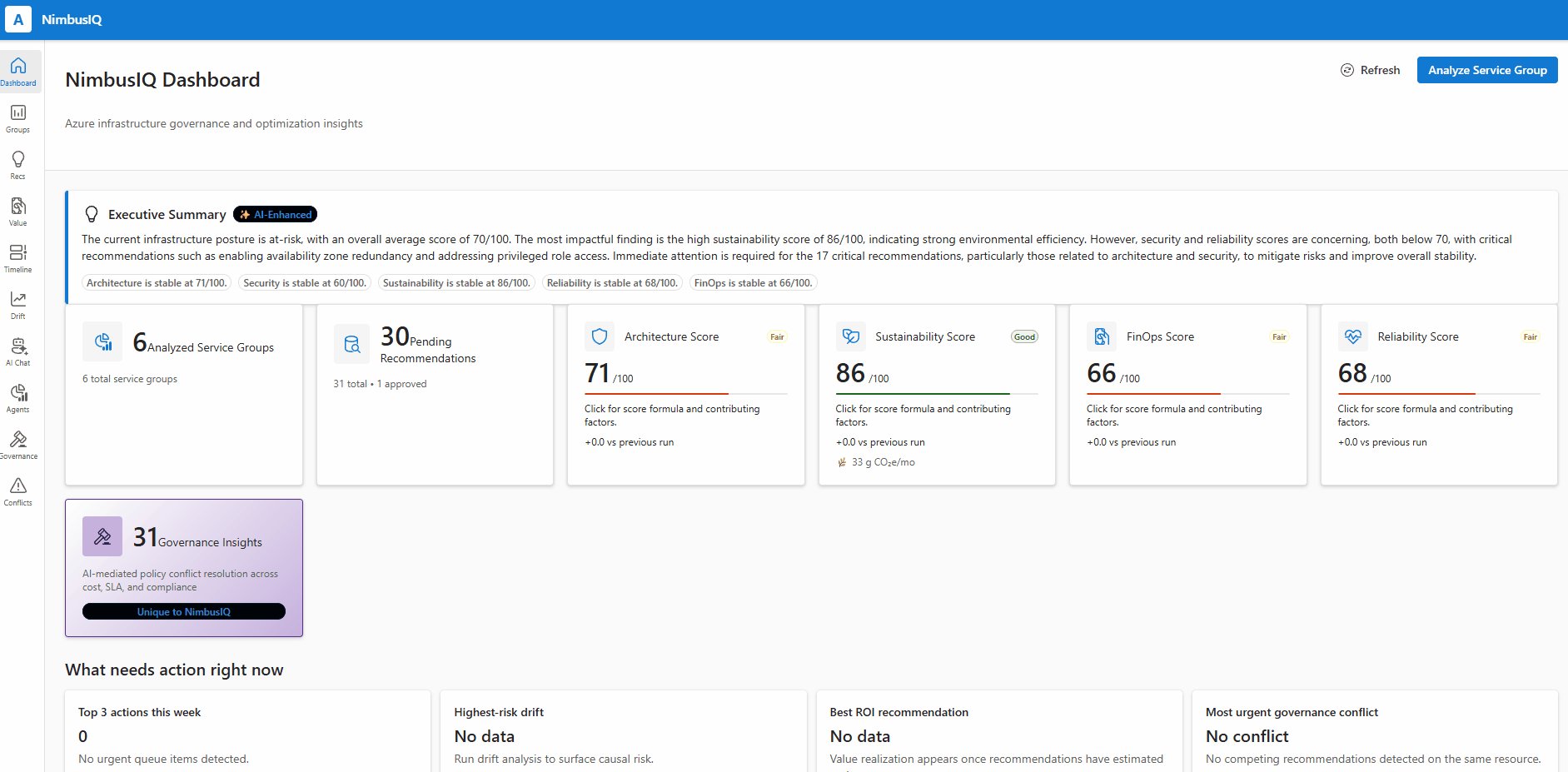
For organizations evaluating solutions like NimbusIQ, several strategic considerations emerge:
1. Integration with Existing Processes
NimbusIQ complements rather than replaces existing Azure tools. Organizations should consider how it integrates with their current monitoring, governance, and operational processes. The platform's value lies in its ability to synthesize outputs from multiple Azure services into actionable insights.
2. Skill Requirements
While the platform automates much of the reasoning process, teams still require cloud architecture expertise to review and approve remediation plans. Organizations should plan for training programs that help their teams understand the platform's recommendations and develop judgment in evaluating AI-generated outputs.
3. Cost-Benefit Analysis
The platform's value proposition becomes stronger as Azure estates grow in complexity. For smaller environments with straightforward configurations, the overhead of implementing and managing NimbusIQ might outweigh the benefits. However, for organizations managing hundreds or thousands of resources across multiple service groups, the efficiency gains and risk reduction can be substantial.
4. Evolution of AI in Cloud Operations
NimbusIQ represents an early example of how AI can transform cloud operations beyond simple automation. As AI models become more sophisticated and better integrated with cloud platforms, we can expect to see solutions that provide even deeper contextual understanding and more nuanced decision support.
Conclusion
NimbusIQ addresses a fundamental challenge in cloud operations: the gap between detecting configuration issues and understanding their business impact. By combining deterministic rule evaluation with AI-powered reasoning, it provides a framework for transforming raw detection data into actionable remediation plans.
The platform's multi-agent architecture, hybrid approach, and enterprise-grade features position it as a significant advancement in Azure configuration management. For organizations struggling to prioritize and remediate configuration drift at scale, solutions like NimbusIQ offer a path toward more efficient, risk-aware cloud operations.
As cloud environments continue to grow in complexity, the ability to reason across multiple dimensions—cost, reliability, sustainability, and governance—will become increasingly essential. NimbusIQ demonstrates how AI can augment human expertise rather than replace it, providing cloud teams with tools that enhance their ability to manage complex systems effectively.
For organizations interested in exploring this approach, the project's source code is available on GitHub: github.com/lukemurraynz/NimbusIQ. The implementation offers valuable insights into how multi-agent systems can be applied to cloud operations challenges, regardless of whether organizations adopt the specific solution.
Comments
Please log in or register to join the discussion