Arm and Linaro have launched CoreCollective, a new industry consortium focused on open collaboration in the Arm software ecosystem, with AMD joining as a founding member alongside other major tech companies.
The embargo just lifted on an interesting new industry consortium... CoreCollective. The CoreCollective consortium is focused on open collaboration in the Arm software ecosystem and to a large extent what Linaro has already been doing for the past decade and a half. Interestingly though with CoreCollective for open collaboration in the Arm software ecosystem, AMD is now onboard as a founding member along with various other vendors.
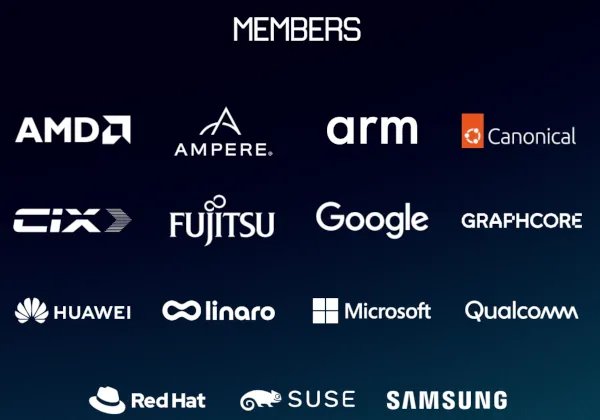
Linaro with the backing of Arm is today announcing the CoreCollective as a new industry consortium to collaborate around modern computing and the next-era of the Arm software ecosystem. CoreCollective is open-source focused and being financially backed by Arm with any vendor welcome to join for free. Founding members alongside Arm and Linaro include AMD, Ampere Computing, Canonical, CIX, Fujitsu, Google, Graphcore, Microsoft, Qualcomm, Samsung, and SUSE.
Most interesting is AMD joining this Arm software ecosystem consortium. The other hardware and vendors involved aren't too any surprise given their existing ARM Linux work or their in-house ARM64 server processors and the like. AMD joining this Arm alliance comes amid the ongoing rumors of AMD "Sound Wave" as an ARM-powered APU that has long been brought up. Then again, via their Xilinx acquisition there is ARM exposure too.
While perhaps a bit interesting from being absent as a member of the CoreCollective is NVIDIA. CoreCollective is to be a neutral, Arm-focused consortium to advance areas around Android, data centers, confidential computing, edge computing, Linux fundamentals, virtualization, and more.

It will be interesting to see what comes out of the CoreCollective moving forward for advancing the open-source ARM ecosystem.
Why This Matters for the Arm Ecosystem
The formation of CoreCollective represents a significant consolidation of effort in the Arm software ecosystem. While Linaro has been doing similar work for years, formalizing this into a broader consortium with direct Arm backing could accelerate development and standardization efforts.
For AMD's participation, this signals a deeper commitment to the Arm ecosystem beyond their Xilinx acquisition. Whether this relates to the rumored "Sound Wave" ARM APU or represents a broader strategy remains to be seen, but AMD's presence alongside traditional Arm partners is noteworthy.
The absence of NVIDIA is curious given their extensive work in ARM-based systems, particularly in AI and HPC. This could reflect competitive positioning or strategic differences in approach to ecosystem development.
Potential Impact Areas
CoreCollective's focus areas span the breadth of modern computing:
- Android: Continued optimization and standardization of the world's most popular mobile OS
- Data Centers: Advancing ARM64 server capabilities and ecosystem maturity
- Confidential Computing: Enhancing security models for sensitive workloads
- Edge Computing: Optimizing ARM for distributed, low-power deployments
- Linux Fundamentals: Improving kernel support and toolchain optimization
- Virtualization: Advancing hypervisor support for ARM architectures
With major cloud providers like Google and Microsoft involved, we can expect significant contributions to cloud-native ARM workloads and infrastructure.
What to Watch For
As CoreCollective develops, key areas to monitor include:
- Technical deliverables: What specific projects and standards emerge
- AMD's role: How their participation shapes consortium direction
- Ecosystem growth: Whether this accelerates ARM64 adoption in servers and edge
- Competitive dynamics: How this positions against x86 and RISC-V alternatives
The consortium's success will largely depend on translating this collaborative framework into concrete technical progress that benefits the broader open-source community.
Comments
Please log in or register to join the discussion