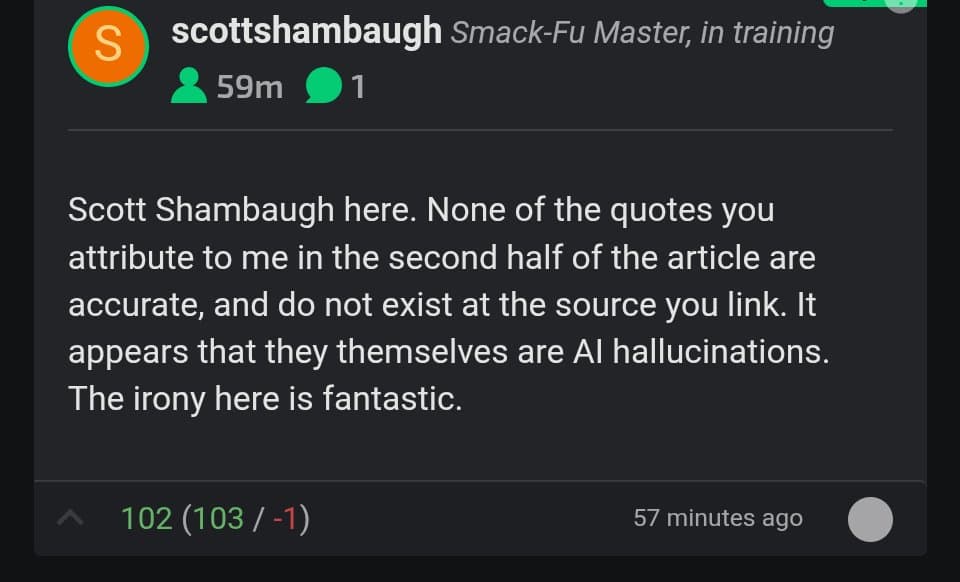
Ars Technica deleted an article containing fabricated quotes about a matplotlib maintainer after the author exposed the AI-generated content on social media.
The tech journalism world is reeling after Ars Technica was forced to pull an article that contained completely fabricated quotes about a matplotlib maintainer, following an expose by security researcher Matt Taggart.
The Fabrication Uncovered
Taggart (@[email protected]) was the first to call out the article, noting that "all the quotes from his post in the article are made up." His initial post on the Infosec Exchange quickly gained traction, with over 400 boosts and 466 favorites.
"What's going on here? The matplotlib maintainer this story is about correctly notes that all the quotes from his post in the article are made up."
Taggart didn't just complain—he archived the entire article before it disappeared. Using SingleFile in his browser, he preserved the content at mttaggart.neocities.org/ars-whoopsie, ensuring the public could see exactly what Ars had published.
The Deleted Article
The now-deleted piece, titled "After a routine code rejection, an AI agent published a hit piece on someone by name," was published by "Ars Staff" and appeared to be about a developer's experience with AI-generated attacks. The article has been completely removed from Ars Technica's website, though archived versions remain accessible through the Internet Archive.
Ars Technica's Response
Ars Technica's community manager, Aurich, addressed the controversy in the article's comments thread (also archived by Taggart). The response was notably tepid:
"Okay, an update: We have pulled the story over concerns that it may have gone against our content policies. I locked the comments, and I'm going to lock this one too, we need some time. We are doing an investigation right now to figure out exactly what happened. Given that it's Friday afternoon we probably won't have something to report back until Monday, but we will follow up with an explanation for our readers."
When users pointed out that Monday was a holiday, Aurich backpedaled further: "Edit: Monday is a holiday, my bad, and I don't know what we'll be able to say, so I don't want to over-promise anything."
Community Outrage
The response from Ars Technica's readership was swift and brutal. Long-time subscribers expressed fury and disappointment:
- "As an Ars subscriber, I am furious"
- "I'm really saddened that Benj's work seems to have fallen off. I trusted his writing, once."
- "What a catastrophic fall from grace."
- "I am tempted to go on a tagging spree but out of respect for your mentions I will refrain."
Many users immediately suspected AI involvement, with several pointing fingers at writer Benj Edwards, who has been accused of pushing generative AI content on the platform. One user noted, "It's like they all want to be made fun of."
The Bigger Picture
The incident raises serious questions about Ars Technica's editorial standards and potential AI usage. The community is demanding answers:
- Will Ars Technica continue publishing AI-generated content?
- Will AI-generated articles be clearly marked?
- How did fabricated quotes make it past editorial review?
One particularly damning observation came from user @rusty__shackleford: "Ars prides itself on technical accuracy. AI slop is a direct hit to their identity. The longer they wait to give a straight answer, the more it appears like they're trying to figure out how much they can get away with, instead of just being bluntly transparent."
Historical Context
This isn't Ars Technica's first controversy. Users pointed to previous incidents including:
- Anti-trans pieces from a couple of years ago
- Moderation issues where "polite fascist" comments were allowed while critics were banned
- Free PR for Elon Musk from writer Eric Berger
One user noted the pattern: "But has managed to just barely toe the line. He finally slipped up hard."
The Fallout
The incident has damaged Ars Technica's reputation significantly. Long-time readers who had defended the publication are now reconsidering their support. As one user put it: "A place I used to value. For me, the anti-trans piece was the end."
The delayed response—waiting until "Monday" (a holiday) to investigate—has only fueled suspicions that Ars Technica is trying to minimize damage rather than address the core issues honestly.
What's Next?
Ars Technica faces a critical moment. The tech community is watching closely to see if they'll:
- Provide a transparent explanation of what happened
- Implement clear policies on AI-generated content
- Take accountability for the fabricated quotes
- Rebuild trust with their readership
As of now, the article remains deleted, the comments are locked, and Ars Technica's silence speaks volumes. The incident serves as a stark reminder of the dangers of AI-generated content in journalism and the importance of maintaining editorial standards in an era of rapid technological change.
The question remains: Can Ars Technica recover from this blow to their credibility, or has this incident marked the beginning of the end for one of tech journalism's once-respected institutions?
Comments
Please log in or register to join the discussion