
Asus has launched the Zenbook DUO (UX8407), a premium dual-screen laptop featuring Intel's latest Panther Lake processors, offering developers and power users a unique form factor for enhanced multitasking and productivity workflows.
Asus has officially released the Zenbook DUO (UX8407), a dual-screen laptop that combines cutting-edge hardware with an innovative dual-display design. Priced at $2499 and up, this 3.6-pound machine targets professionals and developers who need extensive screen real estate without sacrificing portability.
At the heart of this device is Intel's latest Panther Lake processor, with options including the Intel Core Ultra 9 386H and the more powerful Core Ultra 9 388H. The base model at $2499 features the 386H with 4-core Intel Arc integrated graphics, while the $2699 configuration upgrades to the 12-core 388H variant. Both models come equipped with 32GB of non-upgradeable LPDDR5x memory and a 1TB PCIe 4.0 NVMe SSD that can be replaced or expanded.
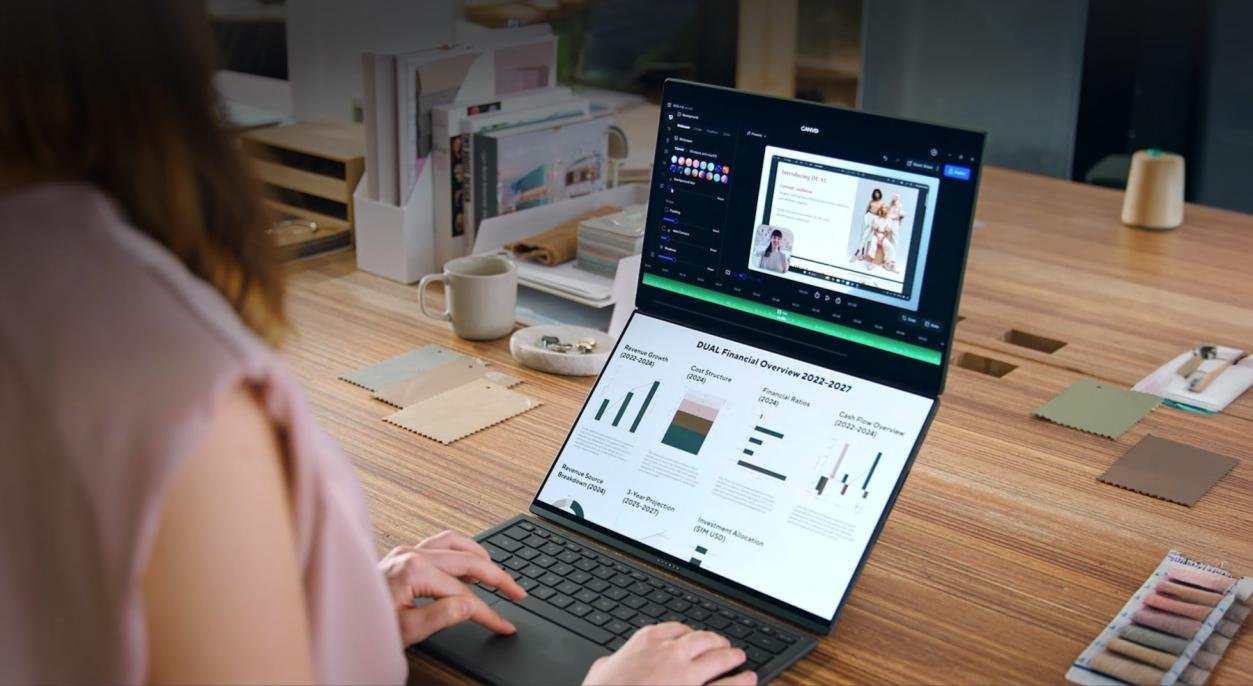
The defining characteristic of the Zenbook DUO is its dual 14-inch OLED displays. Both screens offer 2880 x 1800 resolution with variable refresh rates from 48-144Hz, providing exceptional color accuracy and smooth performance for visual work. The main display sits in the traditional laptop position, while a second touchscreen occupies where the keyboard would normally be. Asus includes a detachable keyboard that can be placed over the bottom screen when a traditional laptop experience is needed, or removed to expose the full dual-screen potential.
For developers and power users, the dual-screen configuration offers several workflow advantages. The built-in kickstand allows users to position the lower screen at an optimal angle, supporting both "desktop mode" with displays side-by-side and "dual screen mode" with one above the other. The lower screen can also function as an input device, potentially serving as a digitizer or secondary control surface.
Connectivity options include dual Thunderbolt 4 ports, HDMI 2.1, USB 3.2 Gen 2 Type-A, 3.5mm audio, and support for the latest WiFi 7 and Bluetooth 5.4 standards. The laptop features a six-speaker audio system with two tweeters and four woofers, and an FHD IR webcam with Windows Hello facial recognition.

Compared to its predecessor, the 2026 Zenbook DUO brings several improvements. The chassis is 5% smaller with slimmer bezels, and the gap between screens has been reduced. Thermal enhancements, including larger fans, allow the processor to run at up to 45 watts—a 28% increase over the 35W maximum in the original model. The detachable keyboard also offers significantly better battery life, providing up to 11.6 hours with the backlight on or 52 hours without it. It can connect via Bluetooth, pogo pins, or USB Type-C.
The laptop's "ceraluminum body" gives it a distinctive ceramic-like finish while maintaining durability. It measures 310 x 209 x 20mm at its thinnest point and 23mm at its thickest, weighing 1.65kg (approximately 3.64 pounds). Asus includes a 100W USB Type-C power adapter in the box.
While the pricing reflects the premium nature of this device, industry observers note that current RAM and storage shortages may also be influencing the cost. Asus had previously mentioned plans for a more affordable model with an Intel Core Ultra 5 325H processor, but no such configuration has been announced for the US market yet.
For developers working across platforms, the Zenbook DUO presents interesting possibilities. The dual-screen setup could enhance mobile development workflows, allowing simultaneous code editing on one screen and preview/testing on another. The high-resolution OLED panels would be particularly valuable for UI/UX design work, where color accuracy is critical.
The Zenbook DUO is now available for pre-order directly from the Asus Store. While the premium price point limits its market appeal, the device represents an interesting evolution in laptop design that could influence future form factors for productivity-focused machines.
For more information about specifications and purchasing options, visit the Asus Store page.
Developers interested in this unique form factor might also want to explore Asus's previous dual-screen offerings to understand the evolution of this concept, and consider how the improved specifications and refined design of the 2026 model might impact their workflow choices.
Comments
Please log in or register to join the discussion