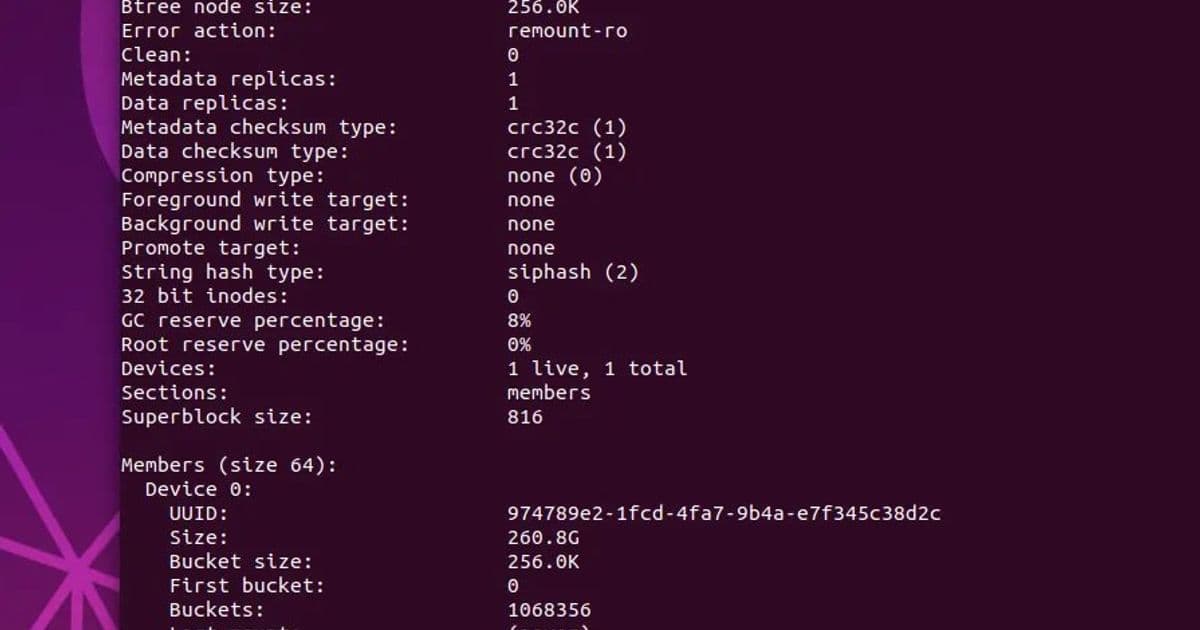
Kent Overstreet's next-generation file system reaches a major milestone with stable erasure coding, enhanced recovery capabilities, and comprehensive documentation update.
Kent Overstreet today marked a significant milestone in the evolution of Bcachefs with the release of version 1.37, bringing stability to long-awaited erasure coding functionality, Linux 7.0 kernel support, and a substantial documentation overhaul. This release represents a crucial step forward for the copy-on-write file system that has been under development for years and is steadily gaining traction among enthusiasts and professionals seeking advanced storage solutions.
Erasure Coding Finally Achieves Stability
The most significant highlight of Bcachefs 1.37 is the promotion of erasure coding from experimental to stable status. This feature, which has been in development for several years with continuous refinements over the past two releases, provides data redundancy similar to RAID implementations but with file-system-level integration.
Erasure coding allows for error correction across distributed storage, enabling Bcachefs to maintain data integrity even when some storage devices fail or develop bad sectors. Unlike traditional RAID, erasure coding in Bcachefs operates at the file system level, providing more flexibility and potentially better performance characteristics.
For those interested in the technical implementation details, the Bcachefs Wiki provides comprehensive documentation on how this feature works and its design considerations. With the experimental tag removed, all core functionality around erasure coding is now considered complete and production-ready.
Enhanced Recovery and Performance Improvements
Bcachefs 1.37 introduces several improvements that enhance the file system's resilience and performance:
Automatic recovery from devices with bad flush/fua support: The file system can now handle storage devices that don't properly implement flush/fua commands, which is common in many consumer SSDs. This reduces the need for manual intervention when dealing with problematic hardware.
Faster recovery from unclean shutdowns: Through improved journaling and recovery mechanisms, Bcachefs can now resume operations more quickly after unexpected power loss or system crashes.
Better performance for multi-device file-systems: The update includes optimizations that improve how Bcachefs handles storage across multiple devices, which is particularly beneficial for users implementing complex storage configurations.
Safe journal rewind functionality: The journal tracking system has been enhanced to automatically determine how far back it can be safely rewound, preventing potential data corruption during recovery operations.
New User-Space Tools and Commands
The release introduces several new sub-commands that enhance the usability of Bcachefs:
subvolume list: Provides a convenient way to enumerate all subvolumes within a Bcachefs file systemlist-snapshots: Allows users to view available snapshots, which are crucial for backup and point-in-time recovery scenariosreflink-option-propagate: Enhances the reflink functionality by properly propagating options when creating copy-on-write clones of files
These additions make Bcachefs more practical for day-to-day use and bring its feature set closer to that of more mature file systems.
Documentation Overhaul
Perhaps surprisingly, Bcachefs 1.37 includes a major update to its "Principles of Operation" (PoO) documentation, expanding it by approximately 100 pages. This comprehensive documentation now provides deep insights into the file system's architecture, design decisions, and operational characteristics.
For developers and power users looking to understand how Bcachefs works under the hood or optimize their deployments, this documentation represents an invaluable resource. The detailed explanations of internal mechanisms can help users make more informed decisions about configuration options and troubleshooting approaches.
Linux 7.0 Compatibility
With Bcachefs 1.37 now supporting the Linux 7.0 kernel code, users running the latest kernel versions can take advantage of this advanced file system. This compatibility opens the door for fresh benchmarking opportunities, as Phoronix and other testing sites can now evaluate Bcachefs performance on the newest kernel.
For those interested in performance metrics, this update should enable more comprehensive testing of how Bcachefs compares to other file systems like ZFS, Btrfs, and XFS under various workloads and hardware configurations.
Rust Conversion Progress
The ongoing effort to convert Bcachefs user-space components to the Rust programming language continues with this release. Rust's memory safety features and performance characteristics make it an attractive choice for system-level software, and this transition aims to improve the reliability and maintainability of Bcachefs tools.
While the kernel components remain written in C, the shift to Rust for user-space utilities represents a significant modernization effort that should pay dividends in terms of reduced security vulnerabilities and easier maintenance over time.
Build Recommendations
For users interested in trying Bcachefs 1.37:
Hardware requirements: While Bcachefs can run on modest hardware, optimal performance requires NVMe SSDs or high-quality SATA SSDs. For erasure coding, having at least 4-6 storage devices is recommended to maximize redundancy benefits.
Backup strategy: Despite its stability improvements, Bcachefs remains an out-of-tree file system. Regular backups are essential, especially for critical data.
Testing environment: Consider deploying Bcachefs first in a non-production environment to familiarize yourself with its features and behavior under different workloads.
Kernel compatibility: Ensure you're running a Linux kernel that supports Bcachefs 1.37, ideally Linux 7.0 or a recent LTS kernel with appropriate patches.
The complete changelog and source code for Bcachefs 1.37 are available in the Bcachefs-tools repository, where users can also track the ongoing development efforts and participate in the community discussion.
As Bcachefs continues to mature with releases like 1.37, it's positioning itself as a compelling alternative to established file systems, particularly for users who value advanced features like erasure coding, snapshotting, and copy-on-write semantics. The combination of technical innovation and practical usability improvements makes this release noteworthy for anyone interested in the cutting edge of file system technology.
Comments
Please log in or register to join the discussion