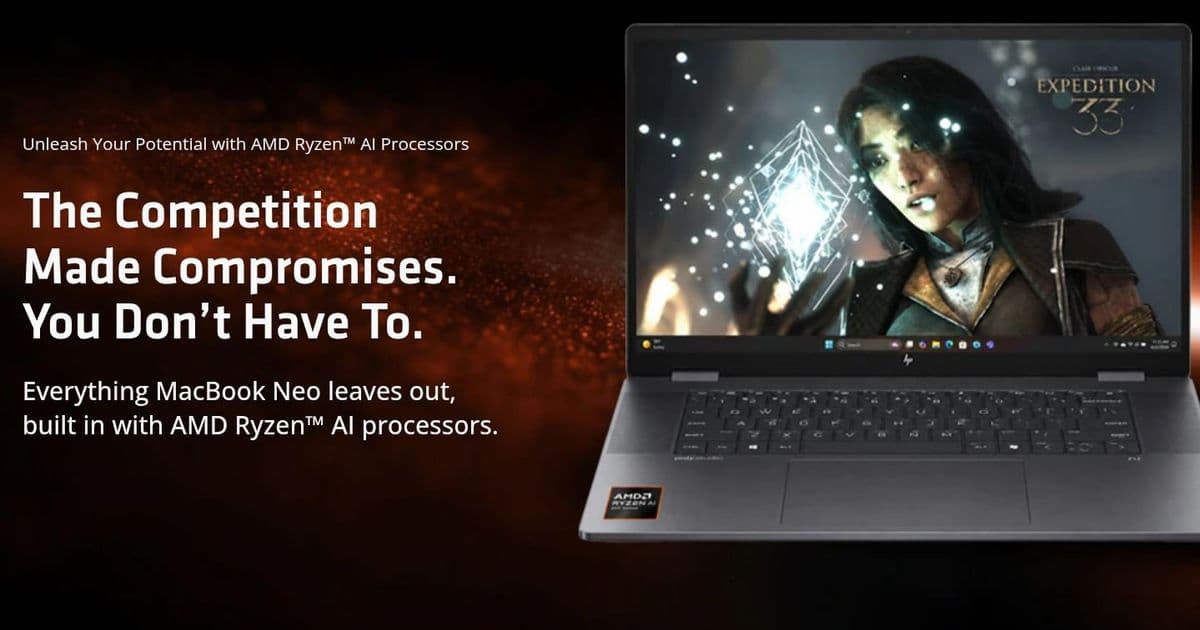
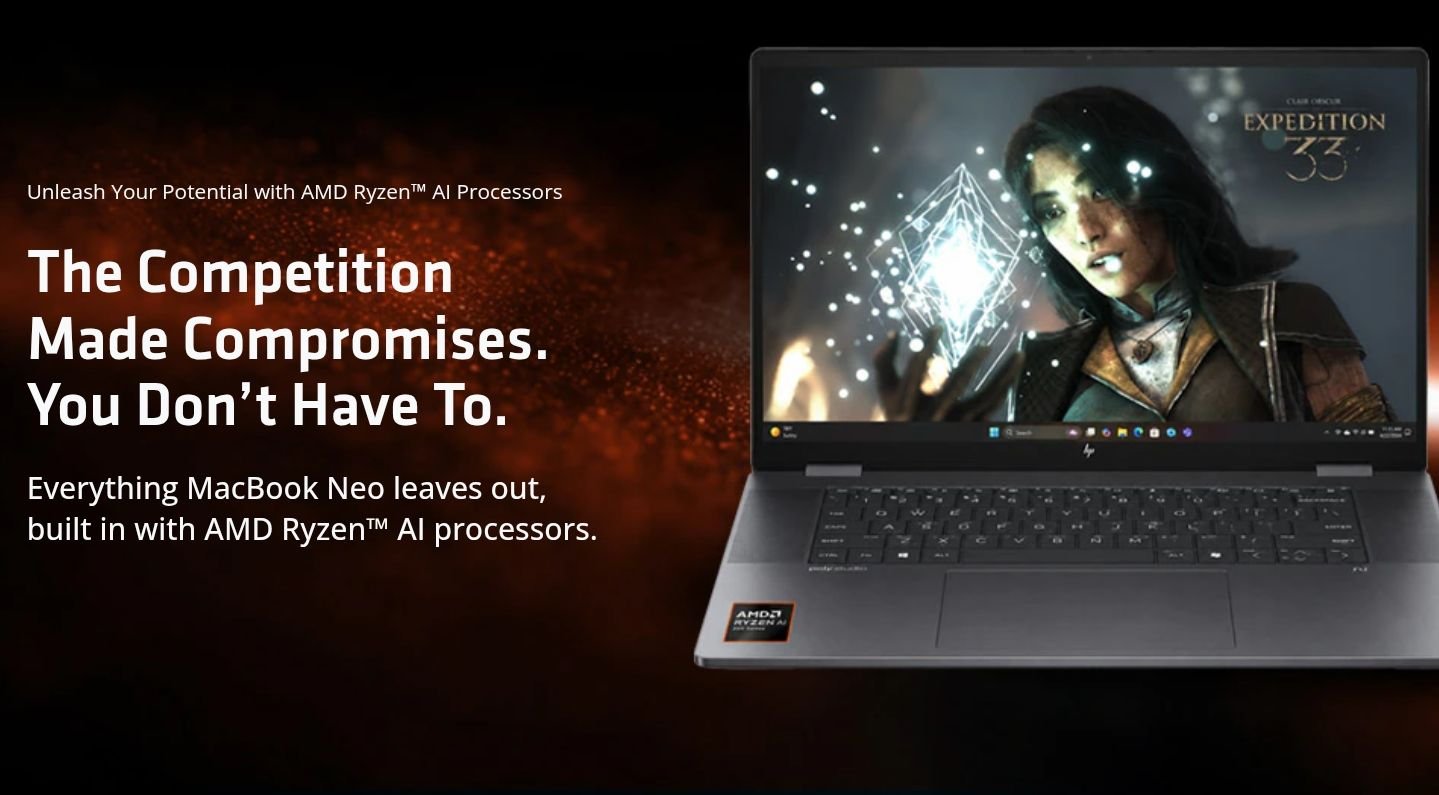
AMD's new marketing material directly compares the Ryzen 200 series-equipped HP OmniBook X Flip to Apple's MacBook Neo, highlighting that only 5 out of the 20 top PC games run natively on the Mac. The comparison underscores the x86 architecture advantage for gaming compatibility.
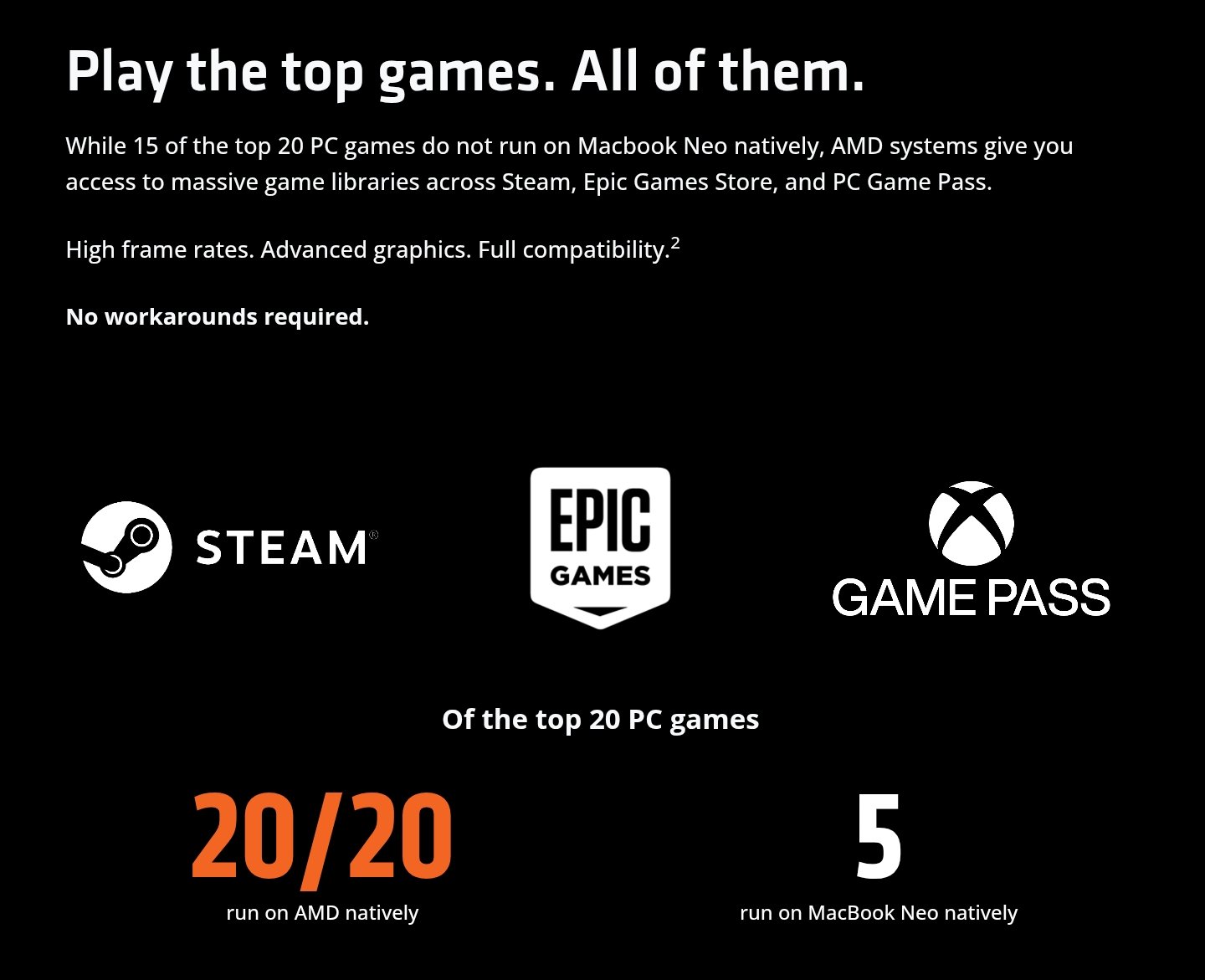
AMD has taken direct aim at Apple's MacBook Neo with fresh marketing collateral that puts gaming compatibility front and center. The comparison pits an HP OmniBook X Flip powered by the Ryzen 5 220 against Apple's budget laptop, and the numbers tell a stark story: only 5 of the 20 top PC games run natively on the MacBook Neo. AMD's system, by contrast, supports all 20.
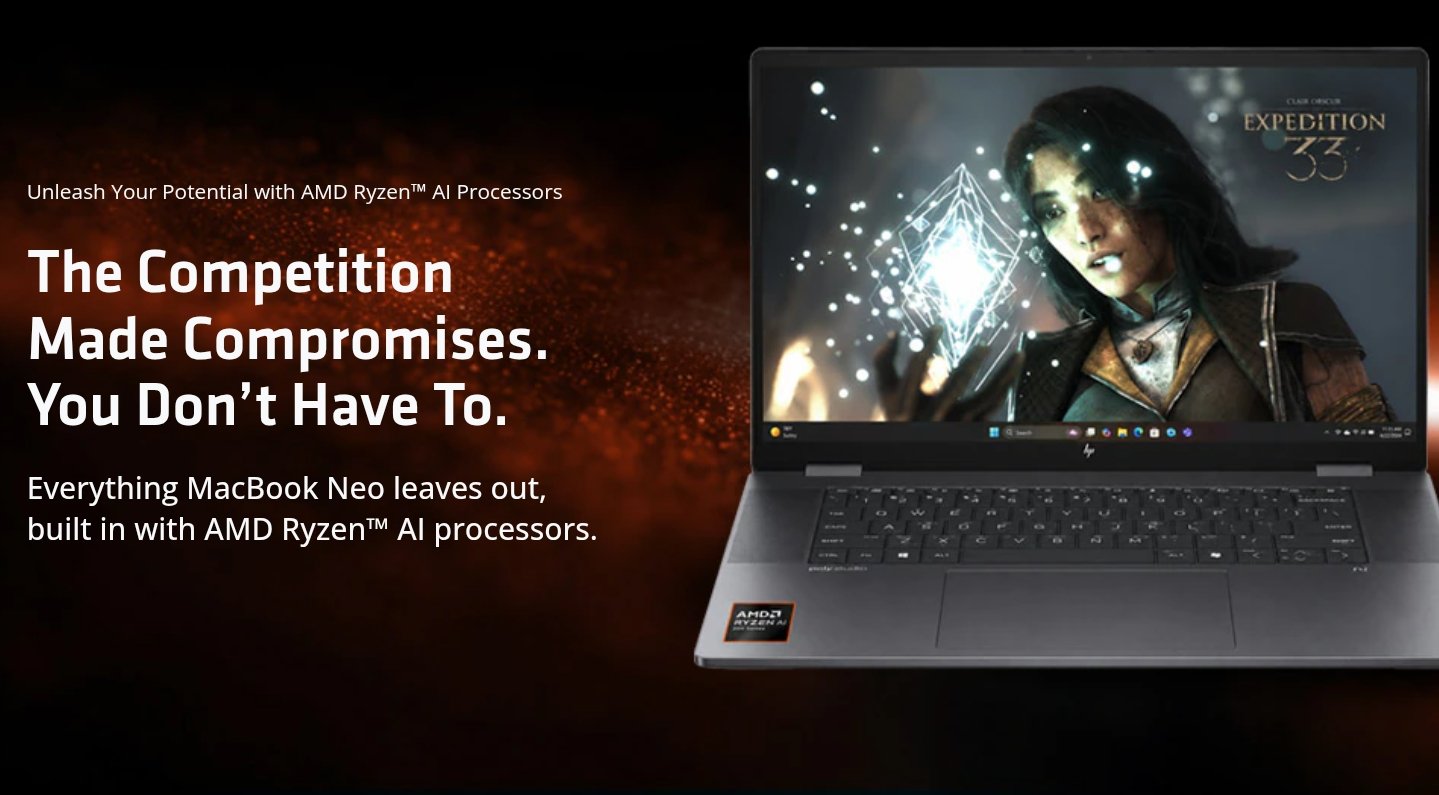
The Ryzen 5 220 powering the OmniBook X Flip is not a new chip. It represents a refresh of the Hawk Point lineup (8540U), featuring 2 full-fat Zen 4 cores and 4 Zen4c efficiency cores for a total of 12 threads. The integrated Radeon 740M GPU is the same silicon found in the original Ryzen Z1 APU, delivering roughly half the graphical horsepower of the Z1 Extreme. In practical terms, this means older titles like GTA V can push past 100 FPS at low settings, but modern releases present a challenge. Hellblade 2 averages around 8 frames per second, while Alan Wake 2 hovers near 11 FPS.
AMD's point is not that the Radeon 740M delivers exceptional gaming performance. The argument is about compatibility. The x86 architecture and Windows operating system provide a universal compatibility layer that Apple Silicon simply cannot match through native support. Every major game storefront, from Steam to Epic Games Store to Xbox Game Pass, operates on AMD-based Windows machines without friction.
The MacBook Neo's limitation stems from two factors. First, Apple's M-series chips use ARM instruction sets, while the vast majority of PC games are compiled for x86. Second, Apple has not prioritized gaming as a platform selling point, leaving developers without sufficient incentive to port titles. The Metal API is technically capable of modern rendering features, but community demand and Apple's own push remain insufficient.
Workarounds exist. Parallels, Crossover, and Game Hub all allow x86 code emulation on Apple Silicon, but AMD specifically addresses this in its materials, emphasizing "no workarounds required" on its systems. The distinction between native compatibility and emulation is central to the marketing message.
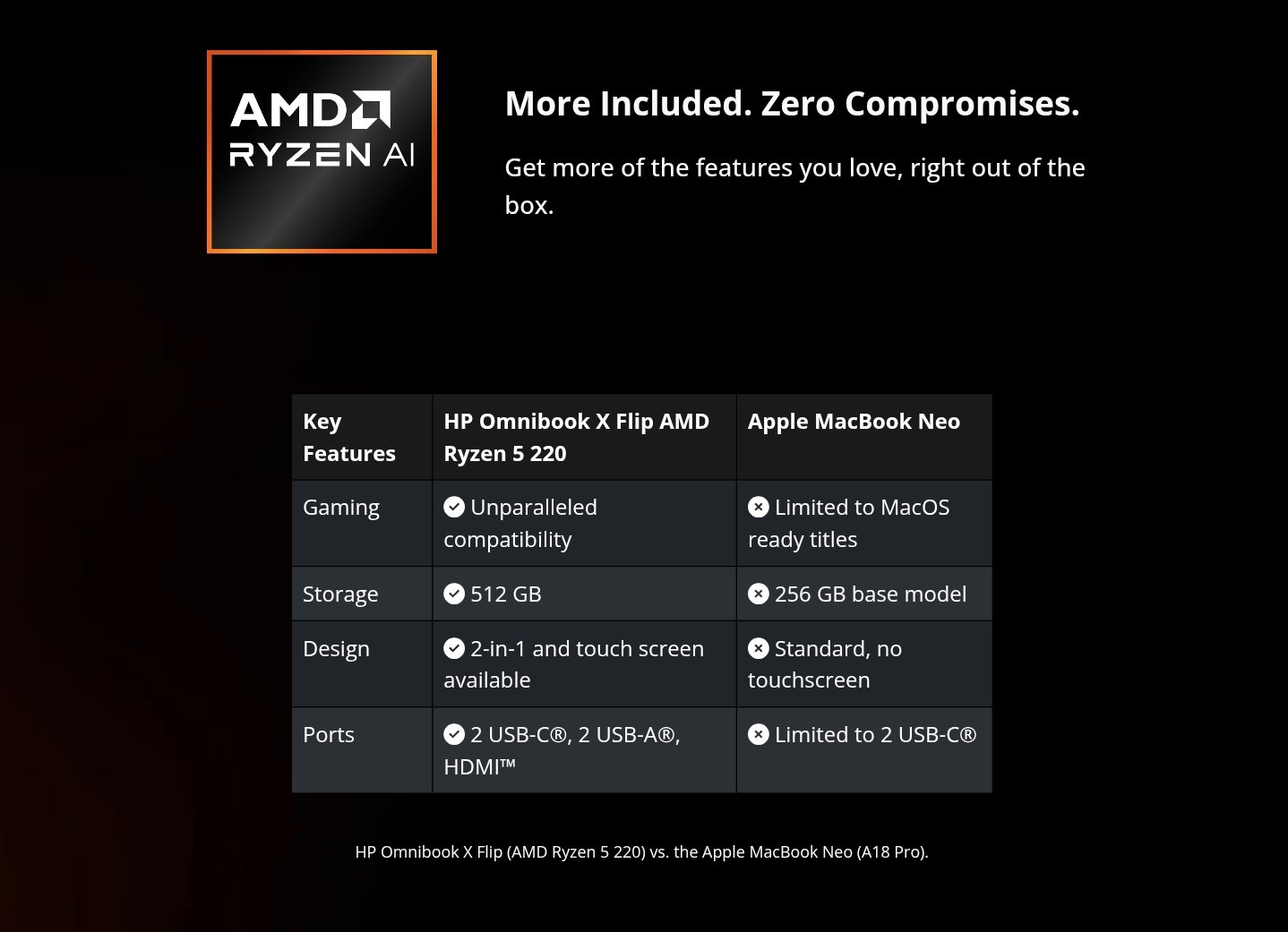
Beyond gaming, AMD stacks additional specifications against the Neo. The OmniBook X Flip includes a 512GB SSD compared to Apple's 256GB base configuration. The HP machine features a 2-in-1 form factor with touchscreen support, while the Neo offers a standard clamshell design with a basic display. Port selection also favors the AMD system: 2x USB-C, 2x USB-A, and 1x HDMI versus the Neo's dual USB-C configuration. And of course, the Windows 11 license is included.
The broader context matters here. The budget laptop segment is experiencing a resurgence of competition. Intel's Wildcat Lake processors are beginning to appear in similarly priced machines, offering compelling value propositions. Qualcomm's Snapdragon C-series chips bring ARM efficiency to Windows, providing an alternative path for users who want Apple-like power consumption without the compatibility trade-offs.
The simultaneous component crisis continues to constrain this segment. Supply chain pressures on DRAM, NAND, and advanced packaging nodes mean that even as competition intensifies, manufacturers face margin compression. TSMC's 4nm and 5nm nodes, used for both Apple Silicon and AMD's latest APPs, remain capacity-constrained, though the allocation dynamics differ significantly between the two companies.
AMD's marketing strategy here is precise. The company is not claiming superior raw performance or efficiency. It is claiming superior ecosystem compatibility, which is a fundamentally different argument. For users who prioritize gaming access alongside general productivity, the x86 Windows combination remains the path of least resistance. Apple's budget laptop excels in build quality, display, and battery life for non-gaming workloads, but the 75% incompatibility rate on top PC games represents a real limitation for a specific audience.

The comparison also reflects the shifting dynamics of the budget computing market. Three years ago, Apple's entry at the $999 price point with the M1 MacBook Air effectively reset expectations for what a budget premium laptop could deliver. Now, AMD, Intel, and Qualcomm are all competing aggressively in this space, each bringing different architectural advantages to the table.
For semiconductor analysts, this exchange highlights the enduring relevance of instruction set architecture in consumer computing. The ARM versus x86 debate has moved beyond power efficiency discussions into the territory of software ecosystem breadth. AMD's ability to claim universal compatibility across 20 top PC games, while the MacBook Neo manages just 5, demonstrates that raw chip performance is only one variable in the equation.
The gaming compatibility gap may narrow over time as Apple continues to invest in Metal and as game developers port more titles to macOS. But for the current generation of hardware, the numbers stand: AMD's budget Ryzen offerings provide access to the full PC gaming library, while Apple's Neo requires workarounds for three-quarters of the top 20 titles.
Comments
Please log in or register to join the discussion