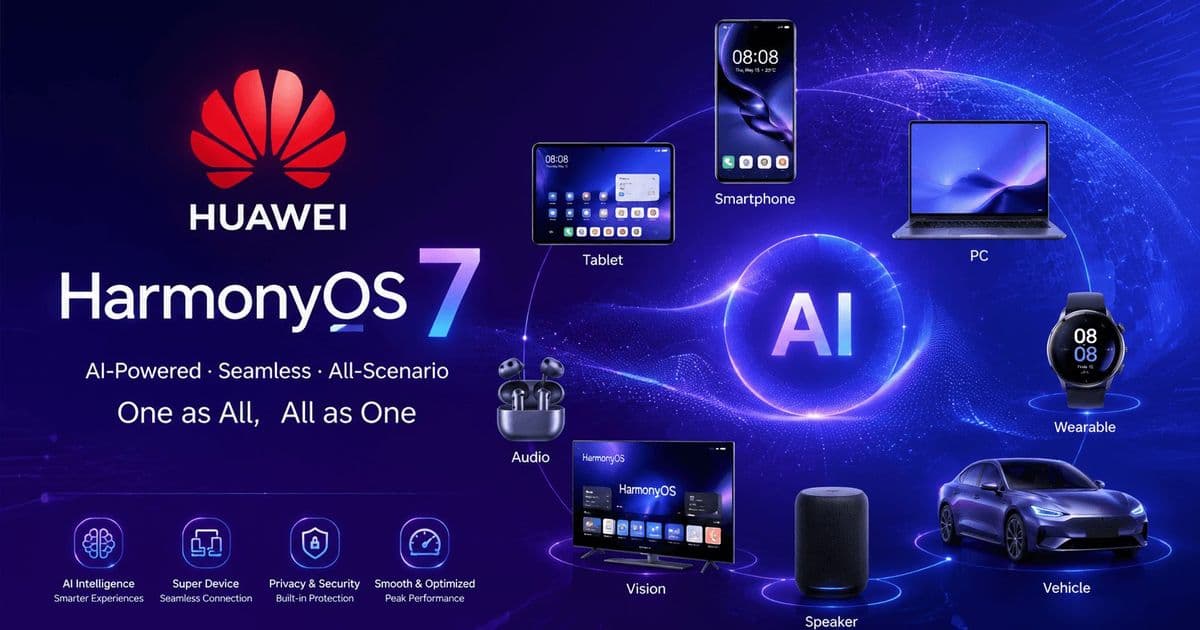
Huawei's latest OS release embeds AI agents at the kernel level and ships a 505B-parameter foundation model. The ambition is clear, but making intent-driven computing work across 2,000 third-party agents is a different problem than building the infrastructure.
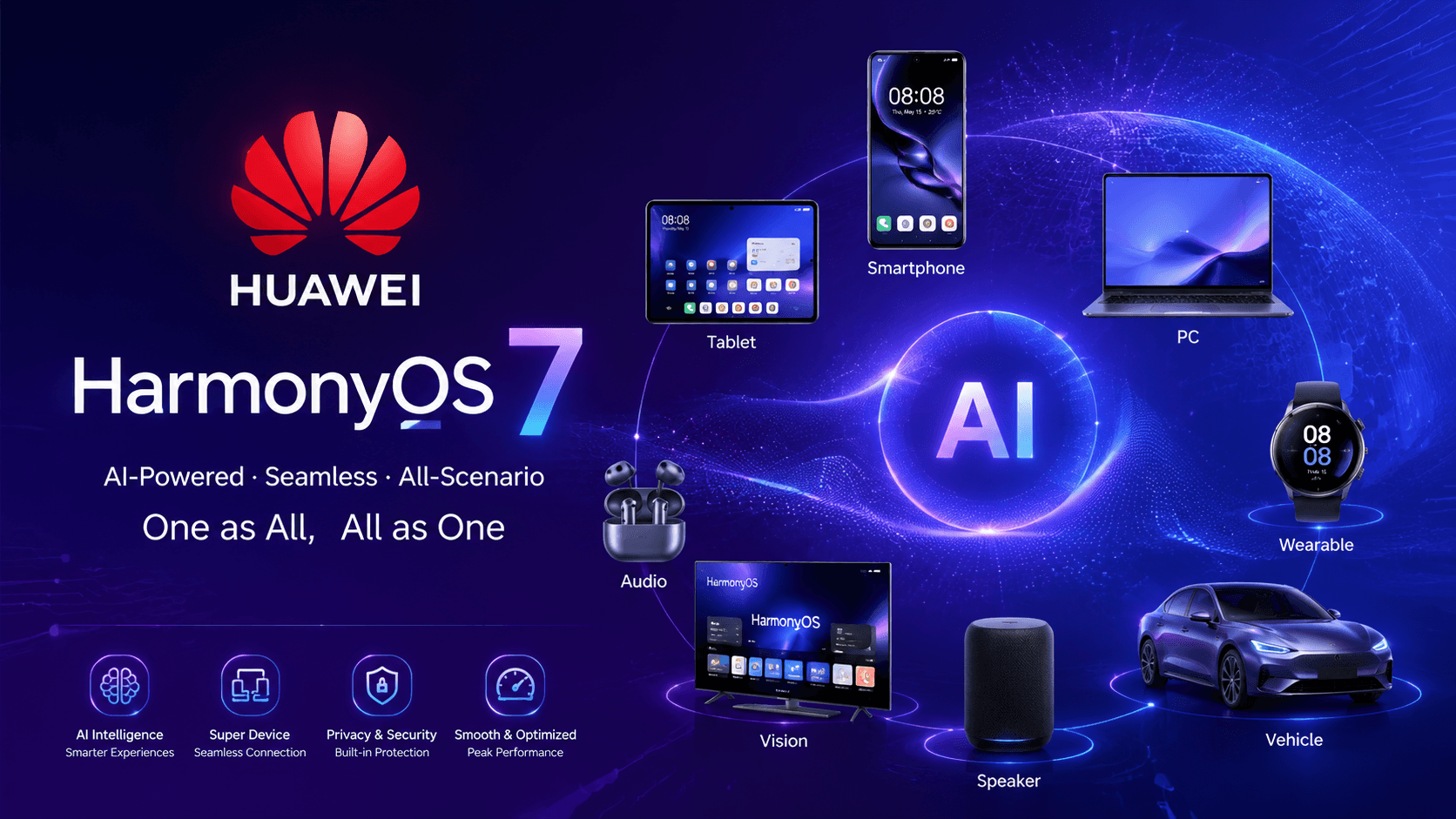
Huawei used its annual developer conference to announce HarmonyOS 7, and the headline feature is exactly what the industry has been circling for years: an AI assistant that doesn't just answer questions but actually operates the operating system on your behalf. The company rebranded its Xiaoyi assistant from a voice interface into what it calls a "system-level intelligence agent," and the distinction matters.
Previous iterations of Xiaoyi, like most AI assistants, operated as an overlay. You could ask it to set a timer or check the weather, but anything beyond basic commands still required you to open an app, navigate to the right screen, and tap through menus. HarmonyOS 7 changes that model fundamentally. Xiaoyi now has direct access to 2,100 system-level capabilities that Huawei calls "Skills," can read from 200+ system data categories, and coordinates with 2,000 third-party AI agents built on Huawei's Agent Framework.
What "Intent-as-Service" Actually Means
The phrase Huawei chose for this approach is "intent-as-service," and it's worth unpacking what that means in practical terms. Traditional OS interaction follows a rigid pattern: you decide which app handles a task, you open that app, and you complete the workflow within its interface. Intent-as-service inverts that. You describe what you want done in natural language, and the system figures out which skills, data sources, and third-party agents need to coordinate to fulfill the request.
A concrete example: instead of opening your calendar app, checking for conflicts, opening a restaurant app, filtering by cuisine and availability, then sending an invite to a contact, you would tell Xiaoyi something like "find a restaurant for Saturday dinner with the team, somewhere we haven't been before." The system would then pull calendar data, check restaurant preferences from past behavior, query available options through third-party integrations, and present a selection.
This is the same pitch that Apple, Google, and Samsung have been making with their respective AI initiatives. The difference with HarmonyOS 7 is the depth of system access. Huawei claims Xiaoyi can modify system settings, interact with notifications, manage background processes, and coordinate across device boundaries through HarmonyOS's distributed architecture. That level of integration is either genuinely useful or a security nightmare, depending on how well the permission model works.
The Foundation Model Behind It
Huawei also announced openPangu 2.0, its foundational large language model, which powers Xiaoyi's reasoning capabilities. The Pro version has 505 billion parameters, and there's a Flash variant at 92 billion parameters. Both support 512K context windows, which is relevant for the kind of multi-step task execution Huawei is describing. Long context windows matter when an AI agent needs to maintain state across a complex workflow without losing track of earlier instructions.
More interesting is the on-device component. Huawei says Kirin chips will support 30-billion-parameter models locally by autumn 2026. On-device inference is critical for the privacy claims Huawei is making. If your AI agent processes sensitive data like calendar entries, messages, and app usage patterns, sending all of that to a cloud server for processing creates obvious privacy concerns. Running a capable model locally addresses that, though 30 billion parameters is modest compared to what cloud-based models offer.
The Self-Evolving Architecture
Perhaps the most ambitious claim in the announcement is what Huawei calls the "Agentic Self-Evolving Architecture." This system gives Xiaoyi long-term memory, autonomous learning capabilities, and what Huawei describes as "reflection" capabilities. In practice, this means Xiaoyi is supposed to learn your habits over time and apply that knowledge to future tasks without explicit re-instruction.
The concept isn't new in AI research. Agents that learn from interaction history and refine their behavior are well-established in the literature. What's new is Huawei building this directly into the OS rather than positioning it as a feature of a standalone app. If your AI agent learns that you always check traffic before leaving the office at 6 PM, it can proactively surface that information or suggest leaving early if conditions are bad.
Huawei reports that Agent Framework 2.0 achieves task success rates exceeding 90% on complex tasks. That number deserves skepticism. "Complex task" is ambiguous without benchmark definitions, and success rates in controlled demonstrations often differ significantly from real-world performance. The 90% figure likely reflects specific, well-defined task categories rather than open-ended user requests.
Security: Star Shield and HPIC
The security component of HarmonyOS 7 addresses real problems. Huawei's "Star Shield" anti-fraud system uses AI to detect deepfake video calls, voice cloning, and face-swapping scams. This is a legitimate and growing threat. As generative AI makes it easier to create convincing synthetic media, the ability to detect manipulation in real-time communication channels becomes important.
Huawei's approach involves partnerships with platforms including Douyin (TikTok's Chinese version) and Alipay, suggesting the detection capabilities extend beyond HarmonyOS devices to cover cross-platform interactions.
The accompanying HPIC (HarmonyOS Personal Intelligent Computing) white paper outlines a "local-first, data-minimization, user-controllable" framework for AI data handling. This is the right set of principles, but principles in white papers and principles in shipped software are different things. The implementation details will determine whether this is meaningful privacy protection or just good marketing.
The Adoption Question
HarmonyOS 7 Developer Beta is available now for Mate 80 Pro, Pura 90 Pro Max, and other flagship devices, with stable release planned for autumn alongside Huawei's hardware lineup.
The technical infrastructure Huawei has built looks substantial. The open developer framework with 2,000+ third-party agents suggests real ecosystem investment. But the history of AI assistant platforms is littered with impressive demonstrations that never translated into daily utility. Siri launched in 2011 with ambitious promises. Google Assistant arrived in 2016 with similar ones. Both have improved, but neither has delivered on the vision of an AI that truly understands and executes complex user intent reliably.
Huawei's advantage is vertical integration. The company controls the hardware (Kirin chips), the OS (HarmonyOS), the foundation model (openPangu), and the assistant (Xiaoyi). That level of integration makes deeper system access possible in ways that Android or iOS don't easily allow for Google or Apple's respective assistants. Whether that technical advantage translates to a meaningfully better user experience depends on execution that hasn't been publicly tested yet.
The 90% success rate claim, the self-evolving architecture, the on-device model deployment. All of these are currently Huawei's assertions. Independent benchmarks, developer reports, and user experiences over the coming months will tell a different story. The infrastructure is there. The question is whether the intelligence that runs on top of it is actually smart enough to be useful, or if it's another AI assistant that's impressive in demos and frustrating in practice.
Comments
Please log in or register to join the discussion