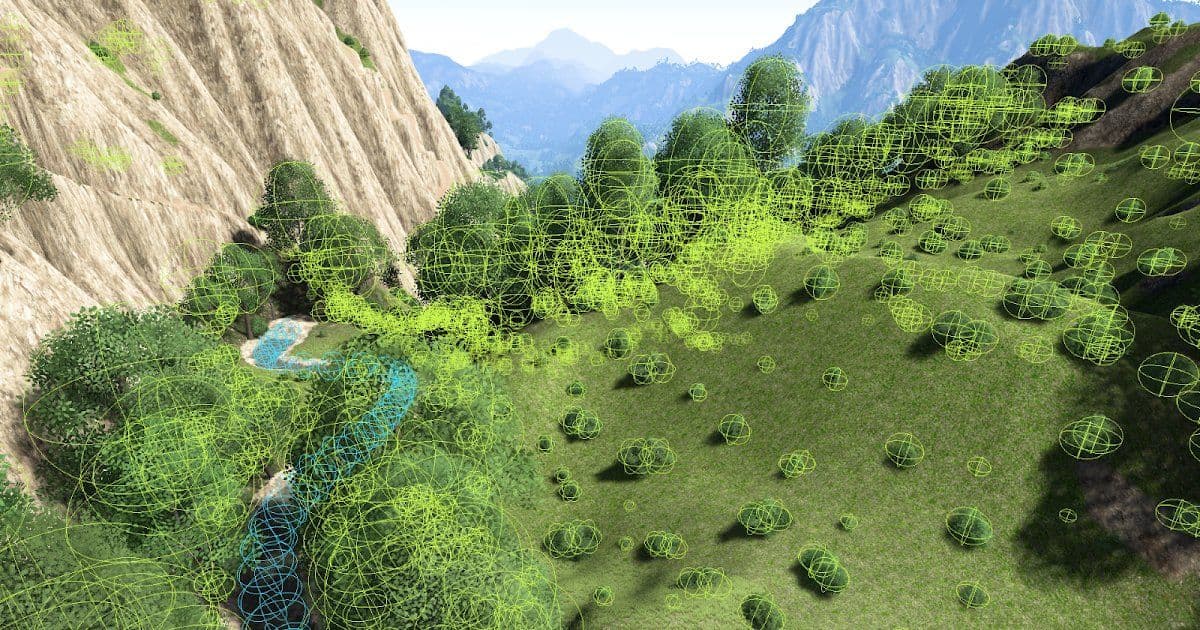
Game developer Rune Skovbo Johansen shares an innovative technique for handling spatial audio from non-point sources like rivers and tree canopies, solving a long-standing problem in game audio design.

In video game audio, sound typically emanates from discrete points in space. A campfire, a character's voice, a ticking clock, each occupies a single coordinate. But what happens when the sound source is a winding river, a dense canopy of trees, or a sprawling bush? The traditional approaches fall short, and game developer Rune Skovbo Johansen has crafted an elegant solution he calls Point Cloud Sound.
The Problem with Point Sources
Most game engines handle spatial audio by treating sound sources as points. When you need sound to come from an extended area, developers have historically relied on two workarounds. The first is the closest-point approach, where a single audio source moves to whichever position within a volume is nearest to the listener. This works adequately for convex shapes like spheres or cubes, but breaks down for non-convex geometry. A winding river presents a perfect example: a listener standing on a bend might be equidistant to two completely different sections of water flowing in opposite directions. The audio would snap jarringly between these directions as the player moves slightly.
The second approach, scattering numerous audio sources throughout the sound-emitting volume, avoids the direction problem but introduces performance concerns. Running hundreds or thousands of audio sources simultaneously demands significant processing power, making it impractical for large-scale environments.
The Point Cloud Sound Technique
Johansen's technique occupies a middle ground, leveraging point samples in 3D space while consolidating them into a single audio source. The method calculates combined volume, direction, and spread each frame by treating each sample as if it were an individual source, then deriving aggregate properties.
The volume calculation follows inverse distance attenuation, which Johansen notes is the physically correct model. Sound amplitude decreases linearly with distance, not with the square of distance as is commonly misconceived. By summing each sample's source volume divided by its distance from the listener, the technique produces a cumulative volume applied to one audio source.
Perhaps the most elegant aspect is the direction and spread calculation. Rather than averaging positions (which would bias toward distant samples), the technique averages normalized direction vectors weighted by their attenuated volumes. The resulting vector's magnitude becomes the spread parameter. When sound arrives equally from all directions, the averaged vector approaches zero length, producing maximum spread. When a single direction dominates, the vector remains long, producing a focused sound. This relationship emerges naturally from the mathematics rather than requiring explicit tuning.
Variable-Size Point Samples
The technique assigns each point sample a radius, with volume scaling by the square of that radius. This models surface-based sound emission rather than volumetric emission, which better represents natural phenomena. Tree foliage concentrates in outer shells where leaves receive sunlight, and water streams emit from flat surfaces rather than spherical volumes.
For water streams, samples are placed along the center at intervals roughly equal to the stream width, with radius calculated from the segment's area. Trees typically require just one or two samples, with radius approximating the crown shape. This sparse representation means thousands of trees can be represented with manageable sample counts.
Parametric Sound and Extensions
The technique extends to parametric audio, where different sound components cross-fade based on a parameter value. For water, this enables continuous intensity variation rather than discrete steps between calm flow and rushing waterfall. Each sample carries a parameter, and precalculated volumes per component avoid evaluating curves for every point each frame.
Additional refinements include directionality controls, spread influenced by listener proximity to individual samples, and collision-based sounds for foliage interaction. The collision variant uses distance to a line segment representing the player's body rather than a point, triggering sounds when moving through bushes and tree crowns.
Performance Considerations
The implementation includes practical optimizations: a maximum distance threshold with volume clamping to prevent abrupt muting, squared distance comparisons to avoid square root operations, and spatial partitioning through collections that map to world chunks. These ensure the technique scales to large environments without excessive computation.
Implications for Game Audio
Point Cloud Sound represents a thoughtful approach to a persistent challenge in game audio design. By consolidating many potential sources into one while preserving spatial accuracy, it enables immersive environmental soundscapes without proportional performance costs. The technique's flexibility across different use cases, water, foliage, collisions, and its support for parametric variation suggest broad applicability for games seeking naturalistic audio environments.
The full implementation details and code samples are available in Johansen's original blog post, along with video demonstrations of the technique applied to water streams and foliage. For game developers working on spatial audio, this technique offers a practical middle ground between simplistic point sources and expensive multi-source approaches.
Comments
Please log in or register to join the discussion