The Pyodide 314.0 release enables direct publishing of Python/WebAssembly wheels to PyPI, eliminating the maintainer burden of manually building and hosting packages. Early adoption shows 28 packages using the new format, with luau-wasm demonstrating the workflow for compiling C/C++ extensions to WASM.
The Pyodide project has long faced a scaling challenge: maintaining over 300 pre-built Python packages for its WebAssembly runtime required significant manual effort from a small team of maintainers. Every new package needed individual review, compilation, and hosting, creating a bottleneck that slowed community contributions. With the Pyodide 314.0 release, this process has fundamentally shifted—package maintainers can now build and publish Pyodide-compatible wheels directly to PyPI using the same tools they use for native platforms, provided their wheels target the PyEmscripten platform defined in PEP 783.
This change became technically possible when PyPI updated its wheel acceptance logic on April 21st to recognize the new pyemscripten_*_wasm32 tags. Previously, PyPI would reject wheels containing these tags as invalid. Now, when a maintainer publishes a wheel like luau_wasm-0.1a0-cp314-cp314-pyemscripten_2026_0_wasm32.whl, PyPI stores and serves it just like any other wheel. At runtime in Pyodide, users install it via micropip.install()—the same interface used for pure-Python packages—without needing special configuration or manual intervention from Pyodide maintainers.
The practical implications are already visible. A quick analysis of PyPI’s public dataset shows 28 distinct packages currently publishing wheels with the new PyEmscripten tags. These include diverse projects like the onnx runtime (for machine learning inference), tkokie (a tokenization library), and cadquery-ocp-novtk-OCP.wasm (a CAD modeling toolkit). Notably, several packages compile C/C++ or Rust extensions to WASM, demonstrating that the workflow supports native code dependencies—a critical capability for performance-sensitive applications.
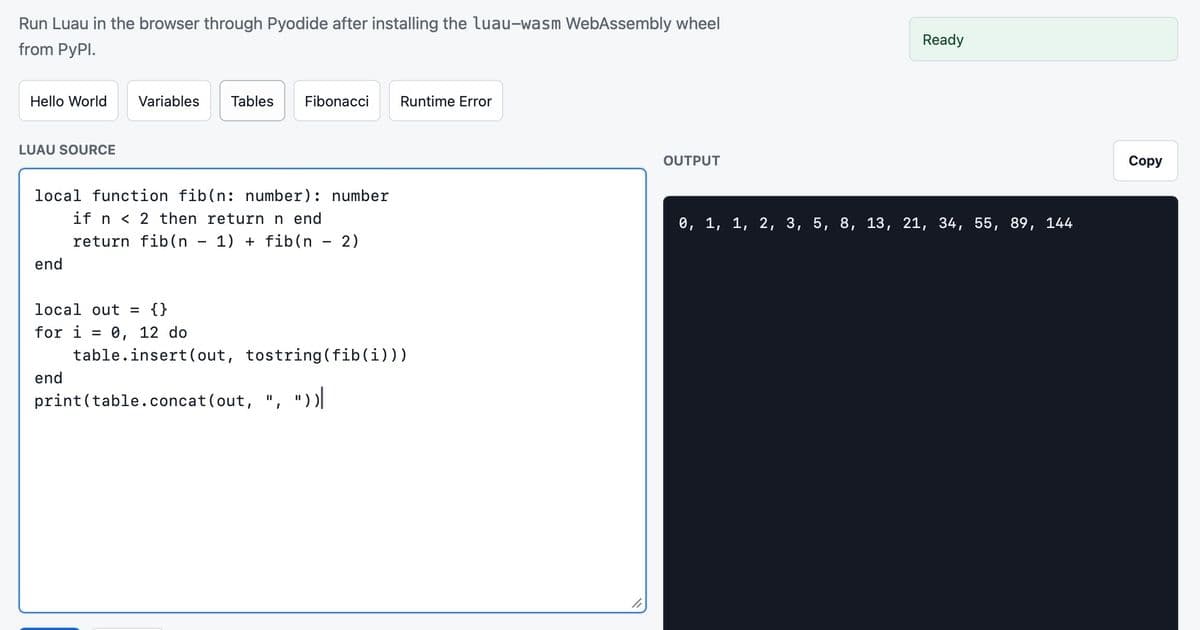
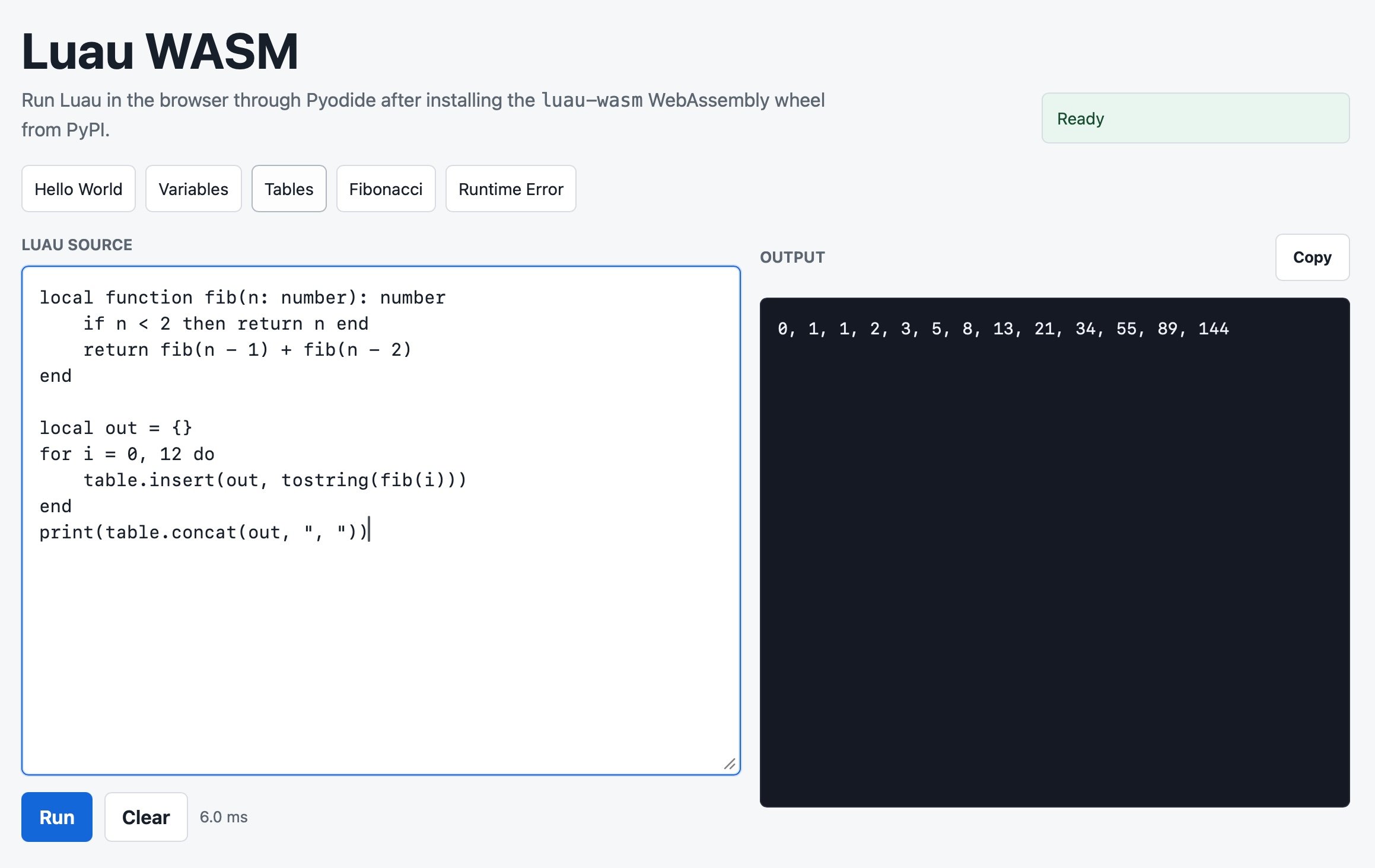
To validate the end-to-end process, I packaged my experimental Luau WebAssembly compiler as luau-wasm. Luau, Roblox’s gradual-typed Lua variant, compiles to a 276KB WASM module. The packaging workflow used standard tools: cibuildwheel for cross-platform builds, GitHub Actions for automation, and the PyEmscripten SDK to target the correct ABI. The resulting wheel installs cleanly in Pyodide via micropip, allowing users to execute Luau scripts directly in the browser-based Python environment. A live demo at https://simonw.github.io/luau-wasm/ shows the full cycle: loading Pyodide, installing the wheel, and running Luau code that sorts and prints animal names.
Despite this progress, limitations remain. The 28-package count represents early adopters—mostly projects with existing WASM build infrastructure. Broader adoption will depend on whether maintainers of complex scientific or data-science packages (which often rely on compiled Fortran or C extensions) find the PyEmscripten toolchain accessible. Additionally, Pyodide itself still needs to evolve its WASM runtime to support newer web APIs and improve startup performance for larger wheels. Crucially, this solution doesn’t eliminate the need for wheels to be built against a specific Pyodide/PyEmscripten ABI version; a wheel tagged pyemscripten_2026_0_wasm32 won’t necessarily work with a Pyodide runtime based on an older SDK.
What’s significant here isn’t just the technical mechanism—it’s the alignment of incentives. By shifting package distribution to PyPI’s established infrastructure, the Pyodide team removes a recurring operational burden. Maintainers gain a familiar publishing path, users get reliable access to pre-built packages, and the ecosystem can grow organically without gatekeeping. For a project that began as a research experiment to bring Python to the browser, this represents a pragmatic step toward sustainable, community-driven growth.
Comments
Please log in or register to join the discussion