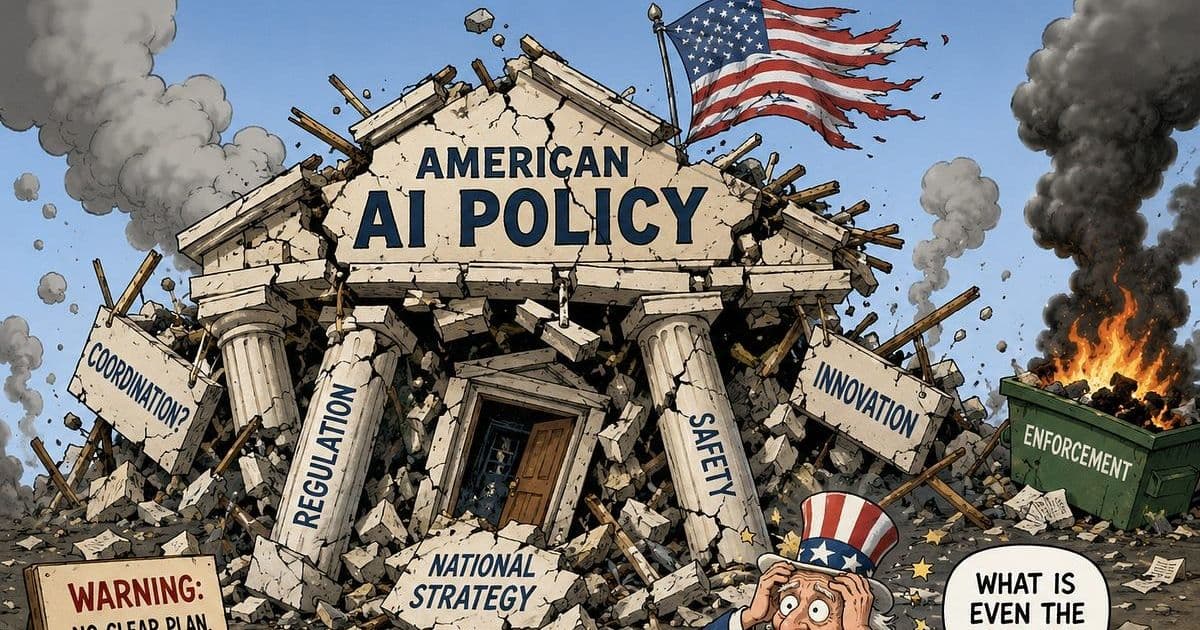
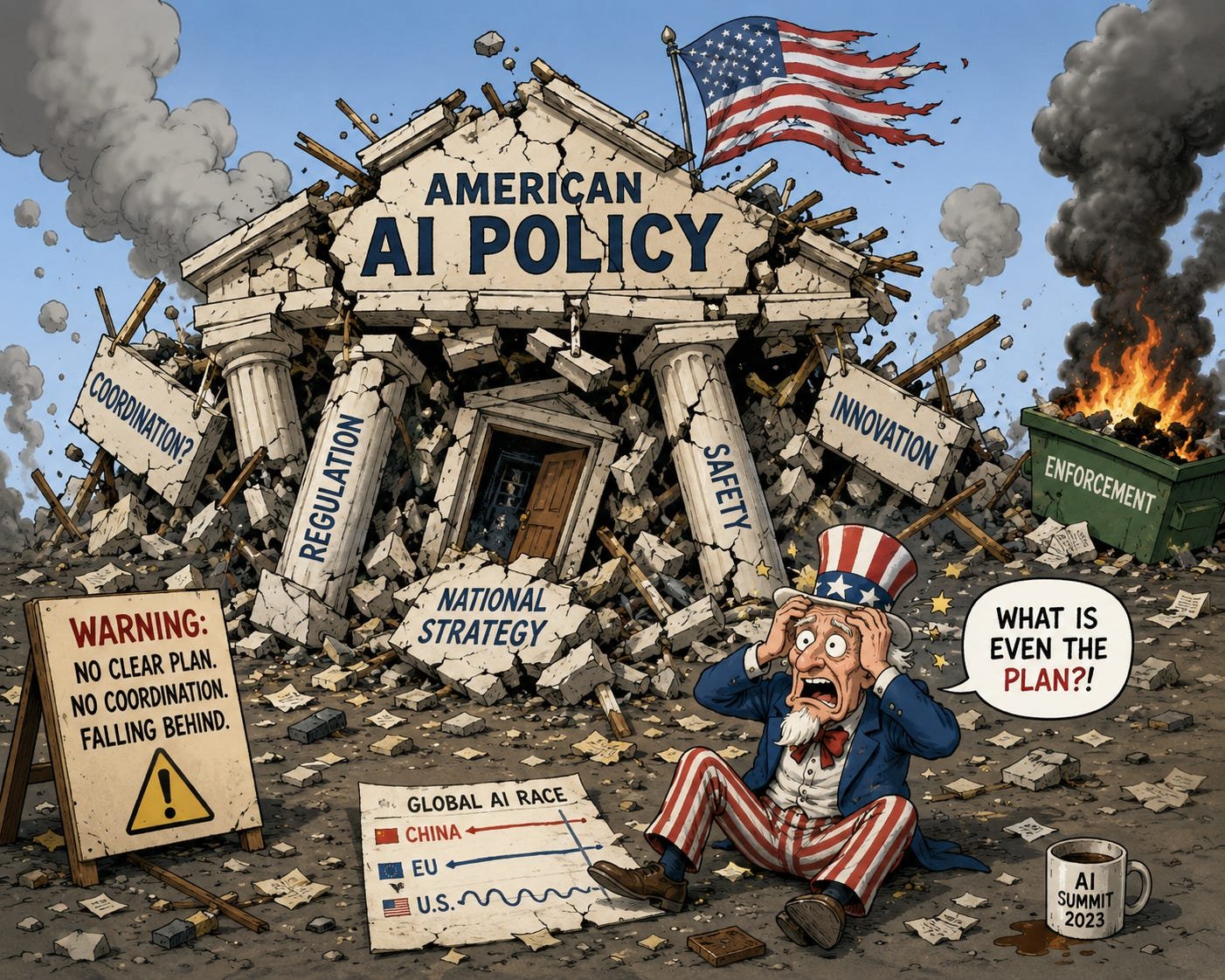
The US government's approach to AI regulation remains fractured, with a voluntary executive order that falls short and a hasty Commerce Department export control that blindsided the industry. Meanwhile, states are stepping in with lawsuits and subpoenas to fill the gap.
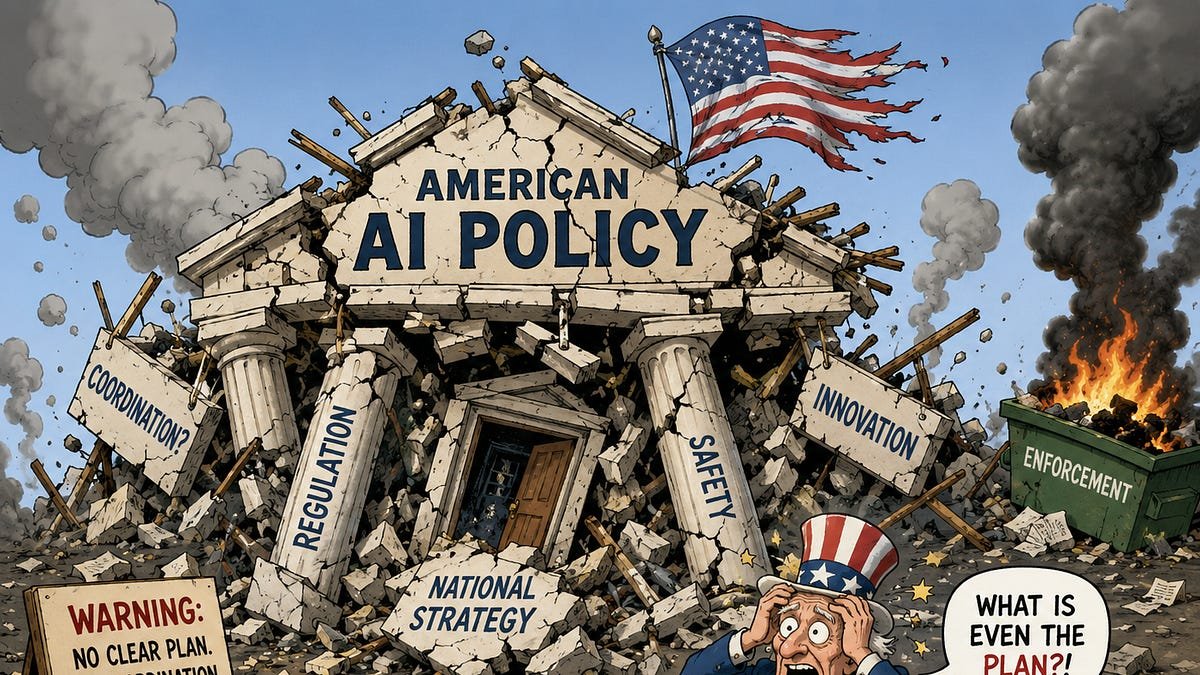
The White House's approach to AI policy is, to put it bluntly, a mess. Two major policy moves in the span of two weeks illustrate a government struggling to find its footing on regulating a technology that's advancing faster than any legislative or executive framework can keep up with.
First, President Trump's Executive Order from June 2, 2026, which at its core does something genuinely useful: it encourages AI companies to conduct preflight testing before releasing models. That's a reasonable starting point. The problem is that the testing requirements are voluntary and narrowly focused on cybersecurity. Companies can simply choose not to comply, which defeats the entire purpose.
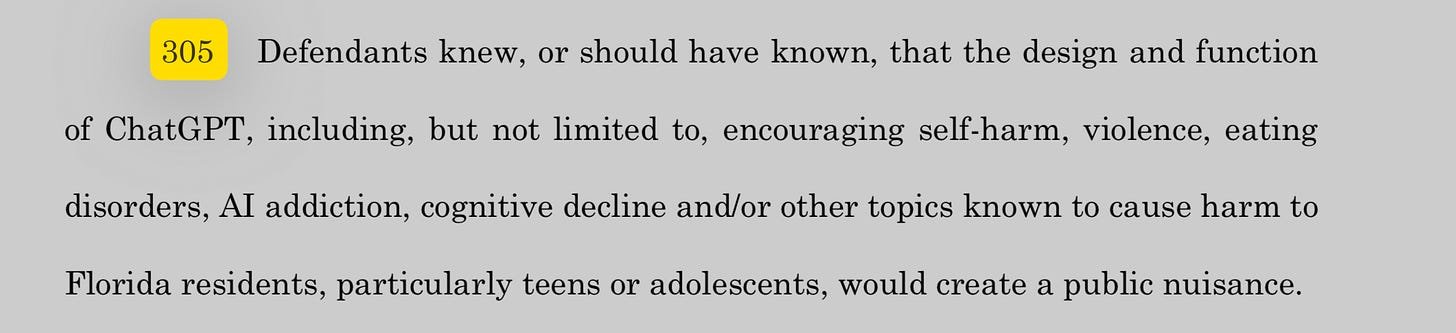
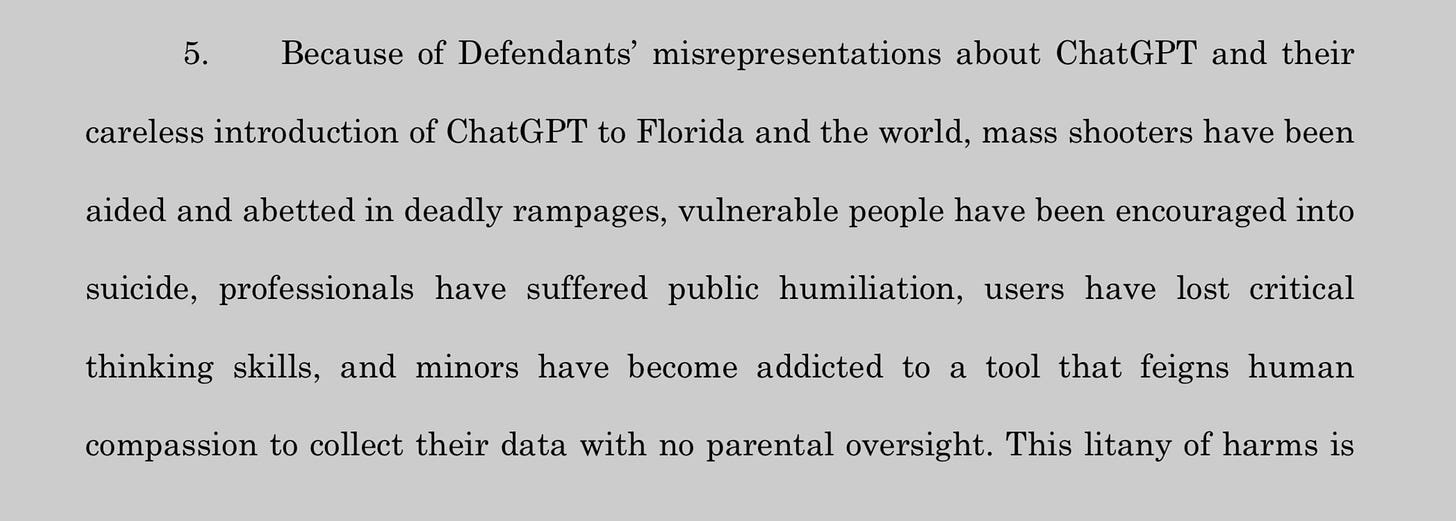
The limitations of this approach became immediately apparent when Florida filed its lawsuit against OpenAI, the first state-level legal action against the company. The complaint details a wide range of harms that the executive order doesn't even attempt to address.
Florida's Attorney General, a Republican in a Republican state, alleges that OpenAI's products cause concrete harms to users. These include risks that extend well beyond the cybersecurity focus of the executive order's voluntary framework. The lawsuit also raises claims of false advertising, suggesting that OpenAI's marketing overpromises on what its systems can safely deliver.
The timing is notable. All of these harms were foreseeable. Most of them were documented in congressional testimony and numerous public warnings going back years. The executive order addresses none of them. It allows AI companies to release software capable of causing all of these harms while demanding little or no effort to mitigate them.
This is the core problem with the federal approach: it treats AI regulation as something that can be handled through gentle encouragement rather than enforceable requirements.
States Are Filling the Gap
New York has now issued a major subpoena to OpenAI, working in coordination with several other states. The subpoena demands information on "a range of its activities and impact on users, including advertising, user engagement and retention, handling of consumer data and health data, activities related to minors and seniors, deep learning models, model sycophancy and company policies."
This is significant. It signals that state attorneys general are moving beyond individual complaints toward coordinated investigations that could establish precedent for how AI companies operate across state lines.
States have no choice but to take this approach. Until the federal government develops a comprehensive framework for addressing AI risks, they're the only entities with both the legal standing and the motivation to act. The downside is that lawsuits can only be filed after harms have occurred. They're inherently reactive, not preventive.
The Export Control Debacle
Then there's the Commerce Department's export control order from last week, which managed to accomplish something rare: uniting critics across the political spectrum in opposition. The order effectively shut down Anthropic's Fable and Mythos operations, potentially sparking a crisis in the US AI industry.
The order appears to have been triggered when Amazon demonstrated that Anthropic's Fable system could be jailbroken. This is a curious basis for policy. Essentially every large language model-based system can be jailbroken. It's a known limitation of the technology, not a specific flaw in Fable or Mythos. Addressing it through an abrupt, sweeping export control suggests a fundamental misunderstanding of the problem.
The government acted as if it had discovered something novel when it identified what was, in reality, a well-documented and widely understood limitation. The response was neither proportionate nor informed by technical reality.
Anthropic bears some responsibility for this situation. The company has spent considerable time overselling the existential risks of AI while simultaneously calling for export controls. When you repeatedly tell policymakers that your technology poses a 10% chance of destroying civilization, you shouldn't be surprised when they respond by restricting it. The framing may have been strategically useful for attracting attention and investment, but it created expectations that inevitably led to regulatory overreach.
The broader issue is that no industry can thrive when the government appears arbitrary and capricious in its regulatory actions. Effectively shutting down an entire thriving sector overnight, with minimal consultation and no apparent technical basis, sends a clear signal to AI companies: plan your operations elsewhere.
What's Actually Needed
The pattern across both the executive order and the export control order is the same: reactive, poorly informed, and lacking the technical depth necessary to be effective.
What the US actually needs is AI oversight that meets three criteria. First, it must be bipartisan. The current approach lurches with political winds, creating uncertainty that benefits no one. Second, it must be technically well-informed. Policymakers need to understand what they're regulating, not just respond to the latest headline or lobbying pitch. Third, it must be proactive rather than reactive. Addressing risks before they materialize requires foresight and deliberate planning, neither of which has been on display.
The export control order also reveals a deeper strategic problem. If the US makes it too difficult for AI companies to operate domestically, those companies will simply move to jurisdictions with more predictable regulatory environments. The goal should be smart regulation that manages genuine risks without driving innovation offshore.
There's a fundamental tension here that no one in Washington seems willing to articulate clearly. AI systems are genuinely powerful and pose real risks. They also offer enormous potential benefits. The government's job is to find the balance between enabling the benefits and mitigating the harms. What we've seen instead is a government that oscillates between doing too little (the voluntary executive order) and doing too much in the wrong direction (the export control order).
The Florida lawsuit and the New York-led investigation represent a third path, one driven by the courts rather than the executive branch. It's slow, it's reactive, and it creates a patchwork of state-level regulations that will be difficult for companies to navigate. But it's what happens when the federal government fails to act responsibly.
The AI industry cannot self-regulate. History has shown this repeatedly with transformative technologies. But the alternative, government regulation, requires competence, technical understanding, and a willingness to think systematically rather than react emotionally. So far, the Trump administration has demonstrated none of these qualities in its approach to AI policy.
The next step should be comprehensive legislation that addresses the full range of AI risks, from data privacy to safety to economic impact, in a single coherent framework. That legislation should be developed with input from technical experts, not just lobbyists and political advisors. It should establish clear, enforceable requirements rather than voluntary guidelines. And it should be designed to adapt as the technology evolves, rather than becoming obsolete the moment it's enacted.
Until that happens, expect more of the same: states filing lawsuits after harms occur, federal agencies issuing hasty orders that create more problems than they solve, and AI companies operating in a regulatory vacuum that benefits no one.
Comments
Please log in or register to join the discussion