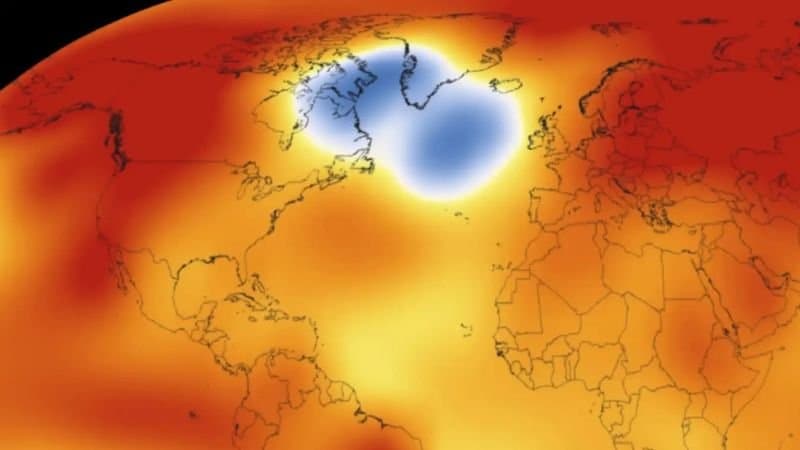
A persistent cold patch in the North Atlantic has divided scientists for years. New research now ties it to weakening ocean currents, adding urgency to debates about climate tipping points and what the data actually tells us.

In the North Atlantic, south of Greenland and Iceland, there's a patch of ocean that refuses to play by the rules. While the rest of the planet's waters absorb heat at record rates, this area has been cooling for more than a century. Scientists call it the "cold blob" or the "warming hole," and after years of debate, new research is pointing toward an unsettling explanation: the Atlantic's great ocean conveyor belt is slowing down.
The cold blob isn't a subtle anomaly. It has cooled by nearly 1 degree Celsius since 1900, a significant shift in ocean temperature terms. For context, the global ocean has warmed by roughly 0.88 degrees Celsius over the same period. This patch is doing the opposite, and the divergence has made it one of the most studied oceanographic puzzles of the past decade.

The Conveyor Belt Question
The Atlantic Meridional Overturning Circulation, or AMOC, operates like a massive heat redistribution system. Warm water flows northward from the tropics, carrying thermal energy toward Europe and the Northern Hemisphere. As it travels, the water cools, becomes denser, and sinks in the North Atlantic before flowing back south at depth. This process moderates Europe's climate, keeping winters milder than they would otherwise be at such high latitudes.
The cold blob sits roughly where the AMOC delivers much of its heat. If the circulation weakens, less warm water reaches this region, and temperatures drop. This is why some scientists have long interpreted the cold blob as a fingerprint of AMOC change.
But the picture was never that simple. Atmospheric conditions, including shifts in wind patterns and cloud cover, could also explain surface cooling. The challenge has been distinguishing between these two explanations.
What the New Study Found
A team of researchers combined real-world ocean heat data from instruments and satellites with climate models to isolate what's driving the cold blob's cooling. Their conclusion: the cooling isn't just on the surface. It extends deep into the ocean, where atmospheric influences are much weaker.
"It is changing ocean heat transport which is driving the cooling of the cold blob," said Stefan Rahmstorf, a physics and oceans professor at Potsdam University and a study author. The deep-water cooling pattern is consistent with reduced heat delivery by the AMOC, not just surface-level atmospheric effects.
This is a meaningful distinction. If the cold blob were only a surface phenomenon, atmospheric variability could explain it, and the AMOC might be fine. But the depth of the cooling suggests something more fundamental is happening in the ocean's circulation.
The study adds to a growing body of evidence. Some research suggests the AMOC is at its weakest point in roughly 1,000 years. The weakening is driven in part by human-caused climate change: as Arctic ice melts and rainfall increases in the North Atlantic, a surge of freshwater enters the ocean, disrupting the salinity and density balance that keeps the AMOC running.

The Tipping Point Debate
Some scientists warn the AMOC could reach a tipping point this century, meaning a future collapse becomes locked in even if emissions are reduced. An AMOC shutdown would bring severe consequences: accelerated sea level rise on the US East Coast, dramatically colder winters in Europe, and disrupted monsoon patterns across Africa that could trigger prolonged droughts.
That's the high-stakes scenario. But not everyone is convinced the data points there yet.
René van Westen, a marine and atmospheric researcher at Utrecht University who was not involved in the study, noted that previous research has generated cold blob-like patterns through atmospheric conditions alone. However, he acknowledged that the new study's consistent results across different datasets "strengthens the robustness of the conclusions."
David Thornally, a professor of ocean and climate science at University College London, offered a more cautious take. The study bolsters the link between the cold blob and AMOC weakening, he said, but the sparseness of real-world ocean data means available datasets "are best viewed as good approximations rather than perfect representations of reality."
"I don't think this study will be the final word on the issue," Thornally told CNN.
Jonathan Baker, a senior climate scientist at the UK Met Office, framed it similarly: "I would view this study as adding evidence for an AMOC contribution to the cold blob, rather than definitively settling the question."
A Pattern Worth Watching
The cold blob sits at the intersection of several ongoing debates in climate science. There's the question of how sensitive the AMOC is to freshwater input, how quickly tipping points can be reached, and whether current climate models accurately capture the complexity of ocean circulation.
There's also the communication challenge. The AMOC is not the Gulf Stream, though the two are often conflated. The Gulf Stream is a surface current driven primarily by wind; the AMOC is a deeper, density-driven circulation system. The Gulf Stream will likely continue even if the AMOC weakens, but the heat transport it enables would change significantly.
The cold blob itself has become a kind of Rorschach test for how different researchers interpret climate data. For some, it's clear evidence of AMOC decline. For others, it's a signal that requires more data and better models before drawing firm conclusions. Both positions have merit, and the reality likely involves elements of each.
What's clear is that the cold blob is not going away. It persists in satellite data, in ocean buoy measurements, and in climate model projections. Whether it represents a warning of imminent collapse or a slower, more complex shift in ocean dynamics remains one of the open questions in climate science.
The study's authors believe the evidence is strong enough to sound an alarm. Others in the field prefer to wait for more data before making definitive claims. In a domain where uncertainty is often weaponized by both sides of the climate debate, the cold blob is a reminder that the most honest scientific position is sometimes the most uncomfortable one: we know something is changing, we have strong theories about why, and we're still working to understand exactly what comes next.
Comments
Please log in or register to join the discussion