
Matthew Card, Software Engineering Manager at BBC, shares his framework for building inclusive teams by changing the bar rather than just raising it. His approach combines psychological safety, resilience hacking, and practical strategies for eliminating toxic behaviors while empowering diverse talent.
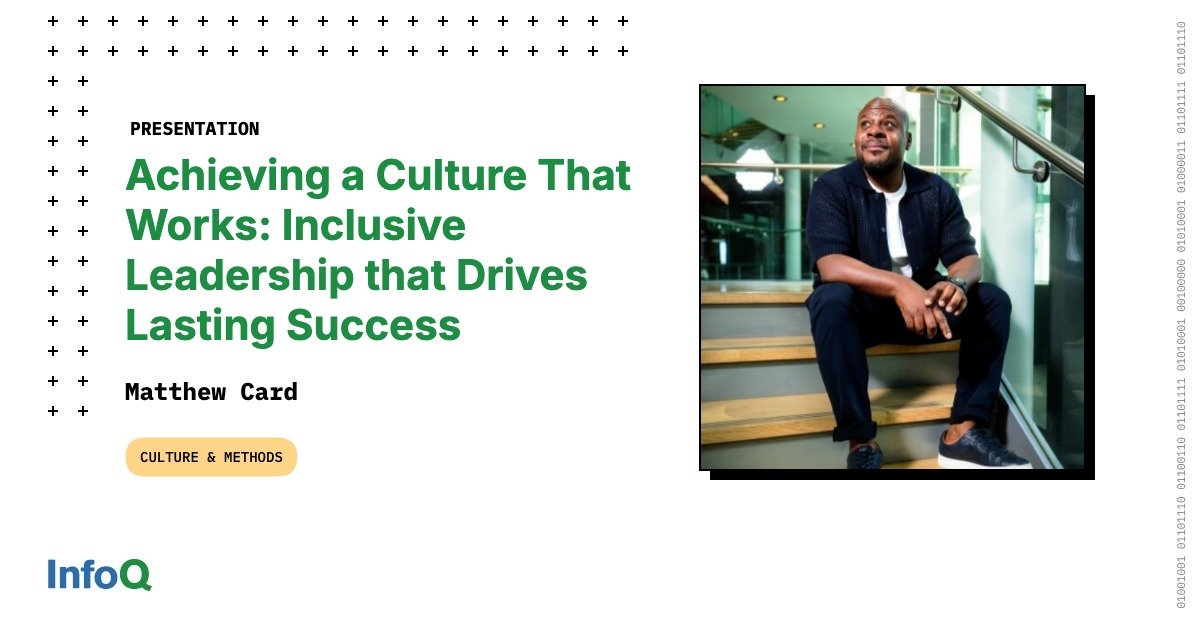
Building an engineering organization where everyone feels valued, heard, and empowered isn't about implementing a diversity program or checking boxes. It's about fundamentally rethinking how leadership shapes culture. Matthew Card, who manages 52 engineers across the BBC's Core Data Platform, has developed a practical framework for creating teams where toxic behaviors have no room to grow and diverse talent thrives.
His core insight is deceptively simple: stop trying to "raise the bar" and start "changing the bar."
The Problem with "Raising the Bar"
Traditional engineering leadership focuses on raising standards—expecting more from senior engineers, pushing for higher code quality, demanding faster delivery. But Card argues this approach often reinforces existing biases and excludes valuable perspectives.
"When we're talking about inclusivity, especially when we're talking about inclusivity, it's not about raising the bar," he explains. "It's about changing the bar. It's about widening that playing field."
Card uses the Olympics as an analogy: "There's about 10,500 people that compete in the Olympics. It would be pretty boring if they all did the high jump. It's about widening the playing field. There's different ways that we can all contribute."
This means creating multiple paths to success. For engineering teams, this could look like:
- Encouraging early-career talent to challenge experienced engineers to explain things differently
- Valuing communication skills as highly as technical depth
- Recognizing different contribution styles—not everyone needs to be the loudest voice in the room
- Creating space for diverse working patterns that accommodate different life situations
How Leadership Shapes Culture
Card identifies three critical areas for achieving success: leadership, building trust, and the mechanics of resilience and motivation. He approaches each from three perspectives: as a leader, as an individual, and as a team.
The Foundation: How Decisions Shape Culture
Two principles guide Card's leadership:
- How we make decisions shapes culture
- Culture is shaped by the worst behaviors tolerated
These aren't abstract ideas—they're practical filters for every choice. When Card wanted to push through a technical decision quickly, he paused. "I could have pushed that through, but I wanted to make that decision as a team," he says. "I want it to be based on sound technical reasoning, so I've stepped back."
The decision took longer, but it modeled the collaborative behavior he wanted to see. "That's how we shape the culture."
Courage Without Recklessness
Inclusive leadership requires courage to lean into difficult situations:
- Challenging microaggressions when they happen
- Questioning your own biases and asking difficult questions
- Addressing toxic behaviors immediately, not letting them fester
But courage must be balanced with wisdom. Card describes being "courageous, but not reckless." This means knowing when to push forward and when to step back, when to make a unilateral decision and when to build consensus.
The Ally Network
Card doesn't try to transform culture alone. He identifies allies—people who share his values and can help reinforce the new standards. "I set the guardrails, set the guidelines, basically set the tone, set the expectations, and then I use my allies," he explains.
These allies use their expertise to help raise the bar (or change it) across the organization. As more people align with the new expectations, they become allies themselves, creating a self-reinforcing system.
Building Trust: Starting with Yourself
Before psychological safety comes trust, and trust starts with the leader. "Trust doesn't start with the team, it starts with the leader," Card emphasizes.
This includes trusting yourself. "Feedback is slow," Card notes. "Sometimes you don't even get feedback, because how do you know your team is doing well? It probably takes two years before you know your team is doing well, especially when you're head of department."
Building internal resilience becomes critical. Card recommends applying engineering attention-to-detail to leadership processes: "As a tech person, an engineer, applying your attention to detail to a new evolving process that fits the problem. As opposed to saying, I've done this like this for 8 years, so I'm just going to apply my attention to detail to the same process."
Leadership as Alignment, Not Control
Card shares a story about a hiring decision where he disagreed with his team lead. The team lead had declined a candidate who scored well on communication—something Card valued highly. After discussing it, they reversed the decision, but Card made a crucial point:
"I said, 'Is that ok?' They were like, 'Yes, that's ok, but the next time I go to make a decision, I'll check with you first.' I was like, 'No, please don't do that. Let's not do that. Let's work on alignment. Let's have more conversations so that we can align, and then we can make decisions, or you can make decisions without me and I can make decisions without you. We both understand where we're coming from.'"
The goal is making yourself obsolete as a decision bottleneck, not creating dependency.
Psychological Safety: The Next Level
Psychological safety builds on trust. Card references his BBC colleague Jit's definition: "a shared belief within a group that individuals can take interpersonal risk, such as speaking up, asking the questions, challenging ideas without the fear of punishment or humiliation."
Creating this requires:
- Promoting open communication without fear of judgment
- Stepping in immediately when someone is shut down or talked over
- Celebrating effort and trying, not just outcomes
- Modeling curiosity, humility, and empathy
Card emphasizes that culture is defined by the worst behaviors tolerated. If someone consistently interrupts others or dismisses ideas, that behavior sets the culture—unless leadership actively stops it.
Resilience and Motivation: The Engine
This is where Card's framework gets practical. He breaks resilience down into components leaders can actually work with.
The C.A.P.S. Framework for Resilience
C - Confidence: Not 100% assuredness, but "the willingness to try." Card measures confidence by "the time it takes you to go from thought to action." Reducing that gap builds confidence.
A - Adaptability: Being flexible enough to handle different situations and change approaches when needed.
P - Purposefulness: Having a clear why. "I'm very passionate. I keep saying I'm going to change the world. I don't know if I have, I don't know if I will. I've got a purpose and that's what I'm setting myself out to do."
S - Social Support: Building relationships at work and beyond. Card learned this the hard way when he moved to Manchester and lost his family support network. "When times got a little bit hard, it got really hard." He had to rebuild support through work relationships and friendships.
The D.O.S.E. Method for Daily Resilience
Card hacks his brain chemistry every morning using what he calls the D.O.S.E. method:
D - Dopamine (Reward): Exercise, eating good food, writing down goals, completing tasks
O - Oxytocin (Love): Hugging, connecting with people, building relationships
S - Serotonin (Loyalty/Gratitude): Gratitude journaling, listening to motivational speakers
E - Endorphins (Happiness): Exercise, positive activities
"For six years, I had a ridiculous routine that I used to get up in the morning," Card shares. "My partner used to hate me, because I used to just get up and go off and not even say morning for a while."
He shares these techniques with his teams because he wants them to become resilient too.
Reframing Negative Experiences
Card advocates reframing key concepts:
- Fear vs. Excitement: The physical symptoms are identical—racing heart, nervousness, butterflies. The difference is what you tell yourself.
- Failure vs. Learning: "Fail fast, fail early, fail often, but don't feel stupid. The only way you can actually feel stupid is if you don't learn from your mistakes, or you give up."
The Motivation Formula: Autonomy, Mastery, Purpose
Drawing from Daniel Pink's "Drive," Card structures motivation around:
- Aligned Autonomy: Not free rein, but autonomy within clear guardrails
- Mastery: Finding what makes each person tick and creating opportunities for deep expertise
- Purpose: Helping people find their own self-purpose
"I try to give them the tools to find their own purpose, their own self-purpose as well," Card explains. "That's really key. That should equal motivation."
Practical Implementation
For Leaders:
- Set clear values and cornerstones that guide decisions
- Create or support employee networks (like Card's Retrace network for Black folks in tech)
- Lean into difficult situations immediately, don't let toxic behaviors persist
- Learn about demographics furthest from your own experience to build understanding
- Share resilience techniques with your teams
For Individuals:
- Build your own social support network at work
- Reframe fear as excitement and failure as learning
- Hack your D.O.S.E. daily—create your own morning routine
- Reduce the gap between thought and action to build confidence
- Find your purpose and connect it to your work
For Teams:
- Celebrate trying, not just succeeding
- Create space for honest discussion without judgment
- Build trust through alignment rather than control
- Support each other's resilience—share what works
- Challenge the status quo when it excludes people
The Long Game
Card ends with a quote: "Don't judge each day by the harvest that you reap but by the seeds that you plant."
Building an inclusive culture isn't a quick fix. It's a continuous practice of making better decisions, challenging worse behaviors, and creating space for diverse talent to thrive.
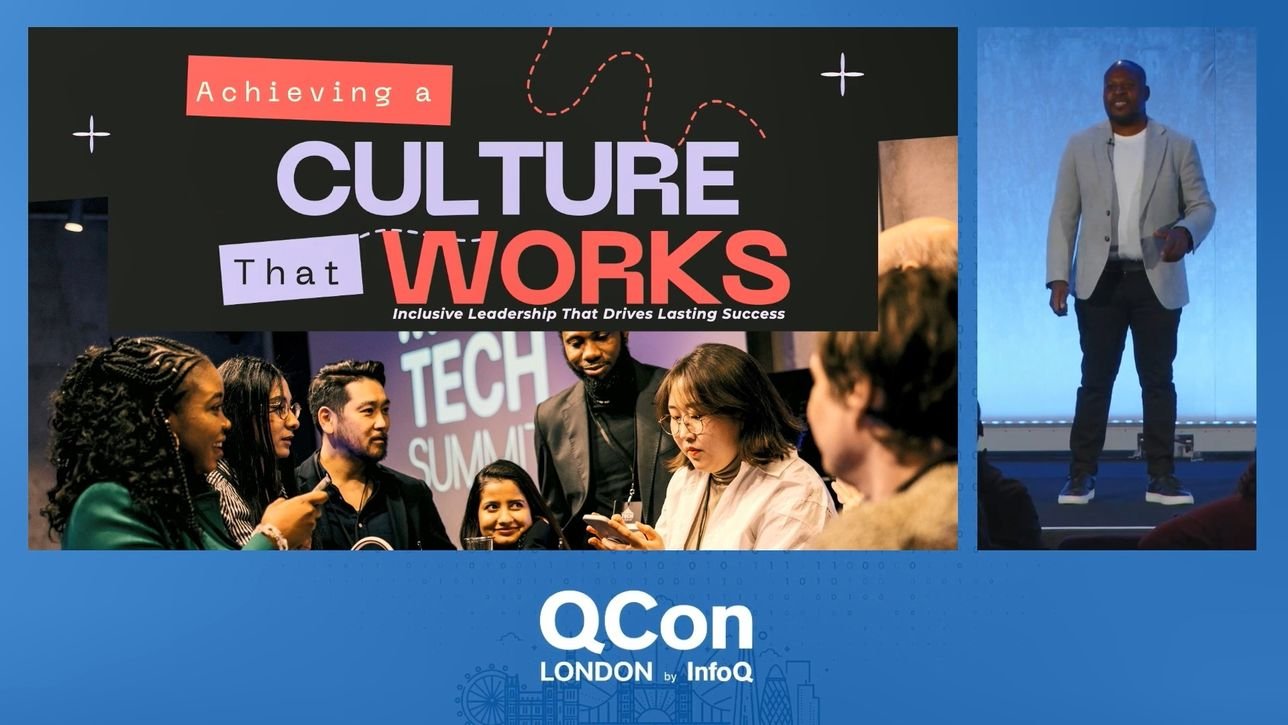
The work is hard, but the payoff is substantial. Teams that score high on psychological safety and inclusion don't just feel better—they perform better. They innovate more, retain talent longer, and solve problems more creatively.
Card's framework provides a roadmap, but the journey requires courage, consistency, and genuine care for the people you lead. As he puts it: "It's a long road. It's not easy."
But for leaders willing to change the bar rather than just raise it, the results can transform both careers and organizations.
Resources mentioned:
- QCon London - Conference where this talk was presented
- Daniel Pink's "Drive" - Framework for motivation
- Simon Sinek's leadership philosophy - Anyone can be a leader
- BBC Retrace Network - Black folks in tech community (internal BBC network)
Related InfoQ content:
- Characteristics of a Great Scrum Team
- The C4 Model for Software Architecture
- Domain Driven Design Quickly

Matthew Card is a Software Engineering Manager at the BBC with over 17 years of experience. He leads the Core Data Platform department and founded the Retrace network for Black professionals in tech. This article is based on his presentation at QCon London.
Comments
Please log in or register to join the discussion