
Tom Greenwood reframes web performance through an environmental lens, establishing data transfer and energy sourcing as measurable metrics for sustainable digital experiences.

Tom Greenwood's exploration of sustainable web design begins with a powerful analogy: Roger Bannister's 1954 shattering of the four-minute mile barrier. Just as athletes needed proof of possibility before collectively surpassing perceived human limits, web professionals require concrete metrics to transcend the industry's environmental complacency. The core thesis contends that establishing standardized environmental benchmarks—specifically data transfer volume and energy source carbon intensity—enables systematic reduction of digital carbon emissions despite the impossibility of direct measurement.
The Two Pillars of Measurement
Greenwood establishes two quantifiable proxies for environmental impact:
- Data Transfer as Energy Indicator
The relationship between data volume and energy consumption forms web sustainability's foundation. Each megabyte transferred triggers energy expenditure across data centers, networks, and user devices. Greenwood identifies page weight (initial load transfer size) as the most practical metric, benchmarked against industry data from sources like HTTP Archive. This reveals alarming trends: median page weight grew 36% for desktop and nearly doubled for mobile between 2016-2020. Images alone constitute roughly half this footprint.
 Fig 2.1 illustrates how hosting dashboards like Kinsta's can track data transfer relative to visits
The solution? Page weight budgets modeled after performance budgets. Unlike subjective load-time perceptions, transfer size provides objective efficiency measurement. Teams can target weights below competitors' averages or previous versions—a practice Greenwood notes yields dual benefits: reduced emissions and improved accessibility for bandwidth-constrained users.
- Carbon Intensity of Energy Sources
Where electricity originates proves equally critical. The carbon intensity metric (gCO2/kWh) varies dramatically by region: French nuclear-powered grids emit under 10gCO2/kWh while coal-dependent grids exceed 400g. Since websites pull energy from multiple grids (user location, data center, transit networks), strategic hosting decisions matter profoundly. Tools like Tomorrow's electricityMap visualize these disparities, showing how hosting in France versus the Netherlands creates significantly different footprints.
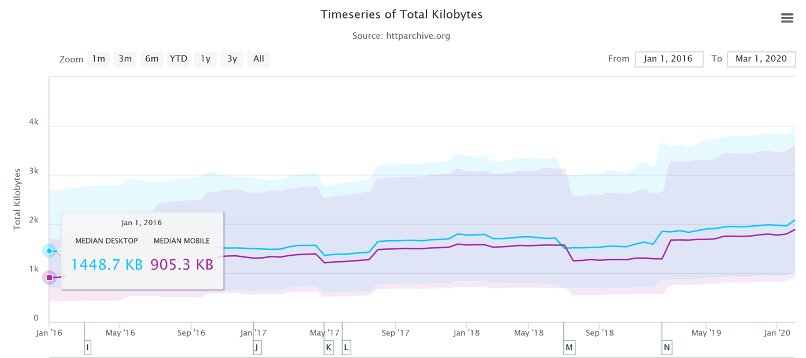 HTTP Archive's historical data (Fig 2.2) demonstrates worsening page weight efficiency over time
Here Greenwood introduces "megabyte miles"—the digital equivalent of food miles. Hosting proximity to primary user bases minimizes transmission energy. A London-hosted site serving California users traverses 5,300 unnecessary miles. This geographical optimization also reduces latency, aligning environmental and user-experience goals.
From Metrics to Action
Practical implementation emerges through synthesis:
- Carbon calculation tools like Greenwood's Website Carbon Calculator combine transfer data with regional carbon intensity to estimate emissions
- Expanded measurement scenarios covering repeat visits and internal navigation reveal caching efficiency opportunities
- Browser energy impact monitors (like Safari's developer tools) expose CPU-driven device energy consumption, highlighting inefficient JavaScript frameworks
Critical Implications
Three paradigm shifts emerge from this framework:
- Performance ≠ Sustainability: A fast-loading site using excessive client-side processing (e.g., React-heavy SPAs) may have higher energy footprints than server-rendered alternatives
- Device Longevity Matters: Energy-intensive websites accelerate device obsolescence, disproportionately impacting low-income users and generating e-waste
- Renewable Hosting Isn't Enough: While green data centers help, they don't absolve bloated design; smaller transfers remain essential
Counterbalancing Perspectives
Greenwood acknowledges measurement complexities:
- Fragmented tooling for client-side energy measurement
- Variable caching behaviors complicating repeat-visit analysis
- Tradeoffs between developer experience (modern frameworks) and energy efficiency
Yet these aren't excuses for inaction. Historical page weight data proves lighter sites are achievable—if prioritized. Just as Bannister's mile proved human potential, measurable sustainability benchmarks make eco-conscious design actionable. The web's environmental "four-minute barrier" awaits collective breaking.
Sustaiable Web Design excerpt originally published on A List Apart. Full book available from A Book Apart.
Comments
Please log in or register to join the discussion