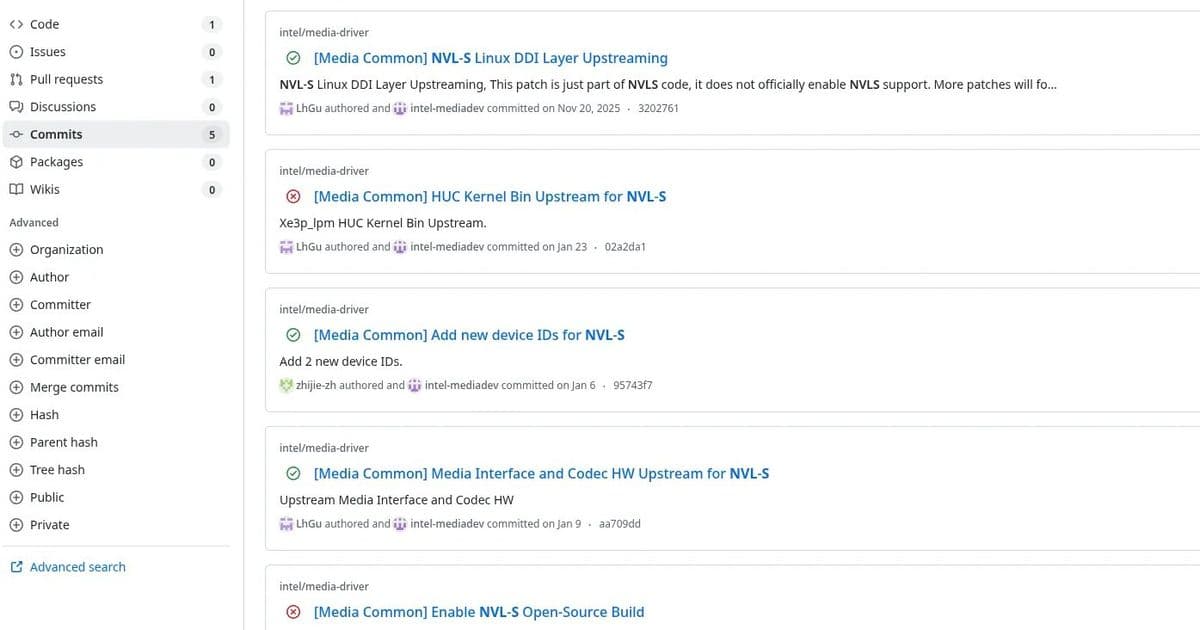
Intel's latest Media Driver 2025Q4 release adds Nova Lake S support while dropping MPEG2 decoding and improving AV1 encode quality.
Intel has released the Intel Media Driver 2025Q4 and VPL GPU Runtime 2025Q4 updates, bringing Nova Lake S support to their open-source media stack. The updates, announced on February 27, 2026, mark an important milestone for Intel's next-generation platform while also delivering improvements to AV1 video processing capabilities.
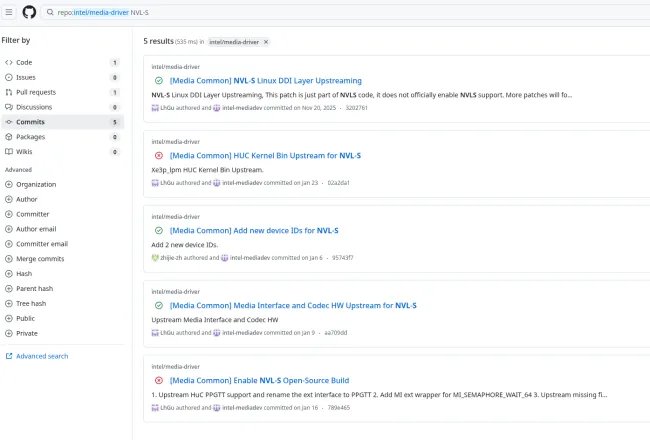
The Nova Lake S enablement confirms that Intel is moving forward with its media engine evolution, though the support matrix hasn't been fully updated yet. This means some details about new media features compared to Arrow Lake or Panther Lake remain uncertain. However, one significant change is clear: accelerated MPEG2 video decoding is being removed with Nova Lake and newer platforms.
This MPEG2 removal represents a strategic shift in Intel's media processing approach. As older video formats become less relevant in modern streaming and content creation workflows, Intel appears to be focusing resources on more current and future-oriented codecs. The decision to drop MPEG2 acceleration suggests Intel is prioritizing performance and efficiency for newer formats like AV1, which continues to gain traction in both encoding and decoding applications.
On the AV1 front, the 2025Q4 release brings several notable improvements. For Panther Lake X3_LPM platforms, Intel has fixed an AV1 video decoding issue that was affecting performance or stability. More significantly for content creators and video professionals, the update enables LUT (Look-Up Table) rounding under CQP (Constant Quality Parameter) on Xe2 architectures. This enhancement specifically targets improved image quality during AV1 video encoding, which could be particularly valuable for those working with high-quality video production where maintaining visual fidelity is paramount.
The VPL GPU Runtime 2025Q4 release mirrors the Media Driver's Nova Lake S support while adding its own AV1 decode improvements. VPL, which stands for Video Processing Library and was formerly known as oneVPL, provides a unified API for video processing across different Intel platforms. The parallel development of both the Media Driver and VPL runtime demonstrates Intel's commitment to maintaining a comprehensive and cohesive media processing ecosystem.
Intel's Media Driver continues its impressive backward compatibility, supporting integrated and discrete graphics hardware from Broadwell through the latest Nova Lake platforms. This extensive support range ensures that users across multiple generations of Intel hardware can benefit from the latest media processing improvements, though the specific features available will vary by platform capabilities.
For developers and system integrators, these updates provide the foundation for building applications that can leverage Nova Lake S's media capabilities. The upstreaming of Nova Lake S support means that the open-source community can begin testing and optimizing their applications for the new platform. However, as Intel notes, future patches are still possible, so the final feature set for Nova Lake S's media engine may evolve before the platform's official release.
The timing of this release, coming at the end of February, follows Intel's typical quarterly update cadence for their media software stack. This predictable release schedule allows developers to plan their work around Intel's media driver updates and ensures that new hardware platforms receive timely software support.
For users wondering about the practical implications of these updates, the removal of MPEG2 acceleration is unlikely to impact most modern usage scenarios, as MPEG2 has been largely superseded by more efficient codecs. The AV1 improvements, however, could provide tangible benefits for those working with AV1 content, whether for streaming, video editing, or other media processing tasks.
More technical details about the Intel Media Driver 2025Q4 release can be found in the official GitHub repository, where developers can examine the specific changes and contribute to the ongoing development of Intel's open-source media software.
Comments
Please log in or register to join the discussion