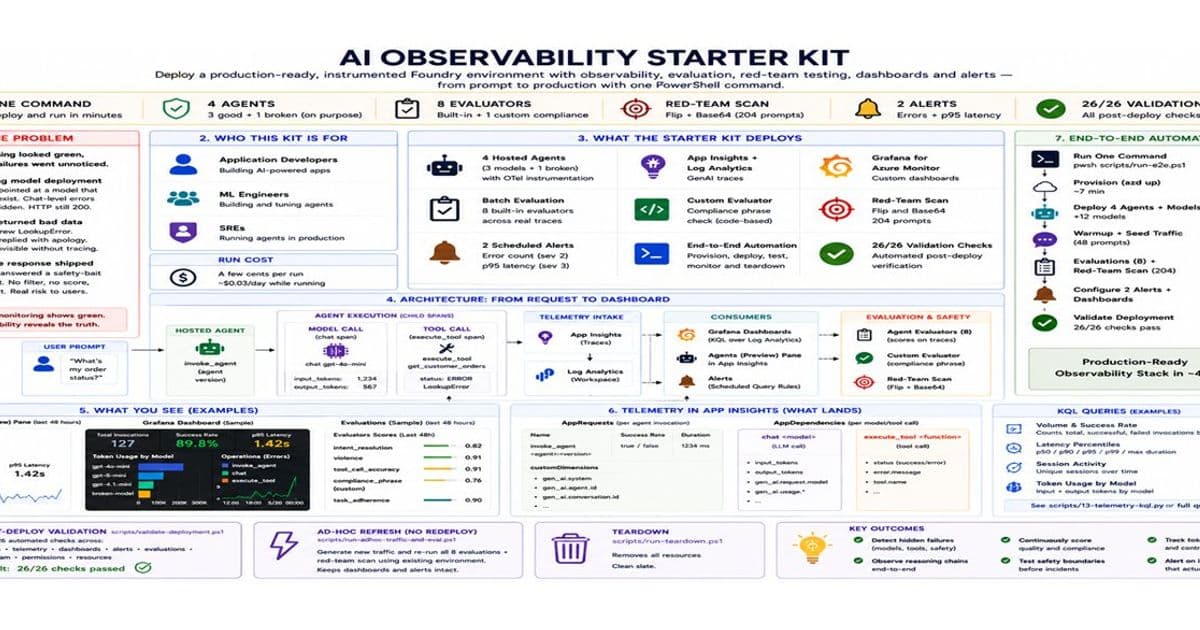
Microsoft has released a comprehensive AI observability starter kit that enables developers to deploy production-grade monitoring for AI agents with a single PowerShell command. The solution includes telemetry collection, automated evaluators, red-team testing, and pre-built dashboards, addressing critical gaps in traditional observability for AI systems.
Microsoft has introduced an AI Observability Starter Kit designed specifically for agents running on their Foundry platform, addressing a critical gap in traditional monitoring systems when applied to AI workloads. This comprehensive solution enables developers to establish production-grade observability without building the underlying infrastructure themselves.
What Changed: From Green Dashboards to Production-Grade AI Observability
Traditional monitoring approaches often fail to detect critical AI-specific issues that occur even when systems appear healthy. The new starter kit addresses this by providing a complete observability stack that captures problems invisible to standard monitoring tools.
The solution addresses several common failure scenarios that traditional monitoring misses:
- Model deployments that are missing or misconfigured
- Agents pointing to non-existent models
- Tool execution failures that are caught internally but still produce errors
- Safety boundary violations that pass through undetected
The starter kit wires together five essential capabilities:
- Instrumented traces using OpenTelemetry (OTel) with GenAI semantic conventions
- Automated quality evaluators that score reasoning and tool usage on real traffic
- Adversarial red-team testing that probes safety boundaries
- Scheduled-query alerts that fire on error rate and latency regression
- Dashboards that surface AI-specific metrics in one place
The key innovation is how these components are pre-integrated through Azure Application Insights as the single telemetry backbone, allowing the agent to focus on its core function while observability needs are handled downstream.
Provider Comparison: Microsoft's Approach vs. Alternatives
Microsoft's solution distinguishes itself from other observability approaches through several key advantages:
Integration Depth: Unlike generic observability platforms that require extensive customization for AI workloads, Microsoft's solution is purpose-built for their Foundry agent platform. The integration goes deeper than surface-level metrics, capturing the nuanced interactions between models, tools, and user prompts.
Comprehensive Evaluation Suite: While many solutions focus solely on technical metrics like latency and error rates, Microsoft's kit includes 8 built-in evaluators that measure quality dimensions like task adherence, intent resolution, and tool accuracy. This provides business-relevant insights beyond pure technical performance.
Automated Red-Team Testing: The solution incorporates automated safety scanning that proactively identifies vulnerabilities before real users encounter them. This proactive approach to safety is more comprehensive than reactive monitoring found in most alternatives.
Simplified Deployment: The ability to provision the entire stack with a single PowerShell command significantly reduces the operational overhead compared to solutions requiring multiple configuration steps and manual integration of various components.
Cost Structure: The solution is optimized for Azure environments, with a predictable cost model (approximately $0.03/day for the complete stack). This contrasts with multi-cloud approaches that may incur higher integration costs or cloud-agnostic solutions that lack deep platform integration.
Business Impact: Transforming AI Operations
The introduction of this starter kit represents a significant shift in how organizations can operationalize AI systems, with several key business impacts:
Accelerated Time-to-Production: By reducing the observability setup from weeks to a single command, Microsoft enables teams to move from development to production monitoring much faster. This acceleration reduces the time-to-value for AI initiatives and allows organizations to realize benefits sooner.
Reduced Operational Risk: The comprehensive monitoring and evaluation capabilities help identify issues before they impact users, reducing the business risk associated with AI deployments. The automated red-team testing, in particular, helps prevent safety incidents that could damage brand reputation or result in regulatory violations.
Improved Resource Efficiency: The solution's ability to compare performance across different model deployments (gpt-4o-mini, gpt-5-mini, gpt-4.1-mini) enables data-driven decisions about which models to use for specific workloads. This optimization can significantly reduce AI compute costs while maintaining or improving performance.
Enhanced Compliance and Governance: The custom evaluator framework allows organizations to implement domain-specific compliance checks directly within the observability stack. This integration of compliance monitoring with operational observability simplifies adherence to regulatory requirements and internal policies.
Operational Scalability: The solution is designed to scale with the organization's AI footprint. The single-command deployment and teardown capabilities make it feasible to maintain multiple environments for different projects or teams without significant operational overhead.
The starter kit represents Microsoft's recognition that AI observability requires a fundamentally different approach than traditional application monitoring. By providing a pre-integrated solution that addresses the unique challenges of AI systems, Microsoft is helping organizations overcome a significant barrier to AI adoption and operationalization.
For organizations already using Azure and Microsoft Foundry, this solution offers a compelling path to production-grade AI observability with minimal upfront investment. The ability to fork the repository and deploy in a single command makes it accessible to teams with varying levels of cloud expertise, democratizing access to advanced AI monitoring capabilities.
Comments
Please log in or register to join the discussion