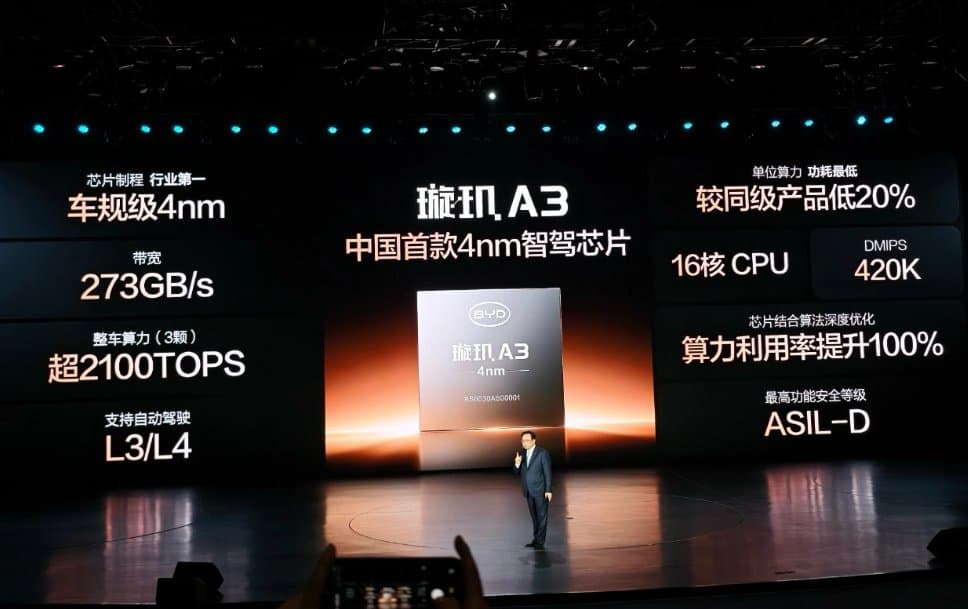
BYD has unveiled its self-developed Xuanji A3 chip, claiming it as China's first 4nm smart driving chip with L3 and L4 autonomous driving capabilities. The chip has entered mass production and offers significant computing power, reflecting BYD's substantial investment in semiconductor technology.
BYD, China's largest electric vehicle manufacturer, has taken a significant step into the semiconductor industry with the launch of its Xuanji A3 chip. At a recent launch event, company chairman and founder Wang Chuanfu unveiled what BYD claims is China's first 4nm smart driving chip, marking a notable achievement in the country's pursuit of technological self-sufficiency.
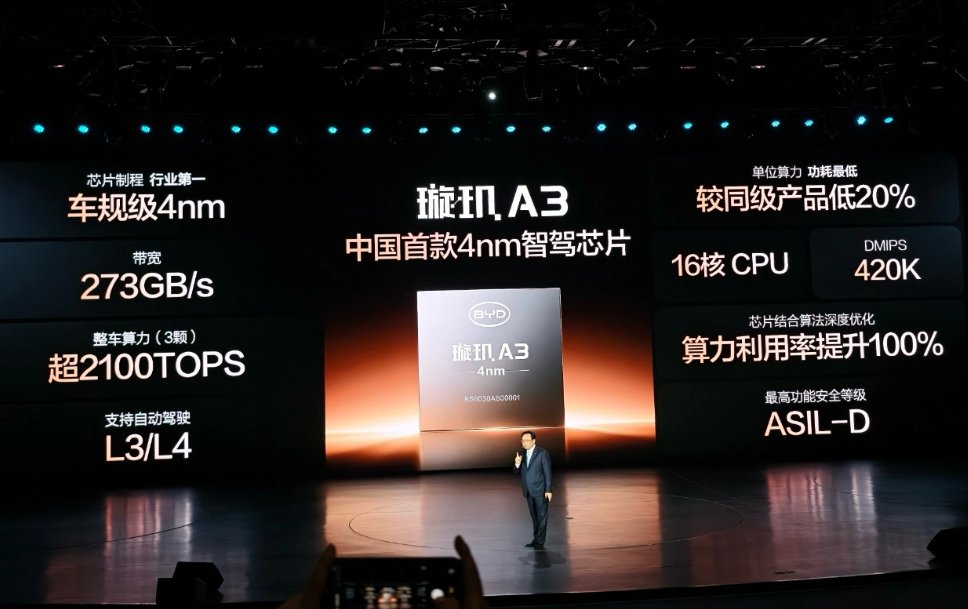
The Xuanji A3 chip supports both L3 (conditional automation) and L4 (high automation) autonomous driving capabilities, positioning BYD as a serious competitor in the race to develop advanced driving assistance systems. According to BYD, the chip has already entered mass production, indicating that the company has overcome the significant technical challenges associated with developing and manufacturing advanced semiconductor technology.
In terms of performance, a three-chip configuration of the Xuanji A3 delivers a combined computing power of over 2,100 TOPS (trillion operations per second). This substantial computing capability is essential for processing the vast amounts of data required for advanced autonomous driving functions, including sensor fusion, real-time decision-making, and path planning.
The launch of the Xuanji A3 represents the culmination of BYD's substantial investment in semiconductor technology. The company currently employs a chip R&D team of more than 7,000 people and has invested over 100 billion yuan ($13.9 billion) in its semiconductor initiatives. BYD operates four major chip research and development centers, underscoring its commitment to developing in-house semiconductor capabilities.
This move into chip development is part of BYD's broader strategy to reduce its reliance on external suppliers and gain greater control over its supply chain. In recent years, global automotive companies have faced significant challenges securing sufficient semiconductor components, particularly advanced chips used in electric vehicles and autonomous driving systems.
The Xuanji A3 chip positions BYD alongside other automotive manufacturers that have developed their own semiconductor solutions. Companies like Tesla have long invested in custom chips to optimize their vehicles' performance, and BYD's entry into this space reflects a growing trend of vertical integration in the automotive industry.
China's semiconductor industry has been under intense pressure following international sanctions and export restrictions on advanced chip technology. The development of a 4nm smart driving chip represents a notable achievement for China's domestic semiconductor capabilities, though it remains to be seen how the chip compares to leading international solutions from companies like NVIDIA, Qualcomm, and Intel.
The market for automotive semiconductors is growing rapidly as electric vehicles become more sophisticated and autonomous driving technologies advance. Industry analysts project that the automotive chip market will reach approximately $100 billion by 2025, with smart driving chips representing a significant portion of this growth.
For BYD, the Xuanji A3 chip offers several potential advantages. By developing its own chips, the company can optimize them specifically for its vehicles' needs, potentially improving performance while reducing costs. Additionally, having control over chip production provides greater supply chain security, which has become increasingly important in the current geopolitical climate.
The launch of the Xuanji A3 also positions BYD to potentially supply chips to other automotive manufacturers, creating a new revenue stream beyond vehicle sales. However, this would require BYD to establish itself as a credible supplier in an already competitive market dominated by established semiconductor companies.
As BYD continues to expand its global presence, with recent announcements of new manufacturing facilities in countries like Brazil, Hungary, and Indonesia, the company's semiconductor capabilities will play an increasingly important role in its international strategy. The ability to produce advanced chips domestically could give BYD a competitive advantage in markets where supply chain security is a concern.
The Xuanji A3 chip represents BYD's most ambitious foray into semiconductor technology to date. While the company has previously developed other chips for various vehicle functions, the 4nm process node and autonomous driving capabilities mark a significant step up in technical complexity.
Industry observers will be watching closely to see how the Xuanji A3 performs in real-world conditions and how BYD integrates the chip into its vehicle lineup. The success of this chip could determine whether BYD continues to invest in semiconductor development or shifts its strategy back to relying on external suppliers.
For China's broader tech industry, the launch of the Xuanji A3 chip is a significant milestone in the country's pursuit of technological self-sufficiency. While China has made substantial progress in developing domestic semiconductor capabilities, advanced chip manufacturing remains a challenge, with the country still heavily reliant on foreign equipment and expertise for producing chips at advanced process nodes.
The development of the Xuanji A3 chip also reflects the growing convergence of the automotive and semiconductor industries. As vehicles become increasingly software-defined and reliant on advanced computing power, the distinction between automotive companies and technology companies continues to blur.
In the coming years, we can expect to see continued investment in automotive semiconductor technology, both from traditional automotive manufacturers and from established semiconductor companies expanding into the automotive market. The Xuanji A3 chip represents BYD's contribution to this rapidly evolving landscape.
As electric vehicles and autonomous driving technologies continue to advance, the demand for advanced automotive chips will only increase. BYD's entry into this space with the Xuanji A3 chip demonstrates the company's commitment to remaining at the forefront of automotive technology, both in China and globally.
The success of the Xuanji A3 chip will depend on several factors, including its performance, reliability, cost-effectiveness, and integration with BYD's vehicle systems. If BYD can successfully develop and manufacture a competitive autonomous driving chip, it could establish itself as a leader not just in electric vehicles, but in the broader automotive technology ecosystem.
For now, the launch of the Xuanji A3 chip marks an important milestone for BYD and for China's semiconductor industry. As the company continues to expand its global presence and technological capabilities, the Xuanji A3 chip could play a crucial role in shaping the future of automotive technology.
Source: IThome (in Chinese)
Comments
Please log in or register to join the discussion