Exploring how AG-UI protocol and CopilotKit solve the integration challenge between AG2's multi-agent orchestration and real-time user interfaces.
Agent frameworks have evolved to handle complex reasoning, orchestration, and tool execution with increasing sophistication. Yet most remain isolated systems, operating behind the scenes without standardized interfaces for user interaction. AG2 (formerly AutoGen) addresses this by providing a shared runtime where specialized agents collaborate as coordinated teams. However, orchestration alone doesn't solve the challenge of creating interactive applications. Teams still build custom protocols and UI wiring to observe agent runs, display tool progress, and capture user actions during execution.
The integration of AG-UI (Agent-User Interaction Protocol) with AG2 and CopilotKit creates a standardized bridge between backend agent orchestration and frontend applications. This architecture decouples agent logic from presentation concerns while maintaining real-time synchronization between the two layers.
The Challenge: Orchestrating Agents Without an Application Contract
Even when multi-agent logic is portable, it doesn't automatically become application-portable. Production applications require a stable runtime contract for several critical interactions:
- Streaming messages and partial results
- Tool lifecycle management (start → progress → finish/fail)
- State snapshots and updates during execution
- Human-in-the-loop actions that can steer or interrupt agent runs
AG2 excels at managing delegation, shared context, and orchestration internally. However, it doesn't define a standard event/state interface for exposing execution to frontends. Without this contract, every application invents its own WebSocket/SSE payload shapes and UI mapping rules, resulting in tightly coupled integration code rather than a reusable interaction layer.
This gap between orchestration capabilities and application interfaces represents a fundamental challenge in building practical agent-based systems. The solution requires a protocol that can standardize the interaction stream while remaining flexible enough to accommodate diverse agent architectures and UI requirements.
AG-UI: Standardizing Agent-Frontend Communication
AG-UI addresses this challenge by defining an event-based protocol that standardizes the live interaction stream between an agent runtime and an application. During execution, the backend emits a structured stream of event types that the frontend can consume and respond to with compatible interaction events.
The protocol's significance lies in its ability to make internal agent coordination observable and interactive at the application boundary. Rather than every application inventing custom payload formats, AG-UI defines a small set of self-describing JSON event types, each with a clear type and structured payload:
TEXT_MESSAGE_CONTENT: Streams LLM tokens as they're generatedTOOL_CALL_START/END: Signals function call initiation and completionSTATE_DELTA: Carries JSON Patch deltas for incremental state synchronizationRUN_STARTED/RUN_FINISHED: Marks execution lifecycle transitions
This standardization creates a clean separation of concerns. The backend doesn't need to understand how the UI renders progress, and the UI doesn't need to comprehend internal orchestration logic. The protocol uses Server-Sent Events (SSE) over HTTP as its primary transport, making it firewall-friendly and relatively simple to implement.
In AG2, this protocol is implemented through AGUIStream, which wraps a ConversableAgent and exposes it as an ASGI endpoint that streams AG-UI events. This wrapper automatically maps AG2's internal execution model to the standardized protocol events.
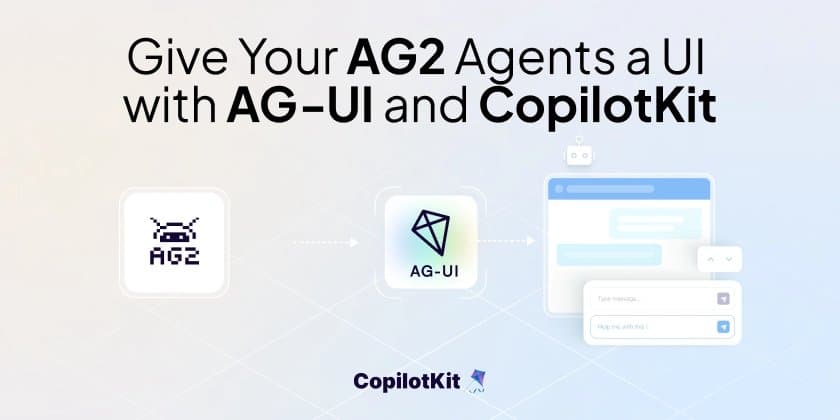
Integration Architecture: AG2 → AG-UI → CopilotKit
The integration creates a three-layer architecture that maintains clean boundaries while enabling real-time interaction:
- AG2 Runtime: Handles multi-agent orchestration, manages delegation and shared state, and executes tools
- AG-UI Integration Layer: Translates AG2 activity into standardized events and handles SSE transport
- CopilotKit: Acts as the client runtime, subscribing to event streams and rendering agent activity
The wiring is straightforward: AG2 exposes agent runs through an AG-UI-compatible endpoint using AGUIStream. This endpoint streams standardized events for the run's lifecycle. CopilotKit connects to this endpoint, subscribes to the live event stream, renders agent activity within the application, and forwards user actions back into the same execution loop.
Comments
Please log in or register to join the discussion