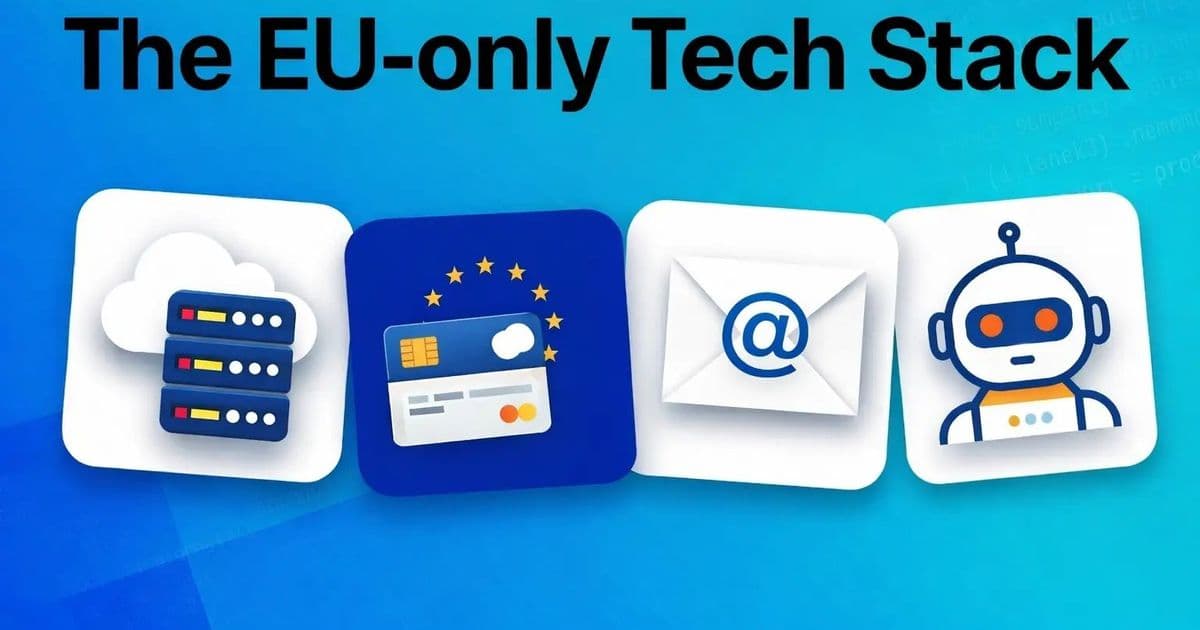
A comprehensive guide to building a SaaS product using only European infrastructure and services, covering hosting, payments, CDN, analytics, and email providers.
Building a SaaS in 2026 Using Only EU Services Apr 03, 2026
In this guide Can you build a SaaS without AWS? Building a SaaS product from scratch in 2026 without touching AWS, Azure, or GCP. Without Stripe, without Cloudflare, without Google Analytics. Is it actually possible? And more importantly, is it practical?
The short answer is yes. The longer answer is that the EU software ecosystem has reached a point where every core layer of a SaaS stack has at least one credible European option. Some are mature and battle-tested, others are newer but capable. In this guide, we walk through each layer and recommend specific providers we think are worth considering.
Hosting and compute
This is the foundation of your stack, and the layer where EU options are strongest. Two providers stand out, depending on your priorities.
If you are comfortable with Linux, Hetzner is hard to beat on price-performance. Clean API, straightforward servers, pricing at a fraction of AWS. You handle more infrastructure yourself, but if your team has ops experience, the savings are significant. Data centers in Germany and Finland.
If you want managed services closer to the AWS experience, Scaleway is the pick. Managed Kubernetes, databases, object storage, serverless functions, and GPU instances. Not the cheapest, but it reduces your operational burden significantly. Data centers in Paris, Amsterdam, and Warsaw.

Hetzner Cloud 🇩🇪 Germany Best price-performance in Europe. Cloud servers, volumes, load balancers, object storage. Clean API. Ideal if your team is comfortable managing infrastructure.
Scaleway 🇫🇷 France Closest to the AWS experience in the EU. Managed Kubernetes, databases, serverless functions, object storage, and GPU instances. Developer-friendly.
Billing and payments
If you have used Stripe before, Mollie is the closest thing to that experience in the EU. Clean API, good documentation, fast onboarding. They support all the major European payment methods out of the box (iDEAL, Bancontact, SEPA, Klarna, credit cards), which is something you will appreciate when selling across multiple EU countries. Mollie is based in Amsterdam and processes payments through EU infrastructure. The integration pattern is familiar: create a payment, redirect the customer, handle the webhook. If you have built a Stripe integration before, you will feel at home. Subscription billing, recurring payments, and multi-currency support are all there.
Mollie 🇳🇱 Netherlands Clean API, good docs, fast onboarding. Supports all major EU payment methods. Subscriptions, recurring payments, and multi-currency built in.
CDN
Bunny.net does everything you need from a CDN, at a price that makes Cloudflare's paid tiers look expensive. They have a global network of PoPs, edge storage, image optimization, a video delivery platform, and DDoS protection. The dashboard is straightforward, the API is well-documented, and the pricing is purely usage-based with no surprise tiers. If you are running a SaaS, you probably need a CDN for static assets, maybe image transformation, and possibly video delivery. Bunny.net covers all of that. Based in Slovenia, EU-owned and operated.
Bunny.net 🇸🇮 Slovenia Fast, affordable CDN with edge storage, image optimization, video delivery, and DDoS protection. Usage-based pricing, no surprise tiers.
Analytics
You do not need Google Analytics. You probably do not even want it, given the cookie consent headaches it creates. Two EU options stand out.
Plausible is the cozy, privacy-friendly option. No cookies, no consent banner needed, GDPR-compliant out of the box. Simple dashboard with the metrics that matter. Open source, based in Estonia.
Simple Analytics is worth a look if you are just getting started, as they offer a free plan that covers the basics. Similar philosophy to Plausible: privacy-first, no cookies, lightweight script. Based in the Netherlands.
Plausible 🇪🇪 Estonia Privacy-friendly, open source analytics. No cookies, no consent banners needed. Simple dashboard that shows what matters.
Simple Analytics 🇳🇱 Netherlands Privacy-first analytics with a free plan for getting started. No cookies, lightweight script, GDPR-compliant out of the box.
Transactional email
Password resets, welcome emails, invoices. Every SaaS needs transactional email, and you do not need SendGrid for it. Three EU providers all offer free tiers that are generous enough to get you through the early stages.
Ahasend (Netherlands) offers 1,000 emails per month for free and is focused purely on transactional email with a developer-first API. Lettermint (Netherlands) gives you 300 emails per month on their free plan and keeps things simple. MailerLite (Lithuania) is broader, covering both transactional and marketing email, with 500 emails per month on the free tier. All three support SMTP relay, so if you are migrating from another provider, you can often just swap credentials. REST APIs are available too.
Ahasend 🇳🇱 Netherlands Developer-focused transactional email. 1,000 emails/month free. Clean API, no marketing features to get in the way.
Lettermint 🇳🇱 Netherlands Simple transactional email. 300 emails/month free. EU-hosted, straightforward pricing.
MailerLite 🇱🇹 Lithuania Transactional and marketing email in one platform. 500 emails/month free. Good option if you need newsletters later.
Yes, you can build on a 100% EU stack
A few years ago, building a SaaS on entirely European infrastructure meant real compromises. Today, the picture is different. Every core layer of a modern SaaS stack has at least one production-ready EU option. The stack we outlined here (Hetzner or Scaleway for compute, Mollie for payments, Bunny.net for CDN, Plausible for analytics, and Ahasend or Lettermint for email) is not a theoretical exercise. These are real products used by real companies in production. The total cost is competitive with, and often lower than, an equivalent US-based stack.
You will not find an EU equivalent for every niche AWS service. If you need something like DynamoDB, SQS, or Cognito, you will either self-host an open source alternative or accept a gap. But for the vast majority of SaaS applications, the foundation is solid.
The practical benefit goes beyond sovereignty. Simpler GDPR compliance, no cookie consent headaches for analytics, payments that support European methods natively, and support teams in your timezone. Building on an EU stack in 2026 is not an ideological statement. It is just a practical choice that happens to be viable now.
Is an EU-only stack more expensive than using AWS and Stripe?
What about vendor lock-in with EU providers? Can I start with this stack and scale to millions of users?
Compare alternatives
EU Alternatives to AWS EU Alternatives to Azure EU Alternatives to Cloudflare EU Alternatives to Google Analytics EU Alternatives to SendGrid EU Alternatives to Stripe
More guides
Choosing an EU Cloud Provider in 2026 Apr 03, 2026
Sovereign EU Cloud Providers Compared Apr 03, 2026
Find more EU alternatives CDN Content delivery networks for serving websites and media. Also includes DDoS protection.
Clouds Cloud computing platforms that offer compute, storage and other services.
Payments Online payment and billing platforms.
Transactional Email Transactional email for app messages, notifications. With SMTP and API access.
Web Analytics EU-based analytics services that track, collect and analyze website visitor traffic.
Comments
Please log in or register to join the discussion