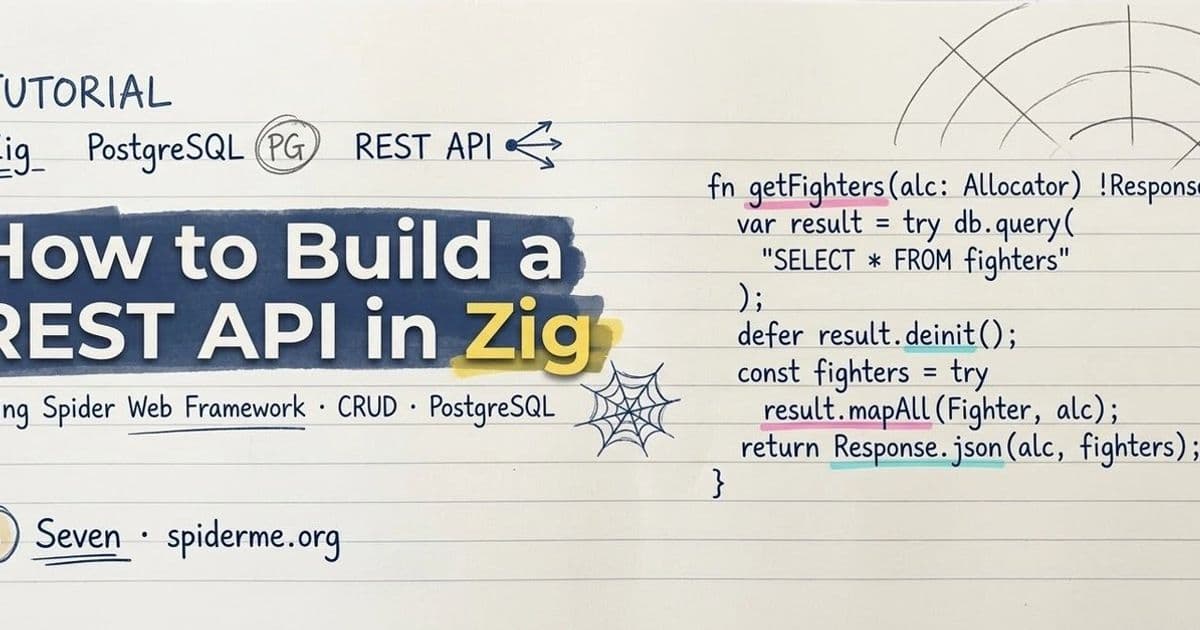
Explore how Zig's Spider Web Framework enables building type-safe, high-performance REST APIs with PostgreSQL integration, offering a compelling alternative to traditional web development stacks.
The emergence of Zig as a systems programming language has sparked interest in its potential for web development. While traditionally associated with low-level systems programming, Zig's focus on performance, memory safety, and simplicity makes it an intriguing choice for building web APIs. The Spider Web Framework represents a significant step forward in this space, offering developers a way to build REST APIs with the same level of control and efficiency that Zig provides for systems programming.
The Appeal of Zig for Web Development
Zig's design philosophy centers on simplicity and performance. Unlike languages that rely heavily on runtime systems or garbage collection, Zig gives developers direct control over memory management while providing safety guarantees through its type system. This approach translates well to web development, where performance and resource efficiency are increasingly important.
The language's comptime feature, which allows code execution at compile time, enables powerful metaprogramming capabilities without the complexity of template systems found in other languages. This feature becomes particularly valuable when building web frameworks, as it allows for compile-time validation of routes, types, and configurations.
Spider Web Framework: Architecture and Design
Spider takes a minimalist approach to web development, focusing on providing essential functionality without unnecessary abstractions. The framework's architecture reflects Zig's philosophy of giving developers control while maintaining safety.
Core Components
The framework includes several key components that work together to provide a complete web development experience:
- Router: Handles HTTP method routing with support for path parameters
- Request/Response: Type-safe handling of HTTP requests and responses
- Database Integration: Built-in PostgreSQL support through libpq
- JSON Handling: Native JSON parsing and serialization
- Middleware System: Extensible request processing pipeline
Type Safety in Practice
One of Spider's standout features is its emphasis on type safety throughout the request lifecycle. When defining routes, developers specify exact parameter types, and the framework enforces these constraints at compile time. This approach eliminates entire classes of runtime errors common in dynamically typed web frameworks.
For example, when defining a route like /fighters/:id, Spider ensures that the id parameter is properly parsed and validated before reaching the handler function. This level of type safety extends to request bodies, query parameters, and response data.
Building a CRUD API: Step-by-Step Analysis
The tutorial demonstrates building a complete REST API for managing fighter data, showcasing Spider's capabilities for real-world applications.
Project Setup and Dependencies
The setup process highlights Zig's modern package management system. Using zig fetch, developers can easily add dependencies like Spider to their projects. The build.zig configuration shows how to properly link against system libraries like libpq, demonstrating Zig's approach to handling external dependencies.
Server Initialization
The basic server setup in Spider is remarkably concise. A few lines of code create a fully functional HTTP server listening on a specified port. This simplicity doesn't come at the cost of flexibility—developers can easily customize server behavior, add middleware, or integrate with existing systems.
Database Integration
Spider's PostgreSQL integration is particularly noteworthy. The framework provides a high-level API that abstracts away much of the complexity of database operations while maintaining performance. The db.query and db.queryParams functions demonstrate how Spider handles SQL operations with type safety and error handling built in.
The mapAll function deserves special attention. It allows developers to map database query results directly to Zig structs, eliminating the need for manual data transformation. This feature significantly reduces boilerplate code while maintaining type safety throughout the data flow.
CRUD Operations Implementation
Each CRUD operation in the tutorial showcases different aspects of Spider's design:
- GET /fighters: Demonstrates querying and mapping database results
- GET /fighters/:id: Shows parameter handling and single-record retrieval
- POST /fighters: Illustrates JSON body parsing and database insertion
- PUT /fighters/:id: Combines parameter handling with update operations
- DELETE /fighters/:id: Shows how to perform delete operations with proper error handling
Performance and Memory Considerations
Zig's approach to memory management shines through in Spider's design. The framework uses allocators extensively, giving developers control over memory allocation strategies. This design allows for:
- Custom memory pools for high-performance scenarios
- Integration with existing memory management systems
- Fine-grained control over allocation lifetimes
The use of arenas for request processing demonstrates an effective pattern for managing temporary allocations in web applications. By using a single arena for each request, Spider can efficiently handle multiple allocations while ensuring all memory is properly freed at the end of request processing.
Error Handling and Reliability
Spider's error handling model aligns with Zig's approach to error management. Instead of exceptions or error codes, Spider uses Zig's error union types, forcing developers to handle potential failures explicitly. This design leads to more robust applications and helps catch edge cases during development rather than in production.
The framework provides comprehensive error information, making debugging easier and allowing for more sophisticated error handling strategies in production applications.
Development Experience and Tooling
The tutorial demonstrates a smooth development experience, from project setup to testing. Zig's build system integrates well with development workflows, and the ability to run the server directly from the build process simplifies the development loop.
Testing the API using curl commands shows how straightforward it is to verify API functionality. The JSON responses are clean and well-structured, making it easy to integrate with frontend applications or other services.
Production Considerations
While the tutorial focuses on development, several aspects of Spider's design make it suitable for production use:
- Performance: Zig's compilation to native code and Spider's efficient design result in fast request processing
- Memory Efficiency: Fine-grained control over memory allocation helps optimize resource usage
- Type Safety: Compile-time guarantees reduce runtime errors
- Error Handling: Explicit error management leads to more reliable applications
The Future of Zig Web Development
Spider represents an early but promising step in Zig's web development ecosystem. As the framework matures, we can expect to see:
- More comprehensive middleware support
- Enhanced database integration options
- Improved development tooling
- Better integration with frontend frameworks
- Performance optimizations and additional features
Conclusion: Is Zig Ready for Web Development?
The tutorial demonstrates that Zig, through frameworks like Spider, is indeed ready for web development, particularly for scenarios where performance, type safety, and resource efficiency are priorities. While the ecosystem is still maturing compared to more established languages, the foundations are solid.
For developers already familiar with Zig or those working on systems where performance is critical, Spider offers a compelling alternative to traditional web frameworks. The combination of Zig's language features with Spider's thoughtful design creates an environment where developers can build high-quality web APIs with confidence.
The journey from a simple "pong" endpoint to a full CRUD API in just a few dozen lines of code illustrates Spider's power and simplicity. As the Zig ecosystem continues to grow, frameworks like Spider will likely play an increasingly important role in systems-level web development.
For those interested in exploring Zig web development further, the official Spider documentation at spiderme.org provides comprehensive resources and examples. The framework's active development and growing community suggest a bright future for Zig in the web development space.
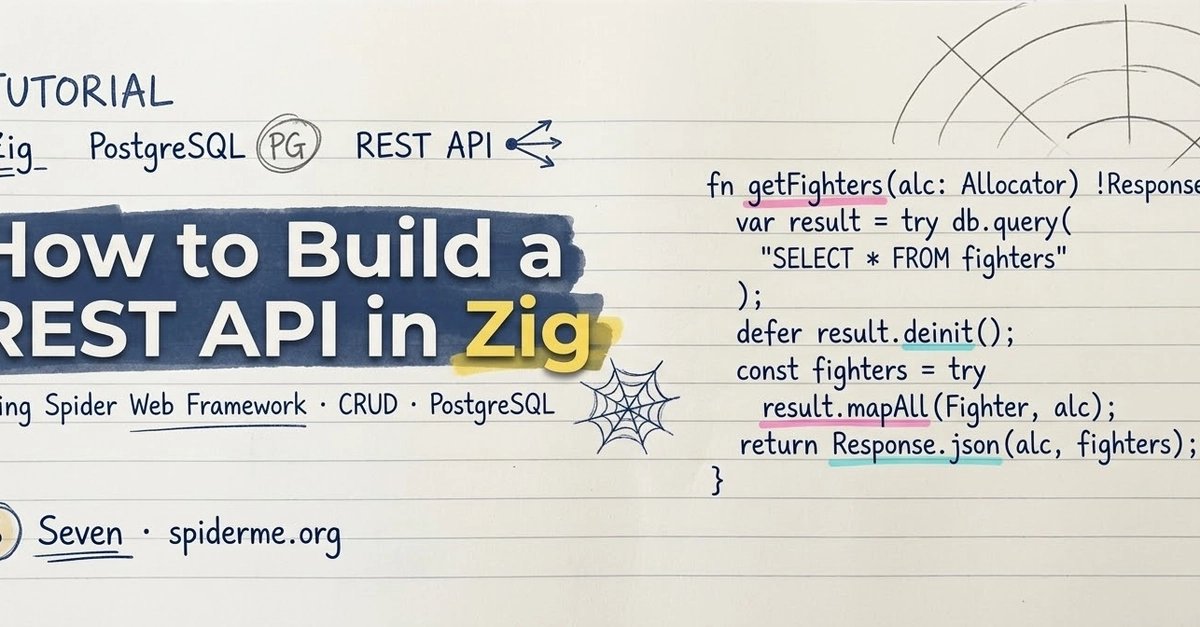

The path forward for Zig web development looks promising, with Spider leading the charge in demonstrating how systems programming principles can create efficient, type-safe web applications. As more developers discover the benefits of this approach, we may see a shift in how we think about building web APIs and services.
Comments
Please log in or register to join the discussion