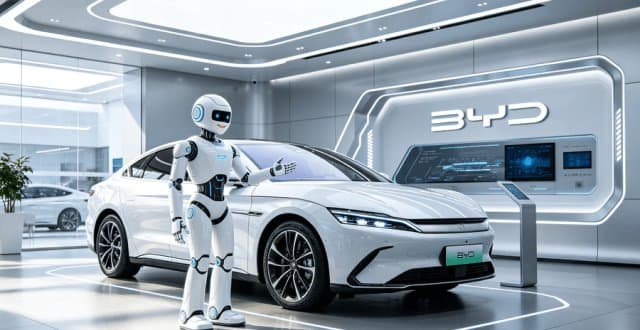
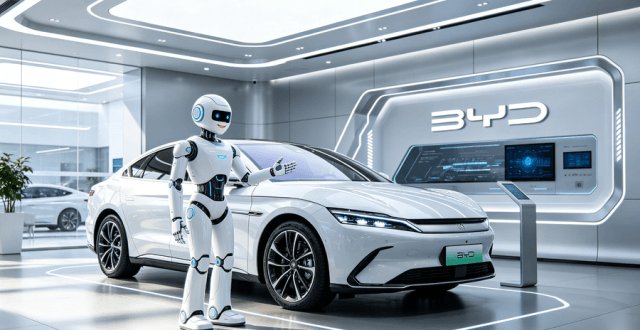
BYD announced a new in‑house humanoid platform, the seventh‑generation Yao‑Shun‑Yu, intended first for global 4S car‑dealership showrooms and later for domestic service tasks. The company bets that its automotive manufacturing pedigree can close the gap between Chinese hardware strength and AI capabilities, but the roadmap still hinges on unproven perception stacks and cost‑effective scaling.
What BYD claims
In a recent interview, BYD’s executive vice president Li Ke said the automaker is preparing to ship its seventh‑generation humanoid robot—codenamed Yao‑Shun‑Yu—to overseas 4S dealership showrooms. The robots are pitched as multilingual greeters and product demonstrators, with a longer‑term vision of handling cooking, cleaning, and companionship tasks in private homes. BYD frames the effort as a natural extension of its expertise in precision mechanical integration and real‑time control software, arguing that the same production line that builds electric cars can be repurposed for large‑scale robot manufacturing.
What’s actually new
1. A seventh‑generation hardware platform
The announcement marks the seventh iteration of BYD’s internal robot chassis. According to the brief technical brief released by BYD, the current model features:
- Actuation: 30 DOF (degrees of freedom) with brushless DC motors and harmonic drives, comparable to the joint count of Boston Dynamics’ Atlas.
- Payload: 10 kg per arm, enough for typical service tasks such as carrying a tray or a kitchen pot.
- Sensors: A stereo visual system, LiDAR for obstacle avoidance, and a force‑torque sensor on each wrist.
- Control: A custom CAN‑based bus running a deterministic 1 kHz control loop, similar to the architecture used in BYD’s EV power‑train controllers.
These specifications are not unprecedented, but the fact that BYD has progressed through seven hardware cycles in under three years suggests a rapid design‑for‑manufacturing feedback loop that many pure‑robotics startups lack.
2. AI stack integration
Li Ke emphasized that BYD is “closing the AI gap” that has traditionally limited Chinese robots. The company points to a partnership with Baidu’s Wenxin Qianfan large‑language model (LLM) for natural‑language interaction and a custom perception pipeline built on OpenMMLab. The robot’s dialogue system can switch between English, Mandarin, German, and French on‑the‑fly, using a language‑identification front‑end that selects the appropriate LLM prompt template.
What is new here is the tight coupling of the perception stack with the low‑level motor controller: sensor data is pre‑processed on an edge‑AI accelerator (the Horizon R2 chip) and fed directly into a model‑predictive controller that adjusts joint trajectories in real time. This reduces latency compared with cloud‑only solutions, a known bottleneck for service robots operating in noisy retail environments.
3. Deployment plan
BYD’s rollout schedule is modestly detailed:
- Pilot phase (Q4 2026): Install 20 units across selected European dealerships (Germany, France, Spain). Each unit will run a 12‑hour daily demo schedule, collecting interaction logs for model refinement.
- Scale‑up (2027‑2028): Expand to 200 units worldwide, including Asian and North‑American locations.
- Home‑service version (2029): Introduce a lighter, domestic‑focused variant with reduced payload and a simplified UI.
The pilot will be evaluated on two metrics: customer engagement time (average minutes a visitor spends interacting with the robot) and service cost reduction (labor hours saved per showroom).
Limitations and open questions
- Perception robustness: The current sensor suite is adequate for structured showroom aisles but may struggle with cluttered home kitchens. No public benchmark results (e.g., on the YCB‑Video dataset) have been released, so it is unclear how the vision system handles occlusions or reflective surfaces.
- AI reliability: Relying on a third‑party LLM for dialogue introduces latency spikes and occasional hallucinations. BYD has not disclosed whether they implement any on‑device safety filters or fallback rule‑based responses for critical interactions (e.g., fire‑safety instructions).
- Cost structure: BYD touts “vertical integration” as a cost advantage, yet the bill of materials for a single unit (estimated at $12‑15 k) remains high compared with low‑end service robots like Temi or Misty II. Achieving price parity will likely require mass production volumes that are not guaranteed until after the showroom pilots prove ROI.
- Regulatory compliance: Deploying humanoid robots in public spaces raises questions about safety certifications (e.g., ISO 10218‑1) and data‑privacy compliance for multilingual voice recordings. BYD has not mentioned any certification pathway.
- Software ecosystem: The robot runs a custom Linux distribution with ROS 2 middleware. While this eases integration for developers, BYD has not announced an open SDK or marketplace for third‑party apps, which could limit the ecosystem’s growth.
How this fits into the broader market
The announcement reflects a broader trend where automotive manufacturers leverage their high‑volume production capabilities to enter the service‑robot market. Similar moves have been observed at Toyota (the Human Support Robot) and Ford (experimental warehouse bots). BYD’s claim of “balanced hardware and AI” addresses a well‑documented split: Chinese firms excel at mechanical design, while U.S. firms dominate LLM‑driven interaction.
If BYD can demonstrate a reliable, low‑latency perception‑control loop and keep per‑unit costs under $10 k, the Yao‑Shun‑Yu platform could become a reference point for large‑scale retail automation. However, the home‑service ambition remains speculative until the company releases a dedicated prototype and publishes benchmark results.
Further reading
- BYD press release on the Yao‑Shun‑Yu project (official page) – https://www.byd.com/en/press/2026/yaoshunyu
- Baidu Wenxin Qianfan LLM documentation – https://cloud.baidu.com/doc/WENXIN
- Horizon R2 edge AI accelerator specs – https://github.com/HorizonAI/R2
- ROS 2 integration guide for humanoid platforms – https://docs.ros.org/en/foxy/Guides/Robots.html
Comments
Please log in or register to join the discussion