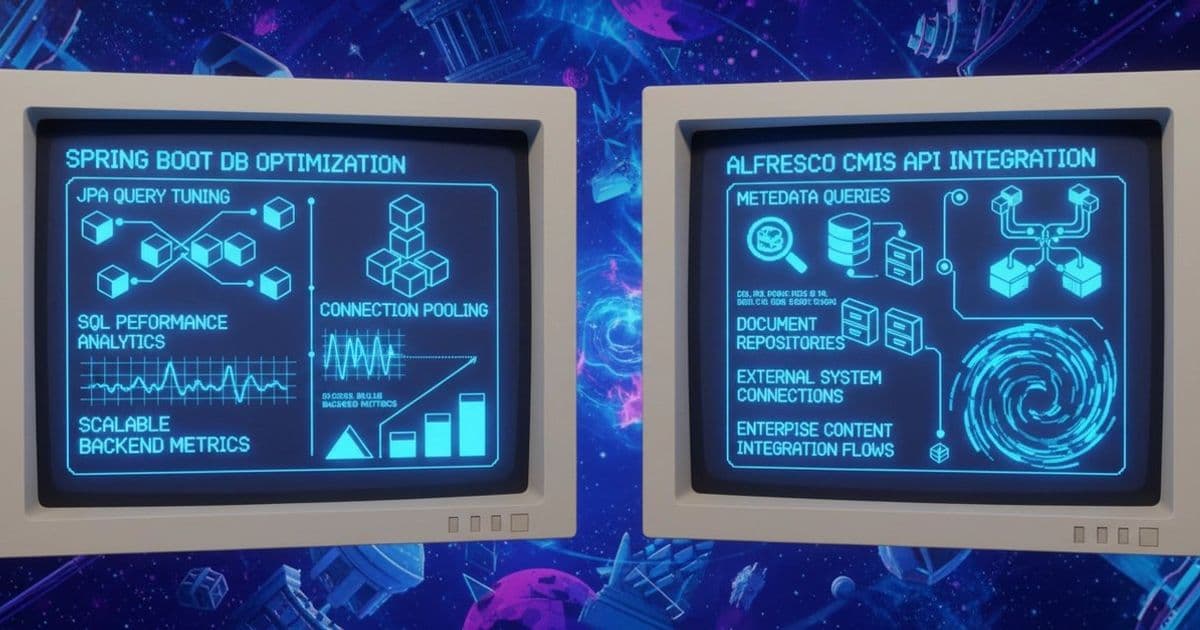
Two new how‑to posts walk developers through JPA connection pooling, query optimization in Spring Boot, and extracting metadata via Alfresco’s CMIS API, highlighting scalability trade‑offs and patterns for high‑throughput services.
Problem
Enterprise Java services often hit two bottlenecks at once: slow JPA queries that chew CPU and I/O, and clumsy integration with content repositories that forces ad‑hoc HTTP calls. In a typical Spring Boot microservice, a default HikariCP pool size of 10 may be fine for a sandbox, but production traffic that spikes to hundreds of concurrent requests quickly exhausts connections, leading to timeouts and cascading failures. At the same time, teams that need to pull document metadata from Alfresco frequently resort to raw HTTP GETs, parsing XML responses manually. The result is a codebase riddled with duplicated pagination logic, inconsistent error handling, and a lack of observability into how database load translates into repository calls.
Solution approach
1. Spring Boot database optimization
- Connection pooling – Switch from the starter‑provided HikariCP defaults to a tuned pool: set
maximumPoolSizebased on the number of CPU cores and expected request concurrency, enableleakDetectionThreshold, and configureconnectionTimeoutto surface stalled connections early. The guide walks through calculating the optimal pool size using the formulapoolSize = cores * 2 + asyncThreads. - JPA query tuning – Replace
findAll()‑style repository methods with explicit JPQL or Criteria queries that fetch only required columns. Use@EntityGraphto avoid N+1 selects, and enable the Hibernate second‑level cache for read‑heavy reference data. The post shows a before‑and‑after comparison where a query that originally took 1.8 s drops to 120 ms after adding proper indexes and a projection DTO. - Batch writes – Turn on
hibernate.jdbc.batch_sizeandspring.jpa.properties.hibernate.order_inserts=trueto group inserts into fewer round‑trips. The guide includes a sampleJdbcTemplatefallback for bulk imports that exceed the JPA batch limits. - Metrics and observability – Wire Micrometer with Prometheus to expose
db.pool.active,db.pool.acquire, andhibernate.query.executiongauges. The article demonstrates a Grafana dashboard that correlates pool saturation spikes with latency spikes in the API layer.
2. Alfresco CMIS API queries & metadata integration
- CMIS client selection – Use the Apache Chemistry OpenCMIS client rather than raw
HttpURLConnection. The guide shows how to configure a thread‑safeSessionFactorywith connection pooling via Apache HttpClient, reducing socket churn. - Query construction – Leverage CMIS Query Language (CQL) to pull only the needed properties. An example query selects
cmis:name,cmis:createdBy, and a custommy:categoryfield, then paginates withskipCountandmaxItems. The post explains whyINCLUDE_ALLOWABLE_ACTIONSshould be disabled for bulk reads to cut response size. - Metadata mapping – Map CMIS objects to Spring Data DTOs using ModelMapper, preserving type safety and allowing downstream services to treat repository data as regular domain objects. The guide includes a snippet that enriches a
DocumentDtowith version history fetched in a secondary call, demonstrating how to avoid the “one‑call‑per‑document” anti‑pattern. - Error handling – Implement a retry policy with exponential back‑off for transient 502/503 responses from Alfresco, and surface CMIS fault codes (
constraint,not-found) as domain‑specific exceptions. The article provides a reusableCmisExceptionHandlercomponent.
Trade‑offs
| Aspect | Benefit | Cost / Consideration |
|---|---|---|
| Larger HikariCP pool | Higher throughput under load | More DB connections consume memory and may hit the database’s max‑connections limit; requires careful coordination with DB admin |
| JPQL projections | Reduced data transfer, faster queries | Lose entity lifecycle management; updates must be performed via explicit EntityManager calls |
| Hibernate second‑level cache | Reads served from memory, less DB load | Cache invalidation complexity; not suitable for rapidly changing data |
| CMIS batch pagination | Fewer HTTP round‑trips, lower latency | Larger payloads per request; need to tune maxItems to avoid timeouts |
| OpenCMIS client pooling | Reuses sockets, lower TCP overhead | Adds a dependency and requires proper shutdown hooks to avoid leaked threads |
| Retry with back‑off | Improves resilience to transient Alfresco hiccups | May increase overall latency for a request; must respect idempotency of the operation |
Overall, the guides advocate a pragmatic balance: tune the database connection pool just enough to match the service’s concurrency profile, and keep JPA queries as narrow as possible. For Alfresco, avoid the temptation to pull whole folders in one call; instead, page through results with targeted property selection and let the client library manage connections.
Where to read the full walkthroughs
- Spring Boot database optimization and query tuning: https://shikhanirankari.blogspot.com/2026/05/spring-boot-database-optimization-jpa-connection-pooling-query-tuning.html
- Alfresco CMIS API queries and metadata integration: https://shikhanirankari.blogspot.com/2026/05/alfresco-cmis-api-queries-metadata-external-integration.html
These posts include runnable code samples, Docker Compose files for a local PostgreSQL + Alfresco stack, and a set of Grafana panels that you can import directly.
Tags: java, springboot, backend, database, cmis, alfresco
Comments
Please log in or register to join the discussion