An analysis of Calvin's innovative approach to distributed ACID transactions through deterministic locking, eliminating the need for 2PC while maintaining serializability.
In the complex landscape of distributed database systems, achieving ACID properties across partitioned and replicated architectures has long presented significant challenges. Calvin, introduced in 2012 by researchers from Yale University, represents a fascinating departure from conventional approaches by embracing determinism as the foundation for distributed transaction processing. This article examines Calvin's core principles, architectural innovations, and the trade-offs inherent in its deterministic approach to distributed transactions.
The Core Philosophy: Eliminating Nondeterminism
At its heart, Calvin introduces a fundamental shift in how distributed transactions are conceptualized and executed. Traditional systems like those using Two-Phase Locking (2PL) combined with Two-Phase Commit (2PC) face inherent challenges due to the nondeterministic nature of lock acquisition. When multiple transactions compete for the same locks, the order in which they acquire these locks is unpredictable, potentially leading to different execution orders across shards and violating isolation guarantees.
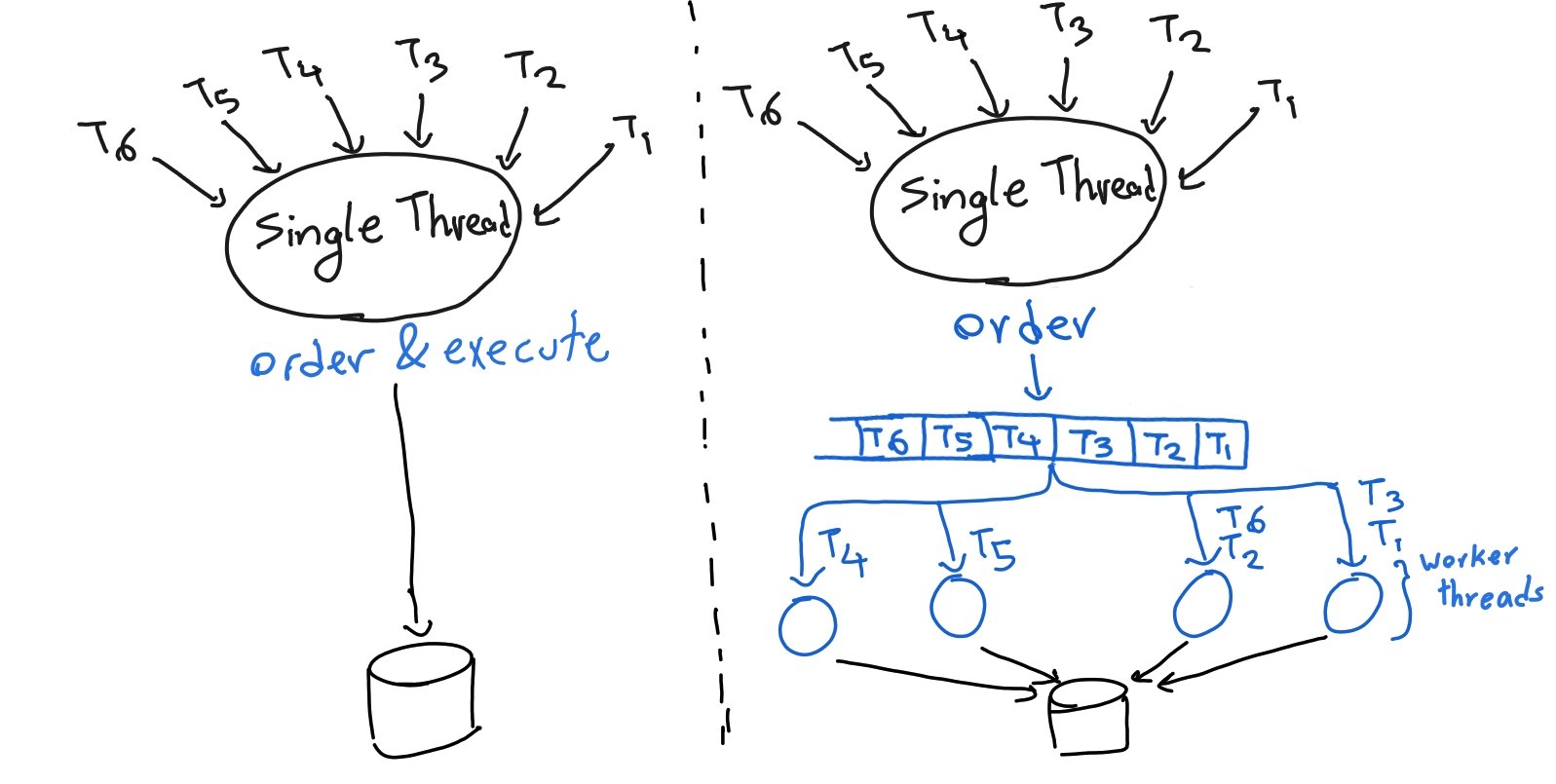
Calvin's revolutionary insight is that by removing this nondeterminism, we can eliminate the need for complex atomic commit protocols while still maintaining ACID properties. The protocol achieves this through deterministic locking, which establishes a global order for transactions upfront rather than discovering it dynamically during execution. This approach transforms the nature of distributed transactions, shifting from a reactive conflict-resolution model to a proactive ordering system.
Architectural Components: Three Layers of Determinism
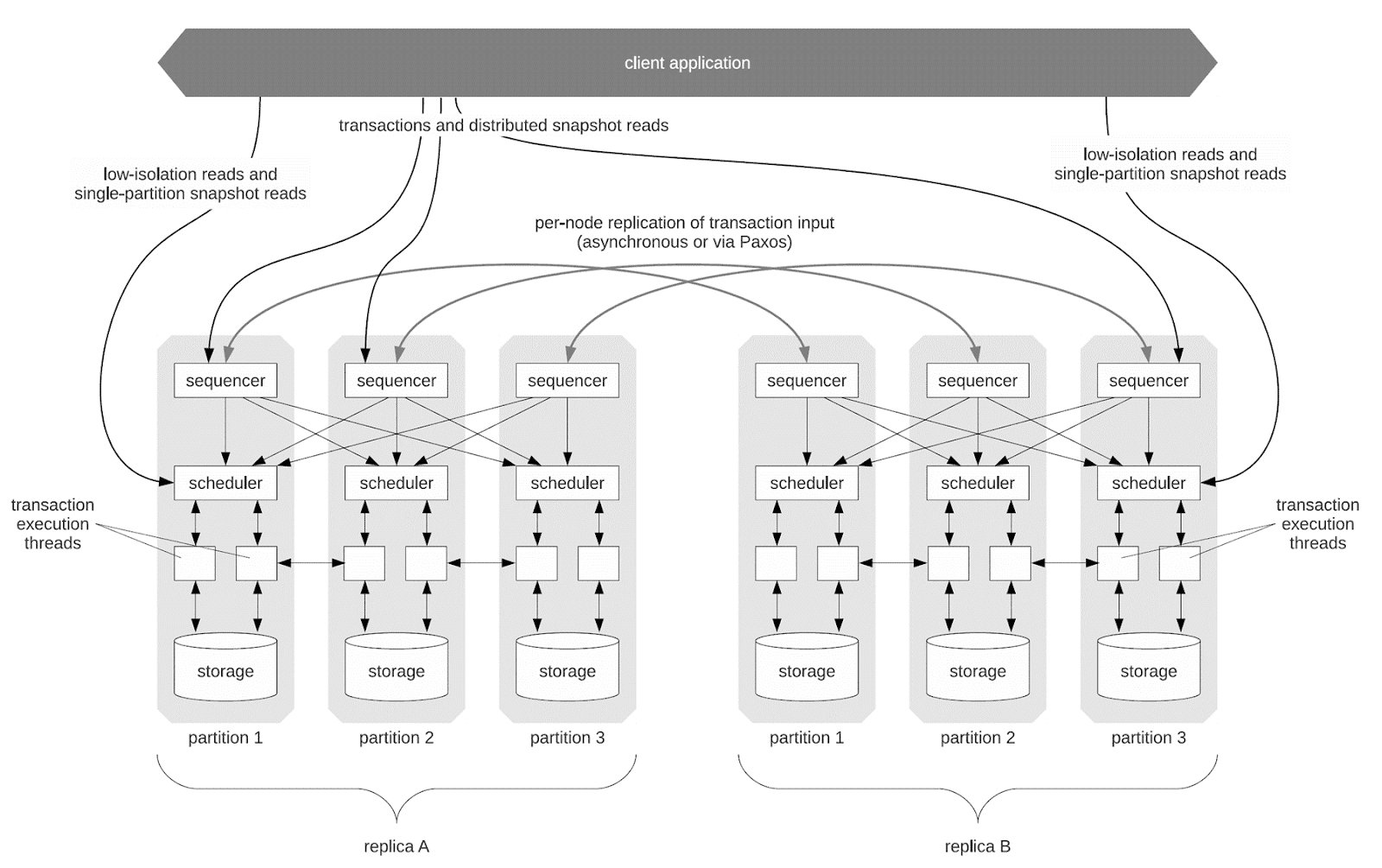
Calvin's architecture consists of three distinct layers, each playing a crucial role in maintaining determinism across the distributed system.
Sequencing Layer: Establishing Global Order
The sequencing layer is responsible for creating and maintaining the global transaction order that underpins Calvin's deterministic approach. Rather than relying on a single bottlenecked sequencer, Calvin implements a distributed sequencing mechanism that divides time into "terms" during which sequencers coordinate to establish a consistent global ordering.
In each term, sequencers exchange transactions they've received and apply a round-robin mechanism to determine the global order. For example, if sequencers 1, 2, and 3 receive transactions T1, T2, and T3 respectively in the first term, they would be ordered as T1, T2, T3. In the next term, if they receive T4, T5, and T6, they might order them as T5, T6, T4, resulting in the global order T1, T2, T3, T5, T6, T4.
This approach allows Calvin to maintain horizontal scalability while preserving determinism. The system supports both synchronous and asynchronous replication models, with trade-offs between consistency guarantees and performance. To optimize performance, sequencers batch transactions over approximately 10ms intervals before sharing them across the system.
A critical preprocessing step occurs before transactions are appended to the replicated log: sequencers analyze transaction code to eliminate sources of nondeterminism. This includes pre-executing any code that might generate different results across replicas, such as random number generation or system time calls, ensuring that all replicas will execute transactions identically.
Scheduling Layer: Deterministic Locking in Action
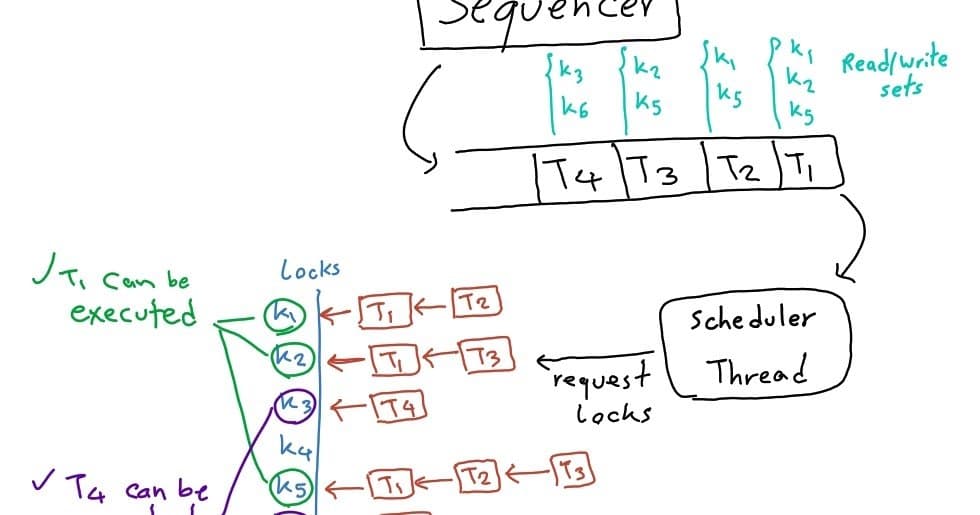
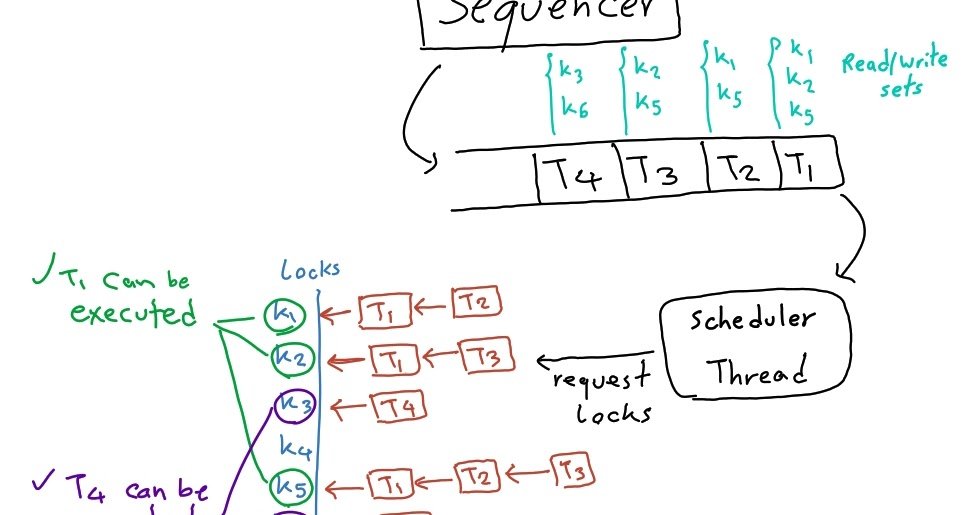
Once transactions have been ordered by the sequencing layer, they're passed to the scheduling layer, which implements Calvin's deterministic locking mechanism. Unlike traditional 2PL, which acquires locks dynamically during execution and risks deadlocks, deterministic locking acquires all necessary locks upfront based on the global order.
When a transaction arrives at the scheduler, it requests locks for all objects in its read and write sets. These locks are granted in the order specified by the global transaction sequence. Transactions that don't compete for common locks can execute in parallel, while those competing for the same lock are executed in their global order. This approach eliminates the possibility of deadlocks, as the global order ensures that no circular wait conditions can occur.
The deterministic locking mechanism represents a significant departure from traditional concurrency control. While 2PL must potentially abort transactions to resolve conflicts and prevent deadlocks, Calvin's deterministic approach never aborts transactions, instead ensuring they're executed in the correct order from the outset. This predictability comes at the cost of requiring knowledge of a transaction's full read and write sets before execution begins.
Storage Layer: Executing Deterministic Transactions
The storage layer is responsible for executing the transactions that have been scheduled. Calvin's execution model involves collaboration between executor threads across different shards to ensure that each transaction is executed consistently across the system.
When a transaction is ready to execute, each executor thread first analyzes the transaction's read and write sets to identify which shards are involved. Nodes that will write data are designated as "active nodes" for that transaction. The execution process follows these steps:
- Each executor reads local objects on its shard
- Active nodes share their locally read values with all other active nodes
- Each active node waits to receive all remote reads
- Once all reads are collected, the transaction is executed
This coordinated execution ensures that even transactions spanning multiple shards are executed consistently, maintaining the deterministic guarantees established by the sequencing and scheduling layers.
Implications of Calvin's Approach
Calvin's deterministic approach to distributed transactions offers several significant advantages over traditional approaches:
Reduced Contention Footprint: By eliminating the need for 2PC, Calvin significantly reduces the time transactions hold locks, as shards don't need to wait for coordination before releasing them. This leads to better performance under contention.
Elimination of Deadlocks: The deterministic locking approach ensures that deadlocks cannot occur, simplifying system behavior and reducing the need for complex deadlock detection and resolution mechanisms.
Predictable Performance: With a predetermined global order, Calvin offers more predictable performance characteristics compared to systems that may experience variable delays due to lock conflicts and aborts.
Simplified Failure Handling: By appending transactions to a replicated log upfront, Calvin ensures durability and provides a clear order for recovery in case of failures.
These advantages make Calvin particularly attractive for certain workloads where determinism and predictability are valued over maximum raw throughput.
Challenges and Limitations
Despite its innovative approach, Calvin faces several significant challenges and limitations:
Dependency Management
Calvin requires knowing a transaction's complete read and write sets before execution begins, which poses challenges for transactions that need to first read data to determine what they will write. These "dependent transactions" require a two-phase approach:
- A reconnaissance query phase that performs necessary reads with low isolation guarantees
- An execution phase that may restart if the reconnaissance phase's data has changed
This approach can lead to transaction starvation in scenarios where dependencies change frequently, potentially creating performance bottlenecks.
Disk Access Bottlenecks
Calvin's locking mechanism can create significant challenges when dealing with slow disk access. Unlike 2PL, which can interleave transactions to optimize disk access patterns, Calvin locks all keys touched by a transaction upfront. This means that a transaction requiring many disk accesses will block other transactions that need only to access already-loaded data.
Calvin attempts to address this through a mechanism where sequencers delay transactions expected to require significant disk access, attempting to preload data into memory. However, accurately estimating these delays is challenging, and both underestimation (leading to blocking) and overestimation (increasing latency) create performance trade-offs.
Stored Procedure Requirement
Calvin's deterministic approach requires that transactions be implemented as stored procedures rather than interactive transactions. This limitation means that application logic cannot be executed on the client side, potentially increasing network traffic and reducing flexibility in application design.
Comparison with Alternative Approaches
When viewed alongside contemporary approaches like Google's Spanner, Calvin represents a fundamentally different philosophy. Spanner uses 2PC with synchronized clocks to achieve external consistency, while Calvin achieves determinism through explicit ordering. These approaches reflect different priorities: Spanner prioritizes maximum flexibility and compatibility with existing applications, while Calvin prioritizes determinism and predictability.
The choice between these approaches depends on specific use case requirements. For applications where transaction order is business-critical and predictability is paramount, Calvin's deterministic approach offers compelling advantages. For applications requiring maximum flexibility and the ability to execute complex application logic across shards, Spanner's approach may be more suitable.
Conclusion: The Trade-offs of Determinism
Calvin represents a fascinating exploration of the trade-offs inherent in distributed transaction processing. By embracing determinism as a first-class principle, it eliminates several challenges associated with traditional approaches while introducing new constraints and considerations.
The protocol's greatest strength lies in its ability to provide predictable, ordered execution of distributed transactions without the complexity of 2PC. This makes it particularly well-suited for certain workloads where determinism is more valuable than maximum raw throughput. However, its requirements for stored procedures, challenges with dependent transactions, and potential disk access bottlenecks limit its applicability to certain scenarios.
As distributed systems continue to evolve, Calvin's approach serves as an important reminder that there is no one-size-fits-all solution to distributed transaction processing. The most appropriate approach depends on the specific requirements and constraints of the application, with trade-offs between determinism, flexibility, performance, and complexity.
For those interested in exploring Calvin further, the original paper "Calvin: Fast Distributed Transactions for Partitioned Database Systems" provides detailed technical insights into the implementation and evaluation of the protocol. The research continues to influence the design of modern distributed systems, particularly in domains where transaction order and determinism are critical requirements.
Comments
Please log in or register to join the discussion