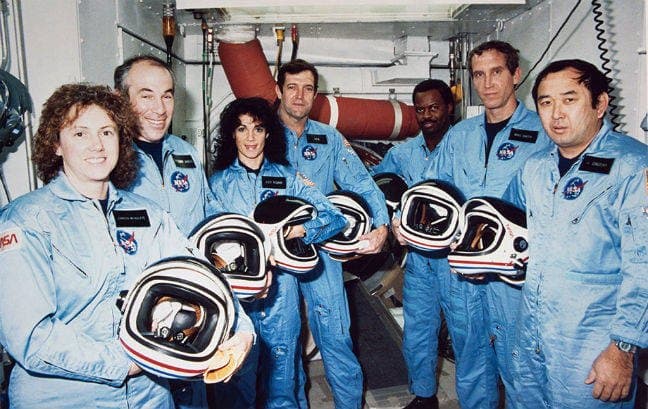
Forty years after the Space Shuttle Challenger disaster, the technical failures and flawed decision-making that led to the tragedy remain a stark reminder of the importance of safety culture in space exploration.
Forty years ago, Space Shuttle Challenger disintegrated 73 seconds into its flight, killing its crew of seven and exposing the management culture and decision-making process that led NASA to launch on a freezing January day.
Four decades on, the technical facts that led to the destruction of Challenger are clear. Erosion had been noted in the rubber O-rings that sealed the segments of the twin solid rocket boosters (SRBs) mounted to either side of the Shuttle stack's external fuel tank. The temperature at launch was 36°F (15° colder than any previous launch). Just after liftoff, the primary and secondary O-rings at the base of the right-hand SRB failed.
The Rogers Commission report, an official investigation into the Space Shuttle Challenger disaster, noted: "At 0.678 seconds into the flight, photographic data show a strong puff of gray smoke was spurting from the vicinity of the aft field joint on the right Solid Rocket Booster."
More puffs were visible as the Shuttle accelerated. "The vaporized material streaming from the joint indicated there was not complete sealing action within the joint."
During the flight, the Shuttle experienced several high-altitude wind shear events, all within design limits, but which caused the SRB steering system to be "more active than on any previous flight."
At 58.788 second, a flickering flame was noted on the right SRB, at or near the aft field joint. That plume increased, and from approximately 62 seconds, the control system began to correct for the forces caused by the plume. This carried on for another nine seconds.
At 64.66 seconds, the first visual indication that the flame had breached the External Tank was noted. At approximately 72 seconds, a series of events happened in rapid succession. The lower strut linking the right SRB to the tank was severed, permitting it to rotate around the upper strut. A structural failure of the hydrogen tank occurred, releasing large amounts of liquid hydrogen and enveloping the Space Shuttle in a massive explosion.
The Shuttle was traveling at Mach 1.92 at an altitude of 46,000 feet. Its reaction control system ruptured, and the reddish-brown colors of the burning hypergolic fuel were visible on the edge of the main fireball. The Orbiter broke apart under severe aerodynamic loads, with several sections visible, including the forward fuselage and a mass of umbilical lines ripped from the payload bay.
The crew consisted of Dick Scobee, Michael J. Smith, Ronald McNair, Ellison Onizuka, Judith Resnik, Gregory Jarvis, and Christa McAuliffe. It was third time lucky for Jarvis after having to make way for US Senator Jake Garn in April 1985 and US Representative Bill Nelson in January 1986. Nelson's flight, STS-61-C, was the mission chronologically before.
In his book Riding Rockets, former astronaut Mike Mullane speculated on the fate of the crew. The cockpit had survived more or less intact, but all electrical power was lost at the moment of breakup. "The mayhem of breakup lasted only a moment before the equally startling calm of free fall began."
The Personal Egress Air Packs (PEAPs) for the pilot, Mike Smith, were activated, probably by Judy Resnik or Ellison Onizuka. "Scobee and Smith were test pilots and reacted as they had been trained," wrote Mullane. "They had faced countless serious emergencies in their flying careers. They knew the situation was perilous, but they were in a cockpit with a control stick, and there was a runway only twenty miles away. They believed they had a chance."
The cockpit, however, was electrically dead. No amount of button mashing or switch flicking could restore control to the blossoming cloud of debris that Challenger had become. The crew members on the upper deck had window views of the disaster as the cockpit tumbled over its arc. The three on the mid-deck – Ronald McNair, Christa McAuliffe, and Gregory Jarvis – were in a darkened, tumbling room, with no communication to inform them of events.
Investigators were not able to conclusively state that the crew was unconscious by the time the cockpit hit the ocean surface. At 207 mph and with a deceleration force of more than 200 g, it wasn't survivable. Unlike Mullane, former Apollo astronaut and chief of the Astronaut Office John Young reckoned that even with the activation of the PEAPs, the crew had only a few seconds of useful consciousness. Enough time to flick some switches, but not much more. He noted in his book Forever Young that the "PEAPs supplied only unpressurized air that was not all that helpful at the altitude of the breakup."
The managerial and cultural factors behind the disaster are equally well documented. The Rogers Commission stated: "The decision to launch the Challenger was flawed. Those who made that decision were unaware of the recent history of problems concerning the O-rings and the joint and were unaware of the initial written recommendation of the contractor advising against the launch at temperatures below 53 degrees Fahrenheit and the continuing opposition of the engineers at Thiokol after the management reversed its position.
"They did not have a clear understanding of Rockwell's concern that it was not safe to launch because of ice on the pad. If the decision-makers had known all of the facts, it is highly unlikely that they would have decided to launch 51-L on January 28, 1986."
As John Young put it later, after summarizing the concerns of the Thiokol engineers, worries about the erosion noted on the O-rings, and the decision-making process that led to the launch: "We astronauts would have thought differently."
The Challenger disaster reverberated through NASA in the years after, though not always loudly enough to prevent the loss of Space Shuttle Columbia. In the chapter "Echoes of Challenger" in their book Comm Check…, Michael Cabbage and William Harwood presented parallels between the last flights of Challenger and Columbia, as presented to the Columbia Accident Investigation Board [PDF].
Has NASA learned from the tragedies? It appears so, judging by the recent Starliner debacle, where caution and safety appeared to win the day in the decision to return the Boeing astronauts in a SpaceX capsule rather than risk a trip in Boeing's CST-100. However, there is also an argument that the astronauts should never have launched in the first place, considering the faults that were stacking up on the ground.
Today's anniversary is an important reminder for engineers to speak out when something doesn't look right, and for managers to listen.
Further reading There are many sources of information regarding the Challenger disaster. This article drew on Mike Mullane's Riding Rockets and John Young's Forever Young. The Rogers Commission report is also an invaluable source, as are Charles Perrow's Normal Accidents and David Harland and Ralph Lorenz's Space System Failures.
Comments
Please log in or register to join the discussion