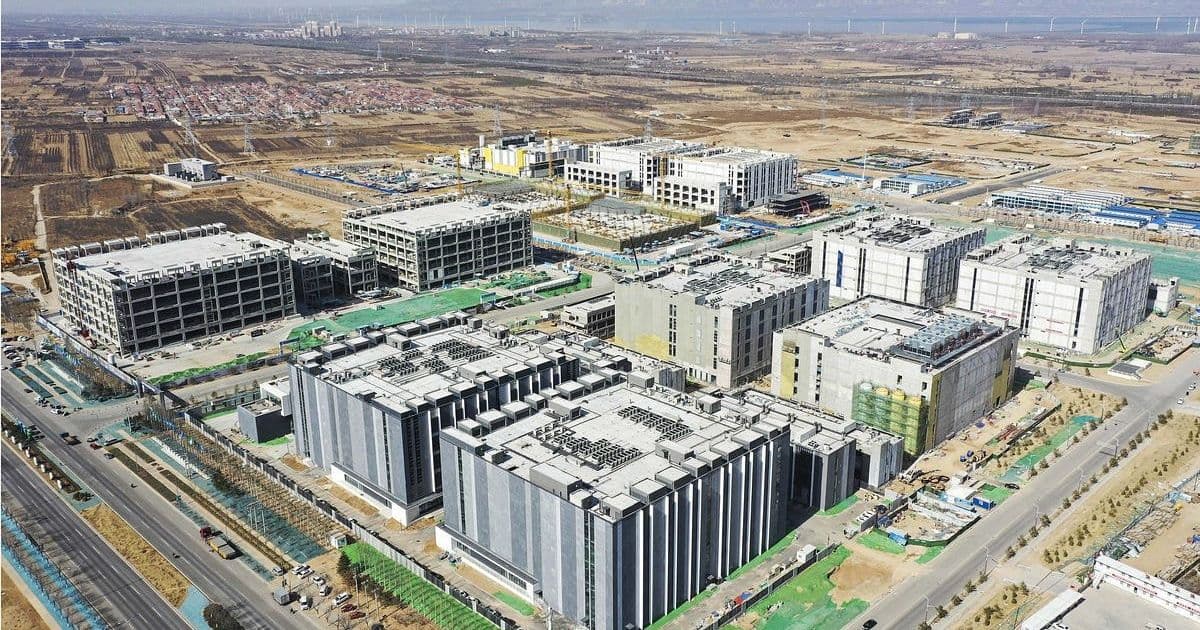
An MIT urban planning researcher explores China's data center expansion through Zhangjiakou, revealing the complex interplay of renewable energy promises, local debt, and the reality of coal-powered AI infrastructure.
China's data center boom is transforming the landscape around Beijing, and nowhere is this more visible than in Zhangjiakou, a city that's become ground zero for the country's ambitious Eastern Data Western Compute initiative.
After a quick 40-minute high-speed rail trip from Beijing North Station, I step off the platform in the sleepy station of Donghuayuan Bei in Hebei's Zhangjiakou. From the elevated platform I get a glimpse of the wind turbines dotting Guanting Reservoir 官会水库. On the other side of the platform I look out across a semi-rural landscape, dotted with apartment blocks and in the distance the hulking warehouses housing new servers to power China's computing needs.
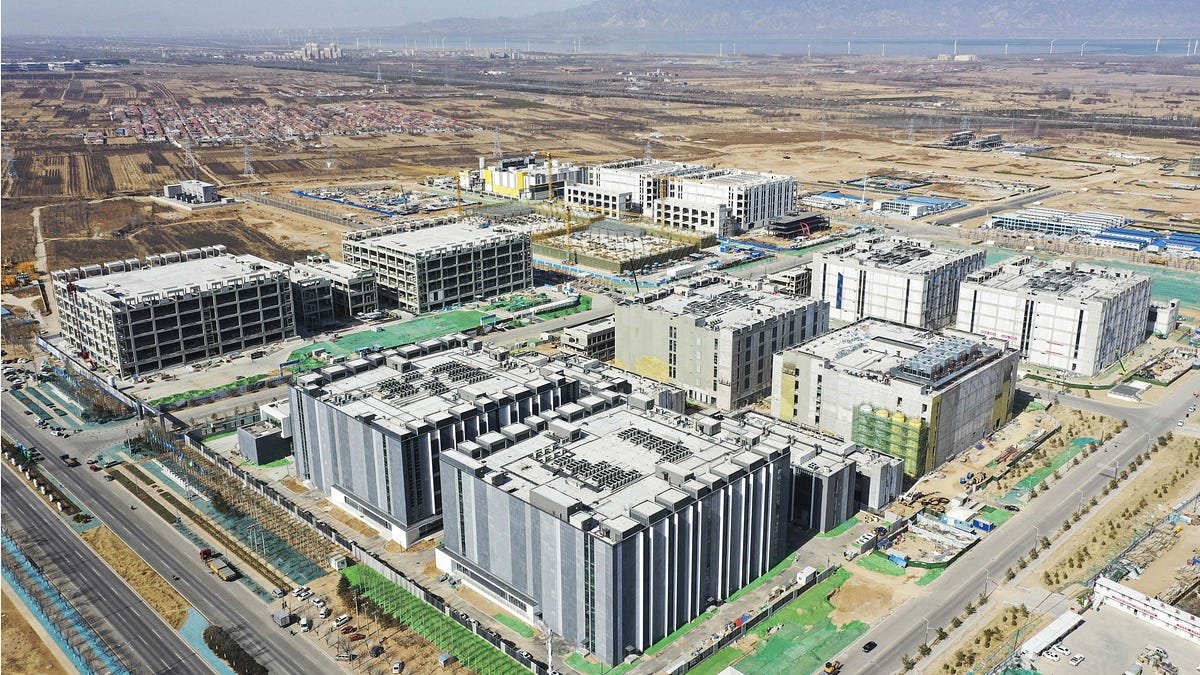
This is one of the eight data center clusters of China's Eastern Data Western Compute (dongshu xisuan 东数西算) project. Zhangjiakou's strategic location adjacent to Beijing offers lower latency for cloud and AI usage than more remote clusters, while its solar and wind energy potential make it attractive for sustainable computing.
But the reality is more complex than the green energy promises suggest.
The Energy Paradox
According to recent reports, Zhangjiakou's data centers used 1.859 billion kWh in 2024, up 43.47% year-over-year. While "green electricity" accounted for 574 million kWh (about 30%), the majority still comes from coal and gas-fired power plants that provide the reliable energy source required by data centers.
Even in Zhangjiakou, a hub for wind and solar energy, the data center draws only part of its supply from renewables. Much of it comes from a coal-burning steam-powered turbine facility in the county of Xuanhua, operated by central SOE Datang Group.
Local Government Debt and the Olympic Legacy
Zhangjiakou remains heavily indebted due to years of excess infrastructure buildout, both leading up to and following the 2022 Winter Olympics. New housing flats constructed a few years ago are mostly empty, some purchased by Beijing residents looking for a cheap place to retire or visit in the summers.
A researcher who met with local officials revealed that the city is essentially selling quotas for wind power to generate revenue to pay down its debt. "The city is essentially mortgaging its future," he told me. "The city has to use the revenue to pay down its existing debt, and doesn't get much benefit from the data centers directly."
The Speculative Boom
The EDWC project was conceived to coordinate the growing energy needs of data centers with renewable energy buildout. However, the process of data center and energy permitting has turned into a new arena of political contestation. Some data center operators bribe their way to obtain permits for building from local governments, fueling a speculative boom that may outstrip the capacity of renewable energy in the areas where they are built.
Real estate companies and other conglomerates have tried to grab a piece of the data center building frenzy, leading to creation of companies that have little experience in data center buildout. The result is a familiar story of overbuilding and overcapacity.
Water Concerns in an Arid Region
Water is also required to cool data centers. The Zhangjiakou data cluster is in an arid region, although the Huailai cluster is close to the Guanting Reservoir. But according to conversations with villagers in the area, water used to cool data centers has to be sourced from groundwater, not the reservoir. This means the cooling demands of data centers could exacerbate groundwater depletion, which is already a significant issue in North China.
Beyond the State-Owned Giants
While much of the investment in the EDWC computing hubs has been from the three major state-owned telecoms (China Telecom, China Mobile, and China Unicom), there are two other main categories of data center operators building data centers: leading cloud companies (Ali Cloud, Tencent, and Baidu), and third-party data center operators that lease their space to smaller companies.
Companies like Chindata, 21 Vianet, and GDS are now expanding abroad and have to carefully balance maintaining their China businesses and good relations with the government while expanding internationally. For example, Chindata, whose largest shareholder is Bain Capital, restructured itself with a holding company based in the Cayman Islands that owns some of its overseas investments.
The Xinjiang Question
While remote regions like Xinjiang have attracted media attention for their desert data centers, in reality China's data center boom is mostly still happening in areas closer to major cities. Getting trained engineers and reliable infrastructure to operate data centers in Inner Mongolia and Gansu is hard enough, let alone in remote Xinjiang.
Economic Impact: Less Than Promised
Data centers are promoted as drivers of digital industry and remedies for the "digital divide" in the underdeveloped and poorer areas in which they are being built. However, the construction of data centers offers few of the benefits of productive industries such as factories. There are few jobs, and because data centers don't directly produce anything, they don't offer much in the way of stable tax revenues for local governments.
A local tells me these projects mostly pre-dated the data centers and provide energy to Beijing. "There hasn't been much economic impact from the data centers. They employ some local people, but mostly in lower jobs—technician or security guards. Most of the engineers are college graduates from elsewhere, or Beijing."
The Future of China's Data Center Expansion
In July of this year, Xi gave a speech where he cautioned against cities rushing to build data centers. There is official recognition that the data center buildout may have gotten ahead of itself. The EDWC plan was premised on the securing of renewable energy supply, but in practice, many of the data center hubs' energy needs exceed that offered by renewable power.
Zhangjiakou's data center cluster is already one of the more developed among the eight—and because of its proximity to Beijing and favorable energy potential, offers an ideal mix of conditions for data centers. But even in Zhangjiakou, data centers have, like elsewhere, failed to deliver significant economic growth.
The dynamics of energy policy and corporate investment in Zhangjiakou are themes that can be seen in China's broader data center buildout, which has already led many observers and even Xi himself to caution against the rush towards data centers by local governments. But for now, there seems to be no sign of a slowdown.
Comments
Please log in or register to join the discussion