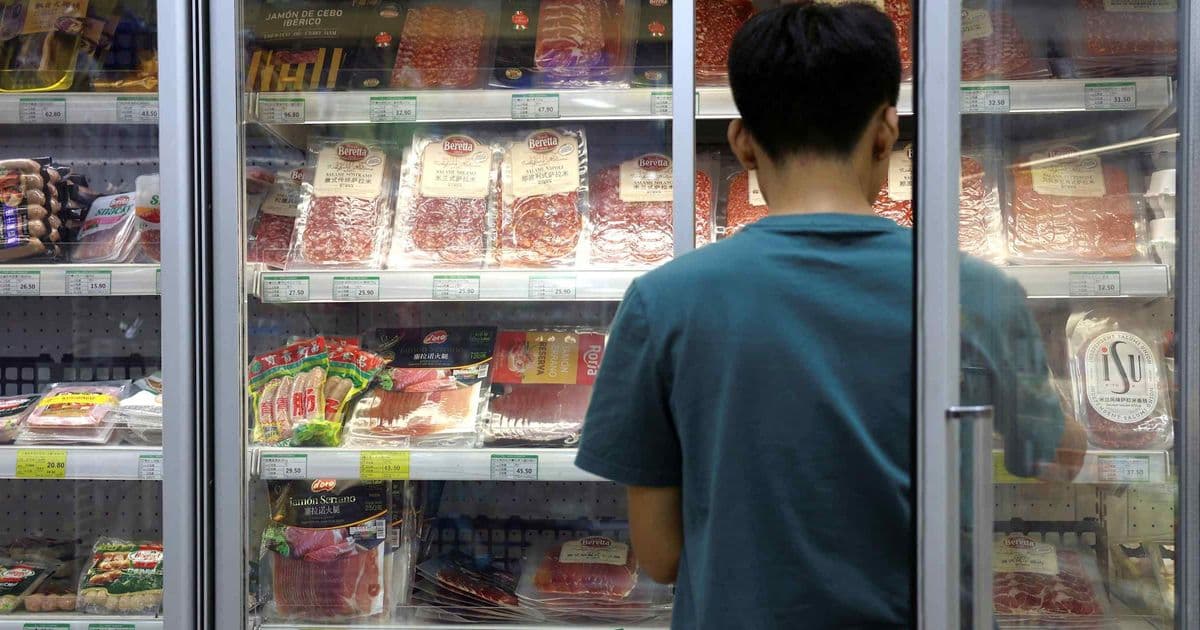
China's retail sales growth plummeted to just 0.2% year-on-year in April 2026, significantly missing analyst forecasts and highlighting the ongoing struggle to revive consumer demand in the world's second-largest economy.
China's retail sales growth slowed to a mere 0.2% on the year in April 2026, falling substantially below market expectations and signaling that policymakers continue to face challenges in reviving sluggish consumer confidence in the world's second-largest economy.
The disappointing retail figures come amid broader economic headwinds for China, which has been working to stimulate domestic demand amid a complex mix of structural challenges, demographic shifts, and geopolitical tensions. The April performance represents a significant deceleration from previous months and underscores the depth of the consumption crisis facing Chinese authorities.
"The retail sales data reveals a worrying trend of consumer retrenchment," said Zhang Wei, chief economist at the Beijing-based China Merchants Bank. "Households are prioritizing savings over discretionary spending, reflecting concerns about job security, property values, and future economic prospects."
The retail sector, which accounts for approximately 38% of China's GDP, has shown persistent weakness despite multiple stimulus measures implemented by the government. These include tax cuts, consumer subsidies, and infrastructure spending initiatives aimed at boosting domestic demand.
"The government's stimulus efforts have had limited impact on consumer behavior," noted Li Jie, retail analyst at Shanghai Securities. "Unlike previous economic cycles, Chinese consumers today are more cautious, with younger cohorts in particular prioritizing financial security and reducing debt levels."
The retail sales figures add context to the recent Trump-Xi summit, where the United States touted purchase pledges from China. While these commitments may provide some short-term support for specific sectors, economists suggest they do little to address the underlying structural issues dampening consumer sentiment.
"The purchase pledges represent more of a symbolic gesture than a fundamental shift in economic fundamentals," commented Michael Pettis, finance professor at Peking University. "Without addressing the core issues of household income growth, wealth distribution, and social safety nets, China's consumption recovery will remain fragile."
Sector-specific data reveals uneven performance within the retail landscape. While online retail sales maintained relatively stronger growth at 4.1%, traditional brick-and-mortar stores saw contraction of 1.3%, highlighting the ongoing digital transformation of Chinese retail and the challenges facing physical retailers.
The automotive sector, traditionally a key driver of retail sales, showed particular weakness, with vehicle sales declining 3.2% year-on-year. This reflects both reduced consumer confidence and the ongoing transition to electric vehicles, which has disrupted traditional automotive sales patterns.
"The automotive industry's struggles are emblematic of broader structural changes in the Chinese economy," said Wang Ming, auto industry analyst at CITIC Securities. "Consumers are postponing big-ticket purchases while waiting for clearer signals about economic policy and technological developments."
Geopolitical factors also continue to influence consumer behavior, with trade tensions and supply chain disruptions creating uncertainty that affects spending decisions. The ongoing US-China trade relationship, while showing signs of stabilization following the recent summit, remains a source of volatility for businesses and consumers alike.
Looking ahead, economists expect the consumption recovery to remain gradual, with retail sales likely to improve modestly in the coming months as seasonal factors and targeted stimulus measures take effect. However, a sustained recovery will require more comprehensive reforms to address household income growth, wealth inequality, and social safety nets.
"China's consumption story is at a critical juncture," concluded Zhang Wei. "The path to a more balanced, consumption-driven economy will require not just short-term stimulus, but fundamental reforms to how income is generated and distributed in the Chinese economy."
For more detailed economic data, China's National Bureau of Statistics provides monthly retail sales reports at stats.gov.cn. Analysis of the US-China economic relationship can be found in the US-China Business Council's quarterly reports.
Comments
Please log in or register to join the discussion