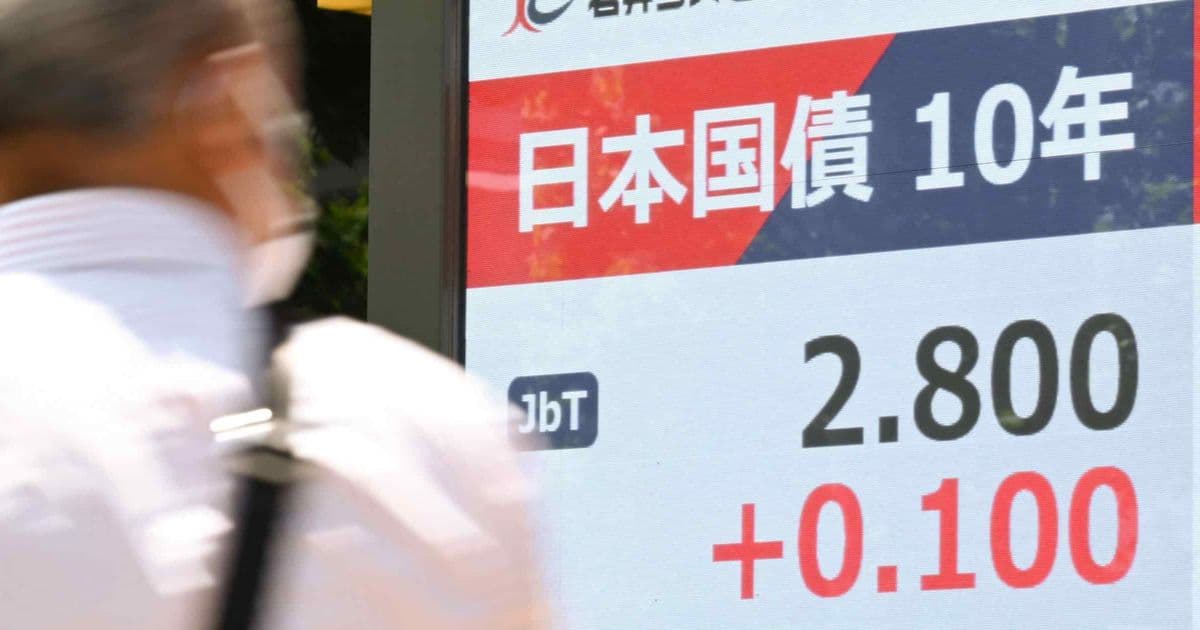
Japanese government bond yields hit multi-decade highs as inflation and fiscal concerns drive investor selling, with the 10-year JGB reaching 2.8% and upward pressure spreading to longer maturities.
Japanese government bond yields reached their highest levels in nearly three decades on Monday, with the benchmark 10-year JGB climbing 10 basis points to 2.8%. This marks the first time since October 1996 that Japan's long-term borrowing costs have reached such elevated levels, signaling a significant shift in the nation's decades-long low-interest rate environment.
The surge in yields reflects growing investor concerns about Japan's fiscal position and inflation trajectory. As one of the world's most indebted nations with a debt-to-GDP ratio exceeding 260%, Japan faces mounting pressure as its central bank gradually unwinds its ultra-loose monetary policy. The yield increase has not been confined to the 10-year segment; upward pressure has spread to longer-dated maturities, with 30-year and 40-year Japanese government bonds also experiencing significant yield increases.
"The market is pricing in a new reality for Japan," said Hiroshi Yoshikawa, professor of economics at the University of Tokyo. "After years of yield curve control and negative interest rates, investors are now demanding higher compensation to hold Japanese government debt amid persistent inflation concerns and the government's massive fiscal needs."
The Bank of Japan's ongoing policy normalization appears to be accelerating this shift. Having maintained its yield curve control policy with a target around 0% for the 10-year JGB for years, the central bank has been gradually adjusting its stance. The latest yield surge suggests that the BOJ may need to reconsider its approach as market forces increasingly challenge its policy framework.
Japan's insurance companies, traditionally major holders of government bonds, are showing increased caution. According to industry reports, insurers are reducing their JGB allocations and seeking alternative investments to hedge against rising interest rates. This institutional selling further exacerbates upward pressure on yields.
The implications extend beyond Japan's borders. As the world's third-largest economy, Japan's shifting monetary policy affects global capital flows and interest rate expectations. Higher Japanese yields could attract international investors seeking better returns in a relatively safe asset class, potentially impacting other bond markets.
For the Japanese government, rising borrowing costs present immediate challenges. With approximately 30% of government debt held domestically by the Bank of Japan, any significant increase in yields would automatically raise the cost of servicing the national debt. This creates a fiscal feedback loop where higher yields necessitate larger budget allocations for debt service, potentially crowding out other expenditures.
The market reaction also reflects broader concerns about Japan's inflation outlook. While the nation has struggled with deflation for much of the past three decades, recent data shows persistent inflationary pressures. The gap between Japanese inflation and other developed economies has narrowed, reducing the relative attractiveness of Japanese bonds in a global portfolio context.
Looking ahead, analysts expect the Bank of Japan to face difficult decisions regarding its monetary policy framework. With market yields consistently testing the upper limits of the central bank's tolerance, the BOJ may need to either adjust its yield targets or implement additional measures to contain borrowing costs. The government's fiscal strategy will also come under scrutiny as higher yields increase pressure on Japan's already strained public finances.
"Japan is at a critical juncture in its monetary and fiscal policy path," said Emi Nakamura, professor of economics at Columbia University. "The combination of high government debt, inflationary pressures, and the need to normalize monetary policy creates a complex policy challenge that will require careful calibration to avoid destabilizing the financial system."
The yield surge comes amid broader market volatility, with Japanese stocks also experiencing declines. This simultaneous movement of lower stock prices and higher bond yields suggests a reevaluation of risk assets in Japan's financial markets, potentially reflecting concerns about the sustainability of Japan's economic model in the current global environment.
Comments
Please log in or register to join the discussion