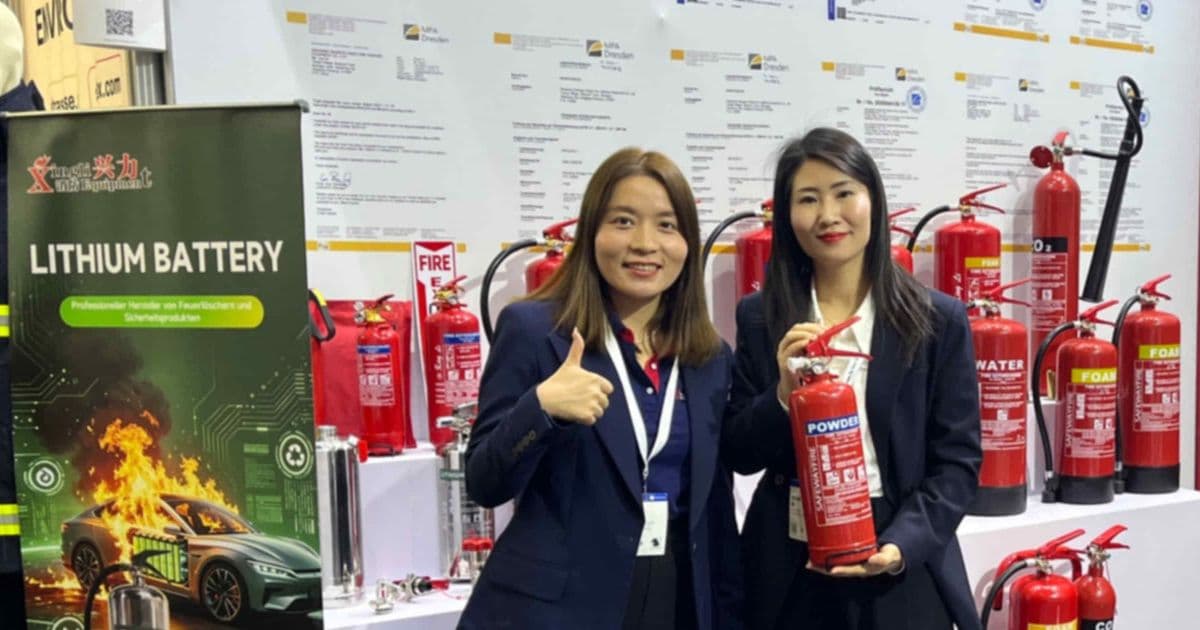
Nearly 300 Chinese manufacturers showed up at Hanover's civil protection fair, the largest non-EU contingent on the floor. The ambition is clear, but European safety certification stands between them and a market worth billions.
Nearly 300 Chinese manufacturers of firefighting and civil protection equipment exhibited at a trade show in Hanover, Germany last week, the largest single contingent from outside the European Union. The scale of the presence signals a coordinated attempt to convert China's dominance in low-cost safety hardware into share of one of the world's most regulated and lucrative end markets.
Shaoxing-based Xingli Safe Way Fire was among the firms working the floor, pitching a line of extinguishers that includes a unit designed specifically for fires triggered by lithium-ion batteries. That product choice is not incidental. Battery fires are one of the fastest-growing categories of fire risk in Europe, driven by the spread of electric vehicles, home energy storage, and e-bikes, and they require suppression chemistry that standard ABC powder extinguishers do not reliably deliver. By leading with a niche where demand is rising and incumbent supply is thin, Chinese vendors are trying to enter through a gap rather than fight established European brands head-on.
The market the numbers point to
Europe's fire protection equipment market is large and steady, estimated in the range of several billion dollars annually and growing in the low-to-mid single digits as building codes tighten and retrofit cycles continue. Unlike consumer electronics, demand here is anchored by regulation: commercial buildings, vehicles, and public infrastructure are legally required to carry certified suppression equipment, and that equipment must be inspected and replaced on schedule. That creates a recurring revenue base rather than one-off sales, which is precisely what makes the segment attractive to manufacturers that already produce at volume.
China's advantage is the same one it has carried into solar panels, batteries, and EVs: scale and cost. Domestic producers can manufacture extinguisher bodies, valves, and suppression agents at prices European factories struggle to match. In commoditized hardware, that cost gap is usually decisive.
Certification is the real barrier
The obstacle is not price or distribution. It is conformity. To sell firefighting equipment in the EU, products must carry CE marking and meet harmonized standards such as EN 3 for portable extinguishers, frequently backed by third-party approvals like those issued under Germany's certification regime. The testing is expensive, slow, and unforgiving, and it has to be repeated for each product variant. For a Chinese manufacturer with a broad catalog optimized for the domestic market, re-engineering and re-certifying each SKU for European norms can erase much of the cost advantage that made the expansion attractive in the first place.
This is why a packed exhibition hall does not automatically translate into market share. A vendor can demonstrate a product in Hanover without yet holding the paperwork to sell it commercially across the bloc. The pattern echoes what other Chinese consumer-goods categories have run into in Germany, where vape makers built strong sales before colliding with regulatory enforcement. The lesson for fire equipment is that distribution follows certification, not the trade-show handshake.
What it means
For European incumbents, the strategic risk is medium-term rather than immediate. The certification moat buys time, but it is not permanent. Chinese firms have repeatedly shown the willingness to absorb compliance costs and the patience to grind through approval processes when the prize is a recurring, regulation-protected market. The lithium-battery extinguisher angle is the tell: it is a category where European supply is still forming, certification standards are still maturing, and an early entrant with certified product could establish itself before the market consolidates.
The broader read is that China's export playbook is moving up the regulatory difficulty curve. Solar and batteries were about cost. Safety equipment is about cost plus the ability to clear compliance gates that were designed, in part, to keep low-cost entrants out. The firms that crack certification at scale will not just win extinguisher sales, they will validate a template for pushing into Europe's other regulated industrial niches. For now, the gap between presence and permission keeps the threat contained, and how quickly Chinese manufacturers close that gap is the number worth watching.
Comments
Please log in or register to join the discussion