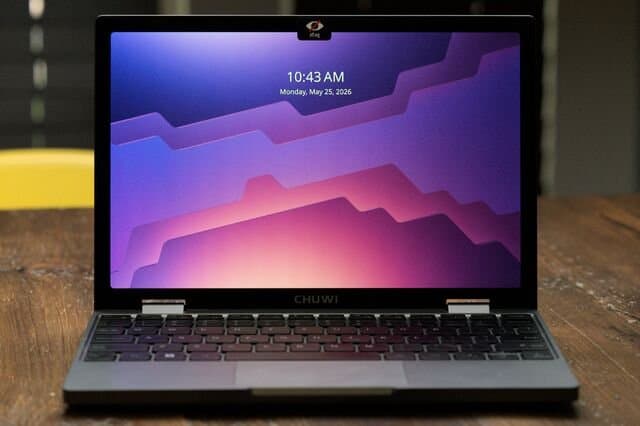
The Chuwi Minibook X revives the netbook ethos with affordable x86 hardware that serves as a playground for Linux experimentation, challenging premium laptop ecosystems.
In a market dominated by premium-priced laptops, the Chuwi Minibook X emerges as a compelling alternative for developers and tinkerers seeking affordable hardware without sacrificing functionality. Priced at just $350, this 10.5-inch sub-ultrabook delivers surprising capabilities in a compact form factor, representing a return to the netbook philosophy of accessible, portable computing.
Chuwi, a Chinese manufacturer known for budget-friendly devices, has created a machine that punches above its weight class. The Minibook X features a 4-core Intel N150 processor, 16GB of soldered LPDDR5-6400 RAM, and a 512GB NVMe storage—all in a package weighing just 911 grams. This combination makes it uniquely positioned for developers who need a portable machine for experimentation without the premium price tag of Apple or Dell alternatives.
The device's true value lies in its role as a playground for software experimentation. As the author notes, "The Chuwi Minibook X is an old building. I can brick the Minibook and have a normal Monday on my serious work laptop." This freedom to experiment without financial consequence enables exploration of alternative operating systems and workflows that would be risky on primary machines.
Linux compatibility on the Minibook X is impressive, with most hardware components working out of the box. Camera, microphone, speakers, touchscreen, USB-C, HDMI, Bluetooth, and Wi-Fi 6 all function properly, though the latter two require non-free Intel blobs. The device's 2K IPS display in a 16:10 aspect ratio offers excellent resolution for its size, though limited to a 50Hz refresh rate.
One notable challenge was the screen orientation issue, requiring fixes at multiple software layers. The author describes a journey through bootloader configuration, initrd modifications, desktop environment settings, and framebuffer adjustments to correct the 270-degree clockwise rotation. This level of technical engagement exemplifies the kind of deep system interaction that makes devices like the Minibook X valuable to the developer community.
Performance-wise, the Minibook X delivers adequate power for everyday tasks. Geekbench 6 scores of 1295 (single-core) and 3332 (multi-core) place it firmly in the budget category, but sufficient for coding, web browsing, and media consumption. Battery life proved better than expected, with approximately 6 hours when playing video, and thermal management kept the chassis below 90°F (32°C) even under stress testing.
The compromises are evident in the keyboard, touchpad, and audio quality, but these must be viewed in context. "Everything I listed here works fine," the author notes. "I'm honestly blown away when I tune my expectations to the sub-$400 laptop range."
What makes the Minibook X particularly interesting is its role in enabling experimentation with alternative software ecosystems. The author used it to explore NixOS, RiverWM, KDE Plasma, and Steam—experiences that might feel too risky on primary work machines. This aligns with Jane Jacobs' observation that "new ideas require old buildings": cheap spaces allow for experimentation without significant consequences.
For developers, the Minibook X represents more than just a budget laptop—it's a tool for creative exploration and technical growth. Its affordability removes barriers to experimentation, allowing users to explore different operating systems, window managers, and development environments without financial risk.
As the tech industry continues to consolidate around premium-priced ecosystems, devices like the Chuwi Minibook X offer an important counterbalance. They remind us that computing doesn't have to be expensive to be valuable, and that sometimes the most innovative work happens on humble hardware.
The Minibook X is available directly from Chuwi's official website, with community support available through various Linux forums and the original review that detailed its Linux compatibility journey. For those interested in exploring alternative workflows without breaking the bank, this device represents an intriguing option in an increasingly homogeneous laptop market.
Comments
Please log in or register to join the discussion