CMake continues evolving beyond its traditional role with new Common Package Specification support, integrated linting, and SBOM generation as it competes with newer build systems like Meson.
CMake continues to evolve and modernize despite increasing competition from newer build systems like Meson. The cross-platform build tool, which has been a staple in C/C++ development for years, is pushing forward with significant improvements in package manager integration, dependency management, and developer tooling.
Common Package Specification: Bridging Build Systems and Package Managers
The most notable recent development is CMake's work on the Common Package Specification (CPS), a JSON-based format designed to improve interoperability between build systems and package managers. This initiative, led by Kitware developers, aims to create a standardized way of describing software dependencies and package metadata that can be understood across different tools and ecosystems.
CPS represents a significant step toward solving one of the persistent challenges in C/C++ development: the fragmentation of package management systems. By providing a common format for dependency descriptions, CMake is positioning itself as a bridge between various package managers and build systems, potentially simplifying the development workflow for projects that need to interact with multiple ecosystems.
CMake 4.3 Brings Experimental Features
The recent CMake 4.3 release introduced several important features, including experimental support for Software Bill of Materials (SBOM) generation. This addition reflects the growing importance of software supply chain security and compliance requirements in modern development practices. SBOM generation allows developers to automatically create comprehensive inventories of all components and dependencies in their projects, which is increasingly critical for security audits and regulatory compliance.
The import/export functionality using CPS in CMake 4.3 demonstrates the tool's commitment to becoming more than just a build system. This feature enables smoother integration with external package management tools and facilitates better dependency resolution across different development environments.
Integrated Linting and Developer Experience Improvements
Beyond package management, CMake developers are working on integrated linting support, which would bring static analysis capabilities directly into the build process. This integration would allow developers to catch potential issues earlier in the development cycle without needing to run separate linting tools.
The focus on developer experience extends to other areas as well. CMake's continued evolution shows a commitment to addressing modern development needs while maintaining compatibility with existing projects. This balance between innovation and stability has been key to CMake's longevity in a rapidly changing software development landscape.
Competition with Meson and Other Build Systems
While Meson has gained significant traction in recent years, particularly among open-source projects seeking faster build times and simpler configuration, CMake shows no signs of losing relevance. The tool's extensive ecosystem, widespread adoption, and continuous feature development have helped it maintain a strong position in the build system market.
Meson's rise has actually seemed to spur innovation in CMake, with the older tool adopting some of the features and approaches that made Meson attractive to developers. This competitive dynamic has benefited the C/C++ development community by driving improvements across both platforms.
Future Directions and Industry Impact
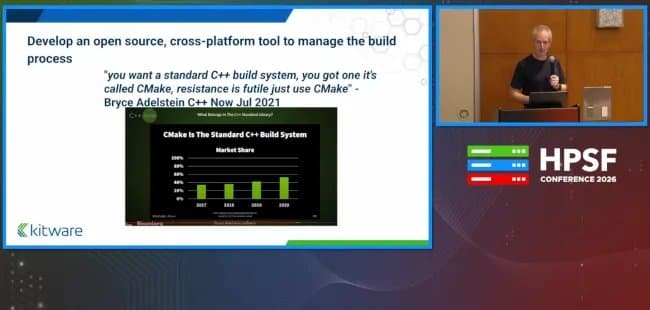
Kitware CTO Bill Hoffman presented on these initiatives at the High Performance Software Conference (HPSF 2026), highlighting the strategic direction CMake is taking. The focus on package manager integration, dependency management, and developer tooling suggests that CMake aims to remain central to the C/C++ development ecosystem rather than being displaced by newer alternatives.
The work on CPS and related features could have broader implications for the software development industry. If successful, these initiatives might help reduce the friction between different build systems and package managers, making it easier for developers to work across multiple projects and ecosystems.
Technical Implementation and Adoption Considerations
For developers considering these new features, the experimental nature of some implementations means careful evaluation is warranted before adoption in production environments. The SBOM generation capabilities, while promising, are still marked as experimental in CMake 4.3, suggesting that the implementation may evolve based on user feedback and real-world usage patterns.
The package manager integration features represent a more mature development, with the import/export functionality already available in the current release. However, the success of these features will ultimately depend on adoption by package managers and other build systems, creating a potential chicken-and-egg situation where widespread utility requires broad ecosystem support.
Conclusion
CMake's continued evolution demonstrates that established tools can remain relevant through thoughtful innovation and responsiveness to developer needs. The focus on package manager integration, dependency management, and developer experience improvements positions CMake to address many of the challenges facing modern C/C++ development.
While newer build systems like Meson continue to gain adoption, CMake's comprehensive approach to solving build system challenges, combined with its extensive existing user base, suggests it will remain a significant player in the C/C++ development ecosystem for years to come. The ongoing work on standards like CPS could even help bridge the gap between different build system communities, benefiting the entire software development industry.
For developers working with C/C++ projects, these developments in CMake represent important considerations for toolchain selection and project architecture decisions. The tool's evolution toward better package management integration and enhanced developer tooling makes it increasingly attractive for both new projects and existing codebases looking to modernize their build processes.
Comments
Please log in or register to join the discussion