A legendary Super Mario 64 speedrun glitch revealed an invisible threat haunting modern computing: cosmic ray bit flips. These rare but catastrophic memory errors—caused by particles from deep space—have altered election results and threaten systems at scale. As data volumes explode, understanding and mitigating these 'single-event upsets' becomes critical for resilient engineering.
Cosmic Rays and Code: When Bit Flips from Space Rewrite Reality
In 2013, a Super Mario 64 speedrunner named DOTA_Teabag executed a jump in the infamous Tick Tock Clock level—and Mario suddenly rocketed through the floor. This wasn't cheating; it was cosmic intervention. The glitch, later dissected by renowned hacker pannenkoek12, traced to a single bit flip at memory address 0xC5837800. The binary changed from 1100 0101 to 1100 0100—altering Mario's vertical position. The culprit? A high-energy particle from space striking the Nintendo 64's memory chip: a cosmic ray bit flip.
The Invisible Particle Storm
Cosmic ray bit flips—or Single-Event Upsets (SEUs)—occur when ionizing particles from deep space collide with transistors, flipping a 0 to 1 or vice versa. These soft errors leave no physical damage but wreak logical havoc. Mario’s accidental teleport wasn’t an isolated incident:
- In 2003, a Belgian election candidate received 4,096 extra votes—precisely the value of a flipped 13th bit position (
2^12) in voting machines. The error was caught only because votes exceeded eligible voters. - IBM researchers estimated a 256MB RAM system could suffer one cosmic bit flip per month in 1996. Modern 16GB systems face 62x higher risk due to denser memory.
- Vanderbilt University found routers with 25GB RAM could experience flips every 17 hours. At planetary scale, millions of cosmic rays bombard Earth per second.
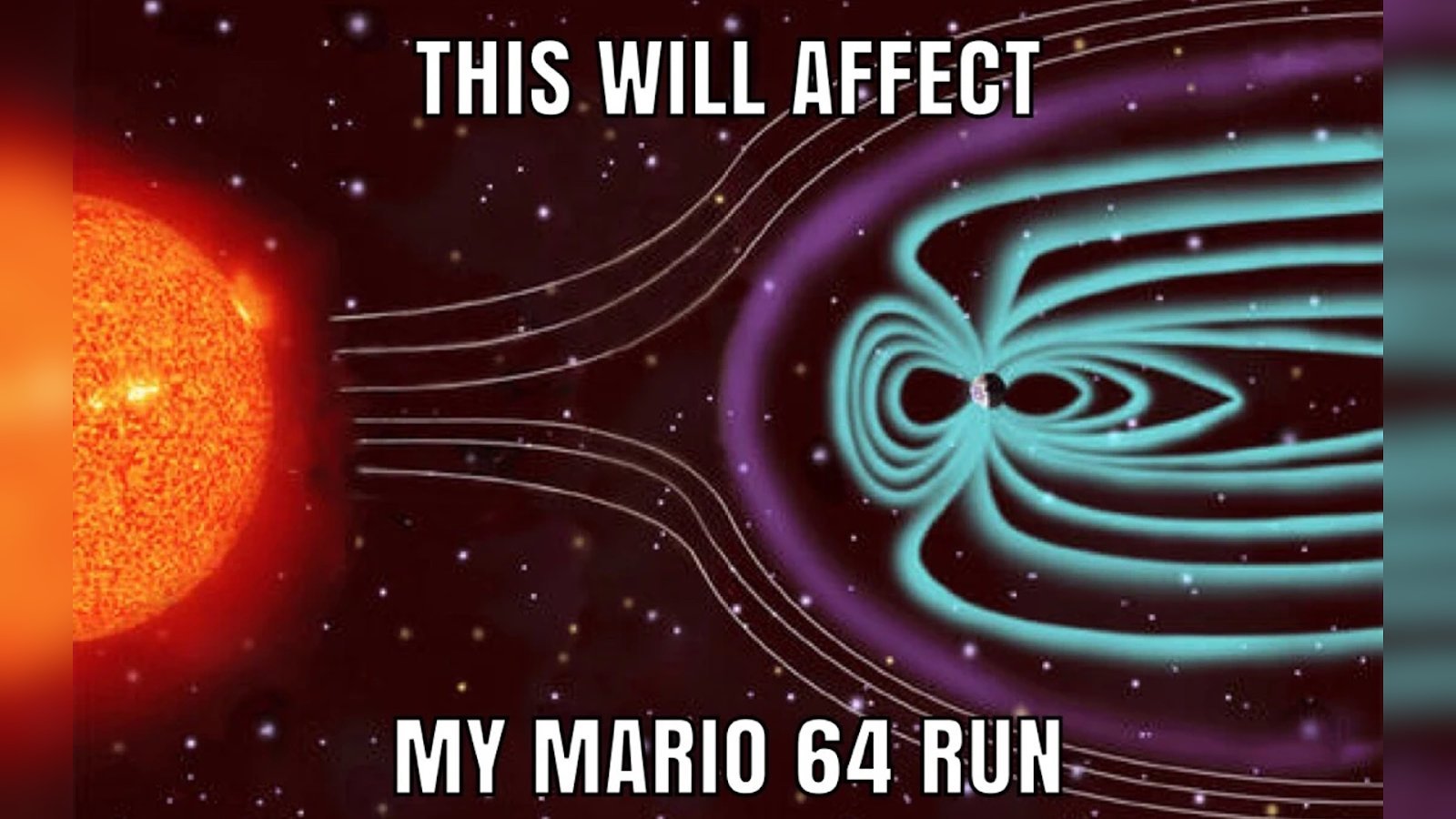 The exact memory bit flip that warped Mario upward (Source: pannenkoek12 analysis)
Why “Rare” Doesn’t Mean Safe
"A one-in-a-million event happens daily when you process a million operations."
As systems scale, statistical inevitability takes over. Client-side security firm cside scans 10 million scripts daily—making even one-in-100-million flips probable. Consumer hardware lacks protection, while enterprise-grade Error-Correcting Code (ECC) memory has blind spots:
- CPU registers, GPU memory, and network buffers remain vulnerable.
- Multi-bit flips can bypass ECC safeguards.
- Cloud infrastructure and edge devices amplify exposure.
Engineering Against Cosmic Chaos
Mission-critical systems already embrace cosmic hardening:
- NASA spacecraft run computations in triplicate, using majority voting to override flipped bits.
- ECC memory corrects single-bit errors in servers and routers (but isn’t foolproof).
- Layered resilience—like cside’s client-side security checks—assumes failures will occur, validating outputs rather than trusting hardware.
The Mario 64 glitch wasn’t just a curiosity; it was a microcosm of universal fragility. As data volumes explode—from AI clusters to IoT devices—designing for cosmic-scale uncertainty isn’t sci-fi. It’s engineering hygiene. Because in a universe raining invisible particles, the most secure system is one that expects bits to lie.
Source: Adapted from cside.dev’s analysis by Simon Wijckmans.
Comments
Please log in or register to join the discussion