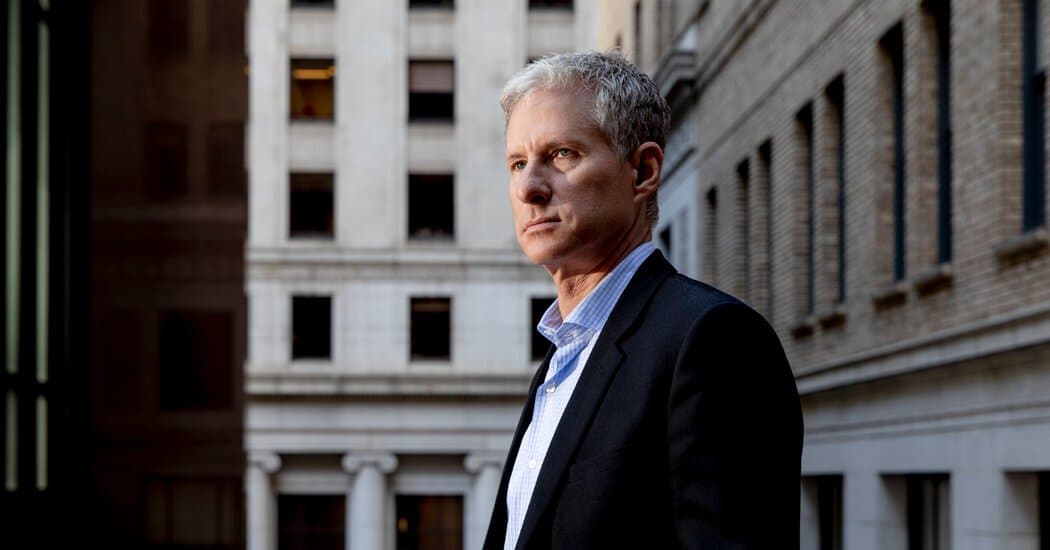
Chris Larsen, Ripple Labs executive and investor, is channeling $3.5 million into supporting New York congressional candidate Alex Bores, who finds himself at the center of a proxy war over artificial intelligence regulation policy, highlighting how tech fortunes are increasingly shaping legislative approaches to AI governance.
The intersection of cryptocurrency wealth and artificial intelligence regulation has taken a new turn with Chris Larsen, the executive chairman and co-founder of Ripple Labs, planning to spend $3.5 million to support Alex Bores, a New York congressional candidate who has become a focal point in the escalating battle over how AI should be governed. This political spending represents a significant development in how tech policy battles are being fought, with major financial interests increasingly influencing election outcomes that will determine the future regulatory landscape for AI.
The New York Times reports that Larsen's financial support places Bores at the center of what can be described as a proxy war over AI regulation. While the specific regulatory positions Bores holds aren't detailed in the available information, the substantial financial backing suggests he aligns with a particular vision for AI governance that resonates with Larsen's perspective. This comes at a time when AI regulation has become one of the most contested policy spaces in Washington, with tech companies, researchers, civil society groups, and national security interests all vying for influence.
Chris Larsen, whose net worth has been significantly boosted by his involvement in Ripple and its XRP cryptocurrency, joins a growing list of tech figures who are attempting to shape AI policy through political channels rather than traditional lobbying or direct advocacy. The $3.5 million commitment represents a substantial investment in a single congressional race, highlighting the high stakes that industry players see in determining who will craft the rules governing AI development and deployment.
"This is how tech policy gets made in the 2020s—not through congressional hearings or public comment periods, but through targeted investments in key races that determine committee assignments and leadership positions," observed one tech policy analyst who requested anonymity to speak candidly about political spending patterns. "The money is following where the power is concentrating, and right now, that's in the committees that will handle AI legislation."
The involvement of cryptocurrency wealth in AI regulation battles adds another layer to an already complex landscape. Crypto industry figures have increasingly positioned themselves as allies of AI developers, particularly in advocating for lighter-touch regulatory approaches that prioritize innovation over precaution. This alliance has grown stronger as both sectors have faced increasing regulatory scrutiny from Washington.
"There's a natural alignment between crypto and AI communities in wanting to avoid overly restrictive regulations," noted Sarah Johnson, a tech policy researcher at the Center for Data Innovation. "Both technologies are moving rapidly, and regulatory frameworks that are too rigid could stifle innovation that benefits consumers and businesses alike."
However, critics argue that this influx of money from tech and crypto interests creates an uneven playing field in AI policy debates. "When candidates are being bankrolled by industry figures who stand to profit from specific regulatory outcomes, it raises questions about whose interests are being represented in policy discussions," said David Hoffman, a privacy advocate and former Facebook product manager.
The proxy war over AI regulation extends beyond this single race. Across the country, congressional candidates with positions on AI are receiving varying levels of support from different industry coalitions. Some are backed by groups advocating for stronger safety regulations, while others receive support from industry coalitions promoting innovation-friendly approaches.
Alex Bores, the New York congressional candidate at the center of this particular financial backing, represents a potentially pivotal vote in future AI-related legislation. New York's congressional delegation includes members who have taken diverse positions on AI regulation, ranging from calls for comprehensive oversight to suggestions for sector-specific approaches.
The involvement of Ripple's leadership in this political spending also highlights the company's continued attempts to influence policy beyond its core cryptocurrency business. Ripple has faced significant regulatory challenges itself, particularly from the Securities and Exchange Commission, which has accused the company of conducting an unregistered securities offering through its XRP token.
"Ripple's willingness to invest heavily in AI regulation politics suggests they're positioning themselves as part of the broader tech ecosystem rather than just a cryptocurrency company," explained tech industry analyst Chris Messina. "This could be part of a broader strategy to build alliances across tech sectors as they continue to navigate their own regulatory challenges."
The $3.5 million commitment from Larsen is notable not just for its size but for its targeting of a single congressional race. In an era where federal elections are increasingly expensive, such concentrated spending can significantly influence electoral outcomes, particularly in competitive races where margins may be small.
This development comes amid broader efforts by various tech interests to influence AI policy through multiple channels. Companies like OpenAI, Google, and Microsoft have established dedicated policy teams and increased their lobbying expenditures. Meanwhile, nonprofit organizations advocating for different approaches to AI governance have also ramped up their efforts to shape the policy debate.
The proxy war over AI regulation reflects deeper divisions about how this transformative technology should be governed. Some argue for precautionary approaches that prioritize safety and risk mitigation, while others emphasize innovation and economic benefits. Still others focus on issues like privacy, bias, and the potential impact on employment.
"AI is too important to be left to technocrats or politicians alone," said one congressional staffer who works on technology issues. "The policy process needs to incorporate diverse perspectives, but when money becomes the primary mechanism for access, it risks drowning out other voices that should be part of this conversation."
As the 2026 elections approach, expect to see more instances of tech and crypto wealth flowing into races where candidates' positions on AI could influence future legislation. The $3.5 million investment in Alex Bores's campaign may be just the beginning of a much broader effort by industry interests to shape the AI regulatory landscape through political channels.
The outcome of these proxy wars could determine whether AI development proceeds with minimal oversight, with comprehensive regulatory frameworks, or through some middle approach that balances innovation with appropriate safeguards. In either case, the involvement of figures like Chris Larsen demonstrates that AI regulation has become a high-stakes political contest where financial resources are increasingly playing a decisive role.
Comments
Please log in or register to join the discussion