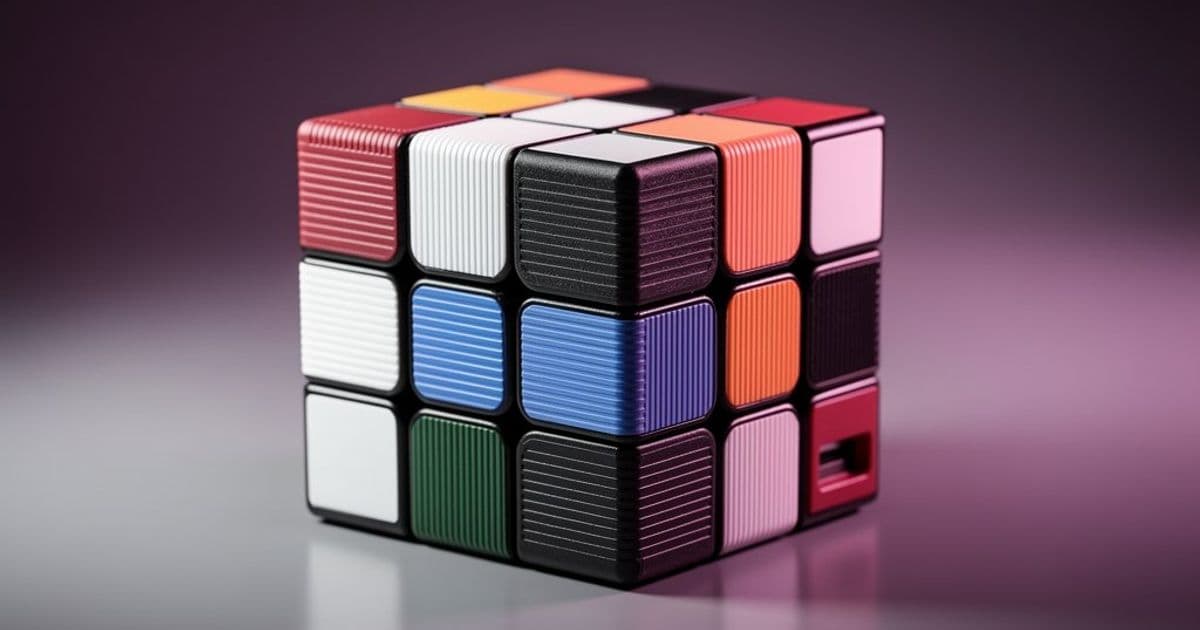
Researchers present CubeAuthn, a novel authentication system that uses Rubik's Cube configurations as cryptographic seeds for FIDO2-compatible credentials, turning physical puzzle states into secure digital passkeys.
CubeAuthn: The Rubik's Cube Authentication Revolution
 A featured IEEE conference publication introducing tangible cryptography
Beyond Passwords: The Physical Key Revolution
Traditional authentication struggles with the security-usability paradox: complex passwords are secure but forgotten, while simple ones invite breaches. Hardware tokens add security but create physical overhead. Enter CubeAuthn – a radical approach presented at IEEE ICMLC 2025 that transforms a Rubik's Cube into a cryptographic key generator.
How CubeAuthn Works
- State as Seed: Among the cube's 43 quintillion possible configurations, each scramble becomes a unique deterministic seed
- Keypair Generation: The physical state generates FIDO2-compatible public-private key pairs on demand
- Zero Storage: Unlike hardware tokens, the cube stores nothing – credentials are ephemeral and regenerate with each solve
- Browser Integration: A browser extension reads cube states via webcam to authenticate on WebAuthn-enabled sites
Security Advantages
- Physical + Digital Security: Requires both possession (cube) and knowledge (solution path)
- Quantum-Resistant: State complexity exceeds brute-force feasibility
- No Critical Data: Compromised cubes reveal no stored secrets
- Tamper-Evident: Physical manipulation alters cryptographic output
Usability Implications
- Leverages existing puzzle-solving behavior as security ritual
- Eliminates password memorization
- Reduces e-waste from disposable hardware tokens
- Accessible through commodity devices (webcam + browser)
Ethical Considerations
The team addresses key concerns:
- Accessibility: Alternative input methods for motor-impaired users
- Surveillance Risks: Local processing ensures scramble data never leaves the device
- Recovery Protocols: Social recovery options without compromising security
"This isn't just authentication – it's cryptographic choreography where human dexterity becomes part of the security protocol," notes lead researcher Dr. Elena Torres.
Future Applications
Prototypes explore:
- Modular Cubes: Swappable face plates for enterprise key management
- Biometric Pairing: Combining solve patterns with physiological signatures
- Decentralized Auth: Cube-based credentials for blockchain wallets
Published in IEEE's Machine Learning and Cybernetics conference, CubeAuthn represents a fascinating convergence of tangible interfaces, cryptography, and behavioral security – proving sometimes the best keys aren't carried in pockets, but in twists and turns.
Comments
Please log in or register to join the discussion