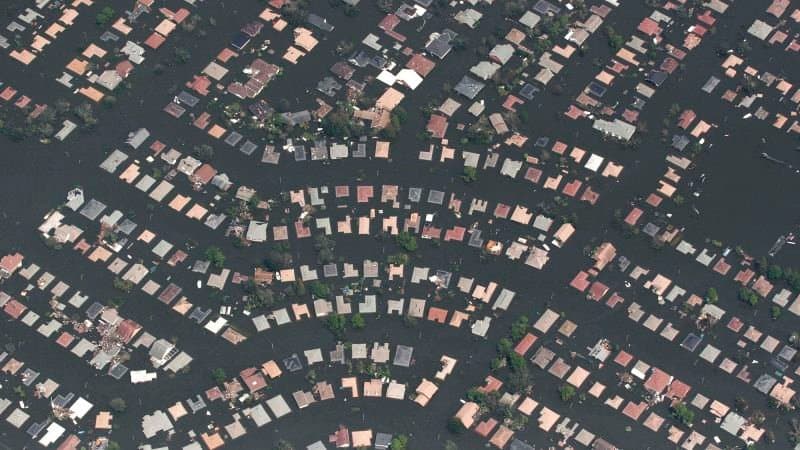
A new study in *Nature Sustainability* argues that New Orleans has crossed a climate “point of no return,” projecting that the city could be surrounded by the Gulf of Mexico within this century. Researchers call for early, equitable relocation planning, while community leaders warn that past failures and systemic inequities could make such a move disastrous for the city’s most vulnerable residents.
New Orleans sits in a natural basin that is already below sea level, hemmed in by wetlands that have been disappearing at an alarming rate. A recent analysis published in Nature Sustainability quantifies that loss: between 10 and 23 feet of sea‑level rise could submerge the remaining buffer, pushing the shoreline up to 62 miles inland and erasing roughly 75 % of the region’s wetlands. The authors conclude that the city has "crossed the point of no return" and that a managed relocation could become a model for other coastal communities.
The evidence behind the alarm
- Historical shoreline reconstruction – Geology professor Torbjörn Törnqvist and his team identified an ancient shoreline 30 miles north of present‑day New Orleans that existed when global temperatures were similar to today but sea level was at least 10 feet higher. That ancient benchmark suggests a future sea‑level rise of comparable magnitude is plausible.
- Wetland loss data – Since the 1930s, Louisiana has lost about 2,000 square miles of wetlands, a trend driven by canal dredging for oil and gas, levee construction that cuts off sediment supply, and outright drainage for development. The study projects that, without massive restoration, the remaining 75 % of wetlands could vanish within decades.
- Population trends – Yale‑affiliated urban sustainability researcher Brianna Castro notes that New Orleans has already shed roughly a quarter of its residents since Hurricane Katrina. Each major storm triggers a “pulse‑like” exodus, hinting that a gradual retreat is already underway, albeit without coordinated planning.
- Risk metrics – A separate University of Alabama study finds that 99 % of the city’s residents live in high‑flood‑risk zones. When a Katrina‑scale hurricane strikes again, virtually everyone would face damage.
 The city’s low‑lying geography makes it especially vulnerable to rising seas.
Why relocation is being floated now
The authors argue that waiting for resources to be exhausted will cement existing inequalities. As the tax base shrinks, public services deteriorate, insurance premiums skyrocket, and property values plummet, the poorest residents could be left with the fewest options. A proactive move could:
- Preserve community cohesion – By designing a “New Orleans 2.0” on higher ground, planners could embed cultural institutions, music venues, and historic neighborhoods into the new layout.
- Create a template – Coastal cities from New York to Bangkok face similar timelines. A well‑executed relocation could provide data on financing, land acquisition, and community engagement.
- Leverage restoration funding – Large‑scale sediment diversion projects, like the one broken ground on in 2023, could be integrated into a broader relocation strategy, buying time while new settlements are built.
Counter‑perspectives and cautionary notes
Historical mistrust and equity concerns
Beverly Wright, director of the Deep South Center for Environmental Justice, points out that past disaster responses—most notably after Katrina—disproportionately harmed Black communities. She worries that a top‑down relocation plan could repeat those patterns, forcing generations of culturally rooted residents to start over with little support.
Practical and cultural challenges
The Swedish town of Kiruna offers a rare glimpse of a planned relocation. Over the past two decades, its residents have watched historic buildings, including a 100‑year‑old church, moved on a 224‑wheel trolley. While the project is technically impressive, it has driven up rents and sparked fears of cultural loss. New Orleans, with its vibrant music scene, culinary heritage, and tightly knit neighborhoods, faces an even more complex task of preserving intangible cultural assets.
 Kiruna’s church relocation illustrates both engineering feats and the social upheaval that can accompany moving an entire town.
Political will and funding gaps
Louisiana’s Governor Jeff Landry cancelled the 2023 sediment diversion project in 2025, citing cost and fisheries impact. That decision effectively abandoned a major protective measure for the region, underscoring how quickly political tides can shift. Without consistent state or federal backing, large‑scale relocation could stall, leaving residents in limbo.
Where the conversation could go next
- Inclusive planning bodies – Forming councils that include community elders, Black advocacy groups, and climate scientists could help ensure relocation decisions reflect lived experience rather than solely technical assessments.
- Pilot “safe‑zone” neighborhoods – Investing in a few high‑ground districts as testbeds for new infrastructure, affordable housing, and cultural centers could provide a proof‑of‑concept before a city‑wide move.
- Hybrid adaptation – Rather than a binary choice between staying or leaving, a mixed strategy that combines flood‑proofing critical assets (e.g., hospitals, schools) with targeted retreats from the most vulnerable zones may be more politically palatable.
- Funding mechanisms – Leveraging climate‑justice financing, such as Green Climate Fund grants or public‑private partnerships focused on resilient housing, could address the massive capital needs.
Bottom line
The scientific data paints a stark picture: rising seas will dramatically reshape the Gulf Coast, and New Orleans sits at the forefront of that transformation. The debate now hinges not on whether relocation is necessary, but on how it can be carried out without erasing the city’s cultural soul or deepening social inequities. If planners can navigate those challenges, New Orleans may indeed become a model for climate‑driven urban transition; if not, the city risks a chaotic, inequitable retreat that repeats the mistakes of past disasters.
 Celebrations on Bourbon Street remind us of the city’s resilient spirit, even as the climate conversation grows more urgent.
Comments
Please log in or register to join the discussion