
Researchers have unveiled Cuddle-Fish, a helium-filled soft robot with bio-inspired flapping wings that eliminates the dangers of traditional drones. Designed for indoor spaces, it invites spontaneous human touch and affection, opening new avenues for social robotics. This innovation challenges the status quo of aerial robotics by prioritizing safety and emotional engagement.
Cuddle-Fish: The Soft, Flapping-Wing Robot Redefining Safe Indoor Human-Robot Interaction
Flying robots are ubiquitous, but their sharp propellers and mechanical rigidity make them hazardous for close human contact. A new prototype called Cuddle-Fish, led by Mingyang Xu, flips this script by combining a helium-filled soft body with low-frequency flapping wings inspired by animal locomotion. Unlike quadrocopter drones, Cuddle-Fish floats gently through indoor environments like apartments, eliminating spinning blades and enabling safe physical interaction.
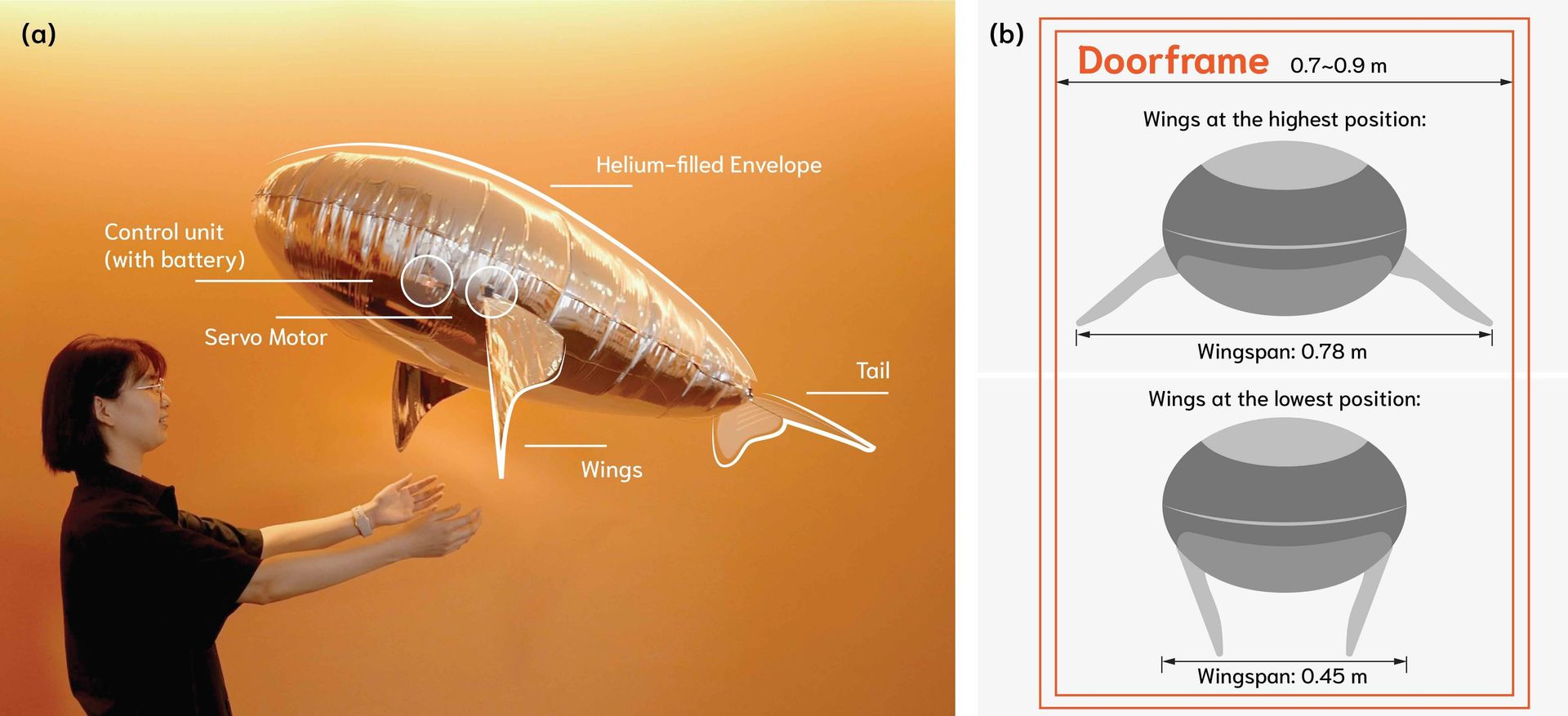
Caption: A picture of the robot prototype Cuddle Fish
A Design Built for Touch
The robot's soft construction is its standout feature. In a study with 24 participants, people didn't just coexist with Cuddle-Fish—they embraced it. Participants spontaneously patted, stroked, and hugged the robot, with some even brushing it against their cheeks. These "spontaneous affective behaviors" highlight how the design fosters trust and emotional connection, a rarity in aerial robotics.
Helium provides the lift, allowing the wings to flap slowly at low frequencies. This dual-purpose mechanism delivers propulsion while creating an organic visual presence and keeping noise levels minimal—ideal for homes where traditional drones would be disruptive. If bumped into, the soft body and slow wings pose no injury risk, addressing key barriers to indoor deployment.
Implications for Social Robotics
Social robotics has traditionally been ground-based, but Cuddle-Fish proves aerial platforms can participate in intimate interactions when safety is prioritized. Potential applications include companionship for the lonely or therapeutic roles in sensitive environments. For developers and engineers, this introduces new challenges in bio-inspired propulsion systems, soft robotics materials, and human-robot interaction (HRI) frameworks.
The flapping-wing system demands precise control algorithms to navigate constrained spaces, potentially leveraging advancements in computer vision and path-planning from drone tech but adapted for lighter-than-air dynamics. Material scientists may explore durable, helium-tight fabrics that maintain softness, while AI researchers could enhance the robot's responsive behaviors to deepen emotional bonds.
Bridging Aerial Freedom with Human Proximity
Cuddle-Fish isn't just safer—it's approachable. By demonstrating that people are willing to integrate flying robots into personal spaces when designed thoughtfully, this work paves the way for hybrid ground-aerial social robots. As the field evolves, expect to see these gentle floaters in everyday settings, transforming how we think about technology's role in human connection.
Source: Mingyang Xu et al., "Cuddle-Fish: Exploring a Soft Floating Robot with Flapping Wings for Physical Interactions," Augmented Humans International Conference 2025 (AHs ‘25), DOI: 10.1145/3745900.3746080. Posted on kaikunze.de.
Comments
Please log in or register to join the discussion