Exploring Venkatesh Rao's concept of the Manufactured Normalcy Field and its implications for technology design, with practical approaches for both normalizing novel technologies and defamiliarizing mundane ones.
Venkatesh Rao's concept of the Manufactured Normalcy Field (MNF) offers a compelling framework for understanding how humans interact with new technologies. The MNF describes our collective psychological tendency to maintain a "familiar sense of a static, continuous present" when faced with technological change. Rather than embracing radical disruption, we work to integrate new experiences into existing mental models with minimal cognitive adjustment.
The MNF operates through two primary mechanisms: metaphorical mapping and intentional design choices. We create stories and metaphors that connect unfamiliar experiences to familiar concepts—smartphones as phones, the web as documents, Facebook as yearbooks. Simultaneously, designers deliberately minimize the perceived strangeness of new technologies, as exemplified by aviation engineering that hides the extreme forces at play during flight.
This framework challenges conventional approaches to technology adoption. Rather than marketing innovations as radically new, successful products often work by finding the smallest conceptual stretch needed to expand the existing MNF. As Rao notes, "Successful products are precisely those that do not attempt to move user experiences significantly, even if the underlying technology has shifted radically."
Design Strategies for the Manufactured Normalcy Field
When developing technology, designers can adopt two contrasting approaches relative to the MNF:
Designing For the Field (Normalization)
For novel technologies that require adoption, the goal is to minimize disruption to existing mental models. This involves:
- Identifying well-understood products and experiences to serve as analogs
- Creating familiar interfaces and interactions
- Reducing cognitive load by building on existing knowledge
Apple's early iPhone marketing exemplifies this approach, positioning the device as an evolution of existing communication tools rather than a fundamentally new category.
Designing Against the Field (Defamiliarization)
For established technologies that have become invisible through familiarity, the goal is to "denormalize" or defamiliarize them. This might involve:
- Exposing underlying mechanisms that are typically hidden
- Creating novel interactions that reveal the artificial nature of the technology
- Highlighting the extraordinary nature of what we consider ordinary
Imagine an aircraft design with transparent hulls that reveal the actual forces and speed of flight, rather than the current approach that obscures these aspects to maintain passenger comfort.
Practical Implementation
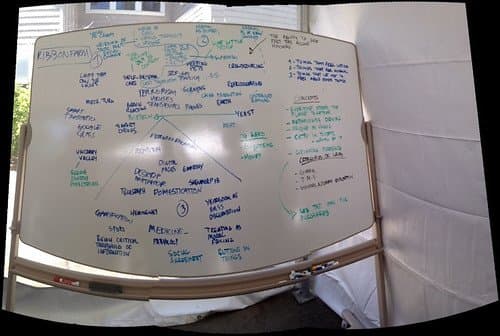
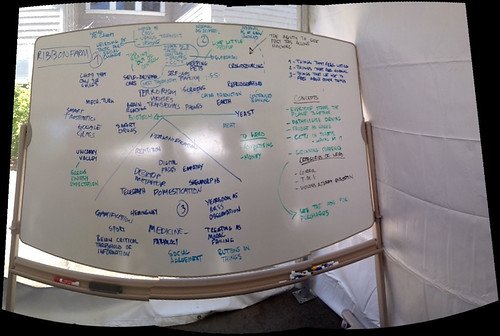
During a FOO camp session facilitated by Greg and Matt Webb, participants brainstormed approaches to both design strategies. The session organized ideas into three categories:
Things That Feel Weird (technologies needing normalization):
- Chips that can see smiles
- Mechanical Turk
- Self-driving cars
- Smart prosthetics
- Google Glass
- Smart drugs
- Brain reading
Things That Feel Normal (technologies needing defamiliarization):
- Keeping pets
- Earth
- Refrigerators
- Crowd-sourcing
- Screens
- Phones
- Centralized banking
- Producing things in China
- Self GPS-tracking
- Yeast
Things We Use to Feel About Things (normalization and defamiliarization techniques):
- Personification/anthropomorphism
- Repetition/routine
- Empathy
- Desktop metaphor
- Skeuomorphs
- Gamification
- Domestication
- Medicine/pathologizing
- Sport/play
- Treating as a moral failing
The session then moved toward actionable concepts by identifying specific "Things That Need Weirding" and "Things That Need Normaling":
Things That Need Weirding
- Advertising: Concepts included "CCTV in toilets" and "Advertising made just for you"
- Money: "Grinning Currency" emerged as a way to make financial transactions more visible and tangible
- Driving: Pathologizing driving as a communicable condition was suggested
Things That Need Normaling
- Refrigerators: The "Fridge as Narnia" concept aimed to make food storage more magical and less utilitarian
- Flying: "Everyone starts the plane together" with placebo controls was proposed to make air travel feel more participatory
Technical Implications
The MNF framework has significant implications for technical design and development:
For Novel Technologies
When introducing genuinely new technologies, successful integration requires:
- Careful consideration of existing mental models
- Gradual introduction of novel concepts rather than abrupt changes
- Interface design that bridges the gap between old and new paradigms
The failure of many innovative technologies stems from their inability to fit within existing cognitive frameworks, rather than technical limitations.
For Established Systems
Defamiliarizing familiar technologies can reveal new possibilities:
- Exposing APIs and data flows that are typically hidden
- Creating alternative interaction paradigms
- Revealing the underlying infrastructure of everyday systems
This approach aligns with the "breaking normal" philosophy explored by Ze Frank, who created an episode of his show after participating in the FOO camp session. Frank demonstrated how reimagining our relationship with fundamental concepts—like picturing ourselves standing on the side of rather than on top of the Earth—can reveal the inherent strangeness in what we consider normal.
Connection to Object-Oriented Ontology
The defamiliarization process resonates with Object-Oriented Ontology (OOO), a philosophical framework that challenges human exceptionalism by treating all objects—whether human, technological, or natural—as equally real. When we "weird" normal things, we're essentially performing what OOO proponents call "flat ontology," revealing the material reality behind cultural abstractions.
As one commenter on Ze Frank's show noted about computers: "In reality, I'm staring at a flat panel made from superheated sand that is connected via strips of ores and really heavily processed dinosaur remains to a thing that we all pretend to understand called 'the internet'. Also, I'm sitting on a cow skin painted black and stapled onto some more processed dinosaur remains."
This perspective reveals the material constituents of what we consider purely conceptual, flattening our understanding of technology and its relationship to the physical world.
Practical Applications for Designers
The MNF framework offers concrete approaches for designers:
For New Technologies: Identify the smallest conceptual stretch needed to integrate your innovation into existing mental models. Build bridges rather than conceptual chasms.
For Established Technologies: Find ways to reveal what's hidden or create novel interactions that challenge assumptions. Make the familiar strange to uncover new possibilities.
When Introducing Change: Consider both the technical implementation and the psychological integration. The most successful innovations often work at both levels simultaneously.
When Evaluating Technologies: Look beyond technical specifications to consider how innovations fit (or challenge) existing cognitive frameworks. The most technically advanced solution may fail if it doesn't account for the MNF.
The Manufactured Normalcy Field concept reminds us that technology adoption is as much a psychological process as a technical one. By understanding and working with these cognitive tendencies, designers can create innovations that are both technically excellent and successfully integrated into human experience.
As we continue to develop increasingly sophisticated technologies—from AI systems to augmented reality—the MNF framework provides a valuable lens for understanding how these innovations will be received and integrated into our collective understanding of what constitutes "normal."
Comments
Please log in or register to join the discussion