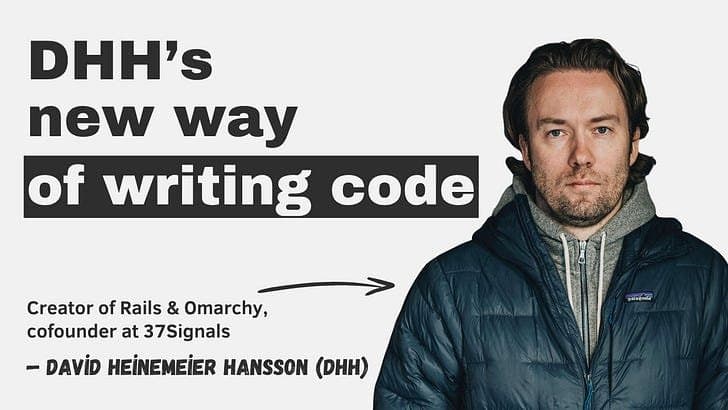
David Heinemeier Hansson reveals how AI agents transformed his coding workflow, why Ruby on Rails is thriving in the agent era, and what this means for the future of software development.
David Heinemeier Hansson, creator of Ruby on Rails and co-founder of 37signals, has undergone a dramatic shift in his approach to software development. Just six months ago, DHH told Lex Fridman he types out all his code manually. Today, he's embracing an "agent-first" workflow that's fundamentally changing how he builds software.
The AI Inflection Point
DHH's philosophy on AI hasn't changed, but the tools have evolved dramatically. "Autocomplete-style coding assistants were genuinely annoying for experienced developers six months ago," he explains. The shift from tab-completion to agent harnesses, combined with powerful models like Opus 4.5, created a tipping point where agents started producing code that DHH actually wants to merge with little to no alteration.
This transformation isn't just about convenience—it's about unlocking work that wouldn't have been considered before. At 37signals, a senior engineer ran a "P1 optimization" project to improve the fastest 1% of requests. They optimized the P1 from 4 milliseconds to under half a millisecond—the sort of work that wouldn't have been considered previously.
The New Development Workflow
DHH's current setup is remarkably specific:
- Two model setup: One fast LLM (typically Gemini 2.5) in one split terminal, and a slower but more powerful model (usually Opus) in another
- Review process: NeoVim for reviewing diffs via Lazygit
- Interface preference: Command Line Interfaces feel like the ultimate AI interface, validating the Unix philosophy from the 1970s
He's building CLIs for all 37signals products because they let agents chain tools together. "GitHub also has a CLI, and Sentry as well," he says. "You can tie all these things together so an agent can check errors, write a fix, post a PR, and report back to basecamp."
Why Rails Thrives in the Agent Era
Ruby on Rails is experiencing a renaissance thanks to AI. DHH points out that Rails is one of the most token-efficient ways of building web apps and is well-suited for agent workflows. Testing is part of the framework, which helps agents write tests and validate their own outputs. It also produces code that humans can read and verify, which matters when reviewing agent output at speed.
The Uneven Impact on Developers
The benefits of AI aren't distributed equally across experience levels. At 37signals, senior engineers gain more from AI tools as they can validate whether an agent's output is production-ready. DHH notes that Amazon reached the same conclusion and no longer lets junior programmers ship agent-generated code to production without review.
This creates a challenging landscape for junior developers. The traditional path of learning through incremental contributions and code reviews is disrupted when senior engineers can produce more with AI assistance. DHH acknowledges this tension but sees it as part of a broader shift in how software is built.
Design and Craft in the Age of AI
Despite the technological shift, DHH's standards for quality and craft remain unchanged. He argues that beautiful code and products aren't matters of vanity—they're signals of correctness. "When something is beautiful, it's likely to be correct," he says, drawing a parallel to Steve Jobs wanting the inside of a computer to be beautiful because people who care about circuit board layout are also those who sweat on the details of the UI.
At 37signals, the design philosophy remains central. The company maintains one designer for every two engineers, with designers doing far more than design—they're product managers and "implementers" rolled into one. They figure out what should be built, how it should work, and often build the first version.
The End of "Shape Up"
The 2019 methodology described in "Shape Up: Stop Running in Circles and Ship Work that Matters" by Ryan Singer covered how 37signals worked at the time. DHH reveals that this methodology now needs rewriting because AI acceleration has made that timeline feel slow. The two-month product development cycle is being compressed as agents handle more of the implementation work.
Work-Life Balance in the AI Gold Rush
Perhaps most surprisingly, DHH maintains that eight hours of sleep is non-negotiable—even during an AI gold rush. He believes the dopamine loop of shipping with agents is intoxicating and can lead to higher risk of burnout. So, he sleeps eight hours and doesn't use an alarm.
This disciplined approach stands in contrast to the frenetic energy that often accompanies technological revolutions. DHH sees the current moment as transformative but not apocalyptic—more like wearing a mech suit than being managed by agents.
The Future of Software Development
The implications of this shift are profound. DHH suspects the rest of the industry is converging toward what 37signals has always done: working with small teams where designers are also builders. AI tools now empower designers to implement more of their vision directly.
For the broader industry, this suggests a future where the distinction between design and implementation blurs further, where senior engineers become validators and architects rather than line-by-line coders, and where the craft of software development evolves but doesn't disappear.
As DHH puts it, we're not replacing developers—we're giving them better tools. The question isn't whether AI will write our code, but how we'll use these tools to build better software, faster, while maintaining the craft and care that makes great products endure.
Comments
Please log in or register to join the discussion