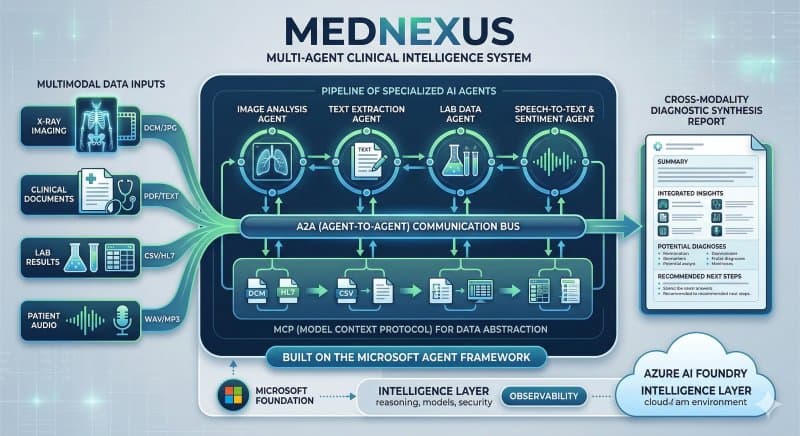
A production-ready multi-agent clinical platform built on Azure services demonstrates how healthcare organizations can evolve from AI prototypes to compliant, auditable systems with proper governance and human-in-the-loop workflows.
The healthcare AI landscape has reached a critical inflection point where experimental prototypes must evolve into production-grade systems. MedNexus, a multi-agent clinical platform built on Azure services, represents this transition by addressing the fundamental challenge of creating auditable, HIPAA-compliant AI workflows that can withstand compliance scrutiny while delivering clinical value.
What Changed in Clinical AI Architecture
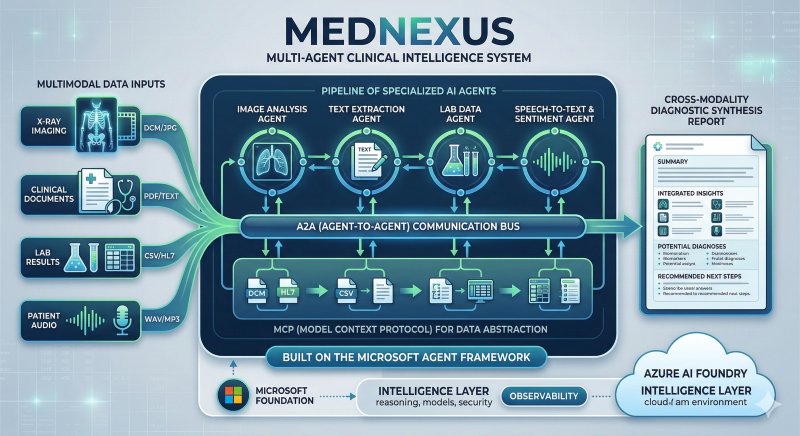
Traditional clinical AI approaches have relied on monolithic models processing all data types through a single prompt-based interface. This approach fails the compliance test with no audit trails, no patient-scoped access controls, and no mechanism for human oversight. MedNexus introduces a paradigm shift by implementing five specialized agents, each handling specific data modalities through a structured orchestration pattern.
The platform addresses the reality that a patient visit produces five-plus distinct artifacts: imaging, lab CSVs, referral PDFs, audio recordings, and free-text notes. Each requires different processing models, parsers, and retrieval strategies. A single prompt to GPT-4o asking to "summarize everything" fails clinical requirements for auditability and patient-specific access controls.
Azure vs. Alternative Cloud Approaches
Microsoft's Azure ecosystem provides unique advantages for clinical AI infrastructure compared to other cloud providers:
- Azure AI Foundry offers integrated model deployment (GPT-4o, Whisper, text-embedding-3-small, gpt-realtime-1.5) with managed identity authentication, eliminating the security risks of API key management
- Azure AI Search provides hybrid search capabilities combining BM25 keyword matching with vector similarity in a single query, a differentiator from AWS Kendra or GCP Vertex AI Search which require separate services for these capabilities
- Azure Container Apps with managed identity simplifies deployment while maintaining security boundaries
- Cosmos DB offers global distribution with consistent throughput pricing, unlike DynamoDB's provisioned capacity model that can lead to unexpected costs
Notably, Azure's Realtime API (gpt-realtime-1.5) with the GlobalStandard SKU is only available in specific regions (eastus2, swedencentral, centralus, canadacentral, francecentral), creating a geographic constraint that healthcare organizations must consider in their cloud strategy.
The MedNexus Architecture: Five Agents, One Orchestrator
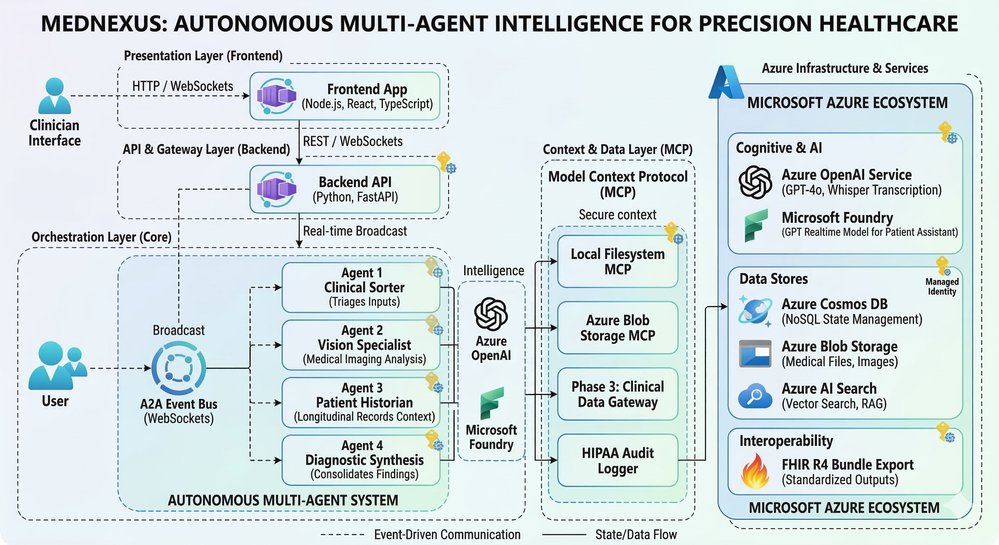
MedNexus implements a microservices architecture with five specialized agents:
- Clinical Sorter: A Python class that classifies incoming files by extension and extracts patient IDs from filename conventions
- Vision Specialist: Processes medical images using GPT-4o multimodal capabilities with strict JSON schema validation
- Patient Historian: Handles PDF text extraction, Whisper transcription with timestamps, and indexing to Azure AI Search
- Orchestrator: Manages the state machine routing files to specialists and tracking episode status
- Diagnostic Synthesis: Performs cross-modality reasoning, comparing audio statements against imaging findings
The orchestration pattern uses ConcurrentBuilder for fan-out processing with a callable aggregator that triggers synthesis once Vision and Historian agents complete their work. This approach ensures parallel processing while maintaining data dependencies.
The Critical MCP Layer: Data Access as Protocol, Not Prompt
Most clinical AI demos fail at the compliance stage by giving agents unconstrained file system access. MedNexus implements the Model Context Protocol (MCP) as a security abstraction layer that:
- Enforces patient-scoped access verification
- Logs every data access operation
- Allows hot-swapping between local development and Azure Blob Storage
The MCP server, built with FastMCP, exposes tools like fetch_medical_image that verify patient IDs before returning any data. Every tool invocation creates a structured audit log entry in JSONL format, creating a defensible trail that survives restarts and can be forwarded to Log Analytics for long-term retention.
Business Impact: From Prototype to Production
The MedNexus platform delivers several business advantages over traditional clinical AI approaches:
- Compliance by Design: The architecture enforces HIPAA requirements through patient-scoped access controls and comprehensive audit trails
- Operational Efficiency: The hybrid AI Search index reduces information retrieval time while maintaining both keyword and semantic search capabilities
- Clinical Validation: The human-in-the-loop approval workflow ensures diagnostic reports meet clinical standards before FHIR export
- Scalable Deployment: The azd + Terraform + Container Apps deployment pattern enables consistent infrastructure across environments
For healthcare organizations considering multi-cloud strategies, MedNexus demonstrates how Azure services can be combined to create specialized clinical AI infrastructure that balances innovation with governance requirements. The platform's architecture shows that clinical AI must be built with compliance as a foundational requirement, not an afterthought.
The FHIR R4 export capability transforms how healthcare organizations can integrate AI-generated insights into existing clinical workflows, while the patient portal with JWT authentication and real-time voice proxy creates new channels for patient engagement without compromising security.
Migration Considerations
Healthcare organizations evaluating similar solutions should consider several factors:
- Regional Constraints: The gpt-realtime-1.5 model availability limits deployment options to specific Azure regions
- Authentication Complexity: The split auth model (managed identity for some services, API keys for others) requires careful configuration
- Cost Management: The multi-model approach (GPT-4o, Whisper, embeddings) can lead to significant compute costs that require monitoring
MedNexus represents a maturation of clinical AI from experimental prototypes to production infrastructure. By combining Azure's AI services with proper governance patterns, healthcare organizations can build AI systems that not only demonstrate clinical value but also withstand the rigorous compliance requirements of healthcare delivery.
For organizations looking to implement similar solutions, the open-source patterns demonstrated in MedNexus provide a blueprint for creating auditable, scalable clinical AI infrastructure that bridges the gap between AI research and clinical practice.
Comments
Please log in or register to join the discussion