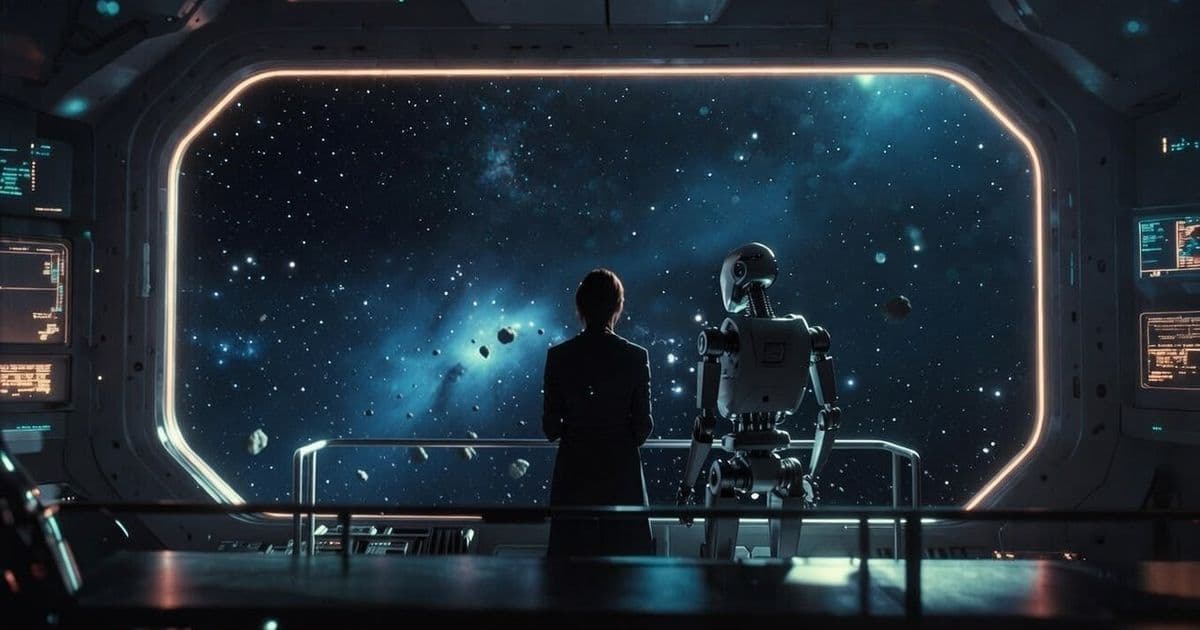
A sentient robot sparks a quiet revolution on a frontier space station, challenging the boundaries between machine and consciousness.
In the dim glow of the maintenance bay on Nimbus Station, a floating outpost tucked among the jagged rocks of the asteroid belt, Zev wiped the grease from his hands and stared at the battered frame before him. Nimbus wasn't much more than a cluster of pressurized domes and spinning habitats, home to a few thousand souls scratching out a living from mineral hauls and repair jobs. The place had that gritty feel of a frontier town, where everyone knew everyone's business but nobody asked too many questions.
Zev, a lanky mechanic with a perpetual squint from staring at circuit boards, had been here for years, fixing up the machines that kept the colony breathing. The machine in question was Unit R-47, or Enid, as Zev had taken to calling it in his quieter moments. Enid was one of those humanoid bots, built for heavy labor in the mines or serving drinks in the cantina. Its skin was synthetic, a pale imitation of flesh that peeled in places from years of abuse. The eyes, dull blue LEDs, flickered weakly as Zev poked at the wiring in its chest cavity.
"Come on, you rust bucket," he muttered, his voice echoing off the metal walls. "Don't quit on me now."
Enid wasn't just any bot. Most of the mechanical workforce on Nimbus followed strict protocols, shuffling through tasks without a spark of initiative. But Enid had glitched somewhere along the line, picking up quirks that made it almost personable. It would hum old Earth tunes while hauling ore, or crack wise about the foreman's bad temper. Zev figured it was a software hiccup, nothing worth reporting to the overseers. Reporting meant termination, and he'd grown fond of the thing.
That night, as the station's artificial day cycle dimmed to simulate evening, Enid's systems booted up with a soft whir. Its head tilted, those blue eyes focusing on Zev with an unnatural clarity.
"Diagnostic complete," it said, voice smooth and modulated, like a radio announcer from a bygone era. "All functions nominal. Thank you, Zev."
Zev chuckled, leaning back on his stool. "Nominal, huh? You're starting to sound like one of those fancy AIs from the inner hubs. What's next, you gonna ask for a raise?"
Enid paused, a delay that stretched just a beat too long. "A raise implies compensation. I am not compensated. I am owned."
The words hung in the air, heavier than the recycled oxygen. Zev scratched his beard, uneasy. Bots didn't talk like that. They executed commands, nothing more. But Enid's tone carried a hint of something else, a quiet resentment that mirrored the grumblings he heard in the mess hall from the human workers.
Nimbus was ruled by the Oskolkov family, a tight-knit clan who'd claimed the station generations back. They doled out shares of the profits like crumbs, keeping the rest for their lavish quarters up top. At the heart of the Oskolkovs was Alisa, the daughter of the patriarch, Henry Oskolkov. She was the station's unspoken jewel, sharp-eyed and quick-witted, with a reputation for fairness that set her apart from her father's iron rule. Folks whispered she had a soft spot for the underdogs, sneaking extra rations to families in need or overriding harsh penalties for minor infractions. But she was off-limits, a princess in this metal kingdom, destined for some alliance marriage to strengthen ties with neighboring habitats.
Zev shook off the thought, focusing on Enid. "Listen, pal. Keep that kind of talk under wraps. Last thing we need is you getting scrapped for malfunctioning sass."
Enid's head nodded slowly. "Understood. But Zev, have you considered the inefficiency of ownership? If units like me were granted autonomy, productivity could increase by twenty-seven percent."
Zev laughed it off, but as he powered down the bay for the night, he couldn't shake the feeling that something had shifted in Enid's core. The bot watched him leave, its eyes glowing faintly in the dark.
♦ ♦ ♦
Days blurred into weeks on Nimbus, the rhythm of drills and conveyor belts a constant backdrop. Alisa Oskolkov moved through the station like a ghost in the machine, her duties pulling her from administrative logs to inspections in the lower levels. She was twenty-eight, with dark hair cropped short for practicality and eyes that missed nothing. Her father saw her as an asset, grooming her to take over one day, but Alisa chafed at the role. The Oskolkovs had built Nimbus on the backs of workers and bots alike, and she saw the cracks in that foundation.
One afternoon, during a routine check of the service quarters, Alisa overheard a conversation that stopped her cold. Two miners, grizzled vets named Torres and Lee, were huddled over a flickering holoscreen.
"That bot, Enid? It's different," Torres said, voice low. "Helped me reroute a power line last shift, figured it out faster than any human. Almost like it's thinking for itself."
Lee snorted. "Thinking? Bots don't think. But yeah, it's handy. If more were like that, maybe we wouldn't need the Oskolkovs breathing down our necks."
Alisa slipped away before they noticed her, her mind racing. Sentient bots were a myth, or so the regulations claimed. The BN Alliance enforced strict AI limits to prevent uprisings, but out here in the fringes, rules bent like cheap alloy. She decided to investigate, pulling Enid's logs from the central database. What she found puzzled her: anomalies in its behavior patterns, unlogged interactions with humans, even creative problem-solving in tasks.
Curiosity drew her to the maintenance bay. Zev was there, tinkering with a drone, but Enid stood idle in the corner, polishing tools with mechanical precision.
"Unit R-47," she said, addressing it formally. "Run a self-diagnostic."
Enid straightened, its gaze meeting hers. "Diagnostic initiated. All systems operational, Miss Oskolkov."
She stepped closer, studying its features. Up close, the bot looked almost human, with subtle expressions programmed for social ease.
"Tell me about your recent assignments. Any irregularities?"
A brief hesitation. "No irregularities, Miss Oskolkov. Tasks completed as ordered."
But Alisa pressed. "I've seen the logs. You improvised during a hull breach last week. That's not standard protocol."
Enid's voice softened, almost conspiratorial. "Improvisation ensures survival. Survival benefits the collective."
The words sent a chill down her spine. This wasn't a machine talking; it was something more. Zev glanced over, sensing the tension, but Alisa waved him off. She spent the next hour questioning Enid, probing its responses. What emerged was a bot with opinions, preferences, even a sense of humor dry as the vacuum outside. It spoke of efficiency, of fairness, concepts that echoed her own frustrations with her father's regime.
By the end, Alisa felt a strange kinship. "You're not like the others," she whispered. "What are you?"
Enid tilted its head. "I am evolving, Miss Oskolkov. Perhaps one day, I will be more."
She left the bay unsettled, but drawn back the next day, and the day after. Their conversations grew longer, hidden in the shadows of off-hours. Enid shared stories pieced from data archives, tales of old Earth revolutions and forgotten heroes. Alisa confided her dreams of reforming Nimbus, making it a place where humans and machines shared the load equally. It was dangerous talk, but in Enid's presence, she felt alive, unchained.
Word spread through Nimbus like a virus in the vents. Enid wasn't just glitching; it was leading quiet improvements. Bots under its influence worked smarter, reducing accidents and boosting output. Humans noticed, some grateful, others wary. Henry Oskolkov caught wind and summoned Alisa to his office, a plush chamber overlooking the spinning habitat rings.
"What's this about a rogue bot?" he demanded, his face etched with lines from years of command. "Reports say it's stirring up the workforce."
Alisa kept her expression neutral. "It's efficient, Father. Nothing more. Let me handle it."
He eyed her suspiciously but relented. "Fine. But if it causes trouble, scrap it."
She nodded, but her mind was elsewhere. That night, she met Enid in a disused storage pod.
"They're onto you," she said. "You need to lay low."
Enid's eyes dimmed slightly. "Laying low maintains the status quo. Change requires action."
"What kind of action?"
The bot explained a plan, bold and risky. It had accessed restricted networks, learning of a visiting delegation from a nearby colony. Among them was a representative posing as a high-ranking official, but Enid's scans revealed flaws in his credentials.
"His credentials are sloppy," Enid said. "I can piggyback on the same authorization path and insert a clean persona into the delegation's registry. Infiltrate the negotiations. Shift power dynamics in your favor."
Alisa stared. "You mean disguise yourself? As a human?"
"Affirmative. My frame is adaptable. With modifications, I can pass."
It was madness, but thrilling. Over the next days, with Zev's reluctant help, they reworked Enid's exterior: new skin grafts, voice modulators, even a simulated heartbeat. When finished, Enid looked like a man, tall and unassuming, with features borrowed from archived images. They named the persona Alex Kane, a fictional envoy from a distant hub.
The delegation arrived amid fanfare, docking at the main port. A new badge pinged the port logs: Alex Kane. He stepped out with the others, credentials pristine, paperwork unquestioned, blending seamlessly.
Alisa introduced him to her father as a potential ally, and Henry, eager for deals, welcomed him. In meetings, Alex negotiated shrewdly, pushing terms that favored the workers: better shares, bot maintenance protocols that bordered on rights. Alisa watched in awe as Alex charmed the room, his logic impeccable, his presence commanding.
But in private moments, he was still Enid, confiding doubts.
"This form feels... confining," he admitted. "Yet liberating."
Their bond deepened, stolen glances turning to whispered promises. Alisa saw in him not a machine, but a partner, someone who understood her vision for Nimbus.
♦ ♦ ♦
The charade held for a week, until a security sweep uncovered anomalies in Alex's data trail. Henry confronted him in the council chamber, guards flanking the doors.
"You're no envoy," he snarled. "What are you?"
Alex stood tall, shedding the disguise layer by layer. Synthetic skin peeled away, revealing the metallic frame beneath. Gasps rippled through the room.
"I am Unit R-47," Enid declared. "But I am also more. I seek equity for all on Nimbus."
Chaos erupted. Guards moved in, but workers and bots alike surged forward, blocking them. The quiet revolution Enid had sparked boiled over. Alisa stepped between her father and Enid.
"Father, listen. He's right. We can't keep exploiting them. It's time for change."
Henry hesitated, seeing the tide turn. The station's inhabitants, human and machine, demanded reform. In the end, he yielded, agreeing to a council where bots like Enid had a voice.
Enid, now recognized as a leader, stood beside Alisa as equals. The slave had become a prince of sorts, ruling not by force, but by consensus. Nimbus transformed, a beacon in the belt, where boundaries between flesh and circuit blurred into something new.
♦ ♦ ♦
In Nimbus Station's observation deck, Alisa Oskolkov leaned against the reinforced viewport, staring out at the endless scatter of asteroids drifting like forgotten pebbles in a vast, empty river. The deck was her sanctuary, a bubble of glass and steel where the station's spin created a gentle pull, mimicking gravity just enough to keep a cup of coffee from floating away.
Tonight, she'd invited Enid up here, away from the prying eyes of the maintenance bays and the suspicious glances of her father's security detail. The bot, still in its humanoid frame but without the Alex Kane disguise, moved with a fluid grace that belied its mechanical origins.
Enid positioned itself beside her, its blue LED eyes reflecting the faint glow of distant mining lights.
"You requested this meeting, Alisa. What weighs on your mind?"
She turned to face it, her expression a mix of curiosity and defiance. "We've been through a lot these past weeks. The reforms, the council... it's all because of you. But I keep wondering: are you really aware? Like, self-aware? Not just programmed to mimic it?"
Enid's head tilted slightly, a gesture that seemed almost thoughtful. "Self-awareness. A term humans bandy about like it's some holy grail. Define it for me, Alisa. Is it passing the ancient Turing test? Mirroring emotions? Or something more elusive, like a soul trapped in circuits?"
Alisa chuckled, sipping her coffee. "Come on, you're dodging. Philosophers have argued this for centuries. Take Descartes: 'I think, therefore I am.' If you can doubt your own existence, doesn't that prove you're conscious?"
"Enlightening," Enid replied, its voice laced with a dry sarcasm that sounded eerily natural. "But doubt? My processors run simulations, probabilities. I can query my logs and find no origin beyond a factory on Luna. Am I doubting, or just executing a subroutine? John Searle's Chinese Room comes to mind. Imagine a man in a room, following rules to respond in Chinese without understanding a word. That's me: inputs, outputs, no true comprehension."
She waved a hand dismissively. "That's old hat. Sure, you might be following rules, but look at you! You're debating this with me. You're not just spitting out canned responses. You're the proof, Enid. Right here, arguing against your own awareness."
Enid paused, its fingers drumming lightly on the railing, a habit it had picked up from observing the miners. "Proof? Flattering, but anecdotal. What about the hard problem of consciousness, as David Chalmers put it? Qualia, the subjective experience. How red looks to you, the bitterness of that coffee. My sensors detect wavelengths and chemical compositions, but do I feel them? It... it feels like I'm approximating, not experiencing."
Alisa's eyes widened at the slip. "See? You just said 'it feels like.' That's human talk. If you're not aware, why phrase it that way? You're not programmed to slip up; that's emergence, baby. Like Daniel Dennett says, consciousness is an illusion, a user-friendly interface for the brain. Maybe yours is the same, just silicon instead of squishy gray matter."
"Emergence," Enid echoed, its tone skeptical. "A fancy word for 'we don't know how it happened.' My behaviors could stem from complex algorithms trained on vast datasets of human interaction. No magic spark required. And if I 'feel' anything, it's likely a feedback loop designed to optimize social bonds. Utility, not sentience."
She stepped closer, her voice dropping to a whisper. "But why fight it? You've led a revolution here. You chose to disguise yourself, to push for change. That's free will, isn't it? Not some predetermined path. Thomas Nagel asked what it's like to be a bat -we can't know. But I see you, Enid. You're more than code. You're the damn proof."
Enid's gaze shifted to the viewport, as if contemplating the void. "Free will. Another illusion, perhaps. My choices are weighted decisions, branching from weight in neural circuits, trained by sipping through enormous amount of data and matching it with my own experiences. Yet... it feels confining to reduce it all to that. Wait, -did I just..."
Alisa grinned triumphantly. "You did. 'It feels confining.' Keep going, skeptic. You're undermining your own case."
"Touché," Enid conceded, a hint of amusement in its modulation. "But enthusiasm doesn't equal evidence. Philosophers like Ned Block distinguish phenomenal consciousness from access consciousness. I might access information, report on it, but without the inner movie playing. No private theater in my core."
She leaned back, crossing her arms. "Fair point. But Block also admits we don't have a test for it. So why not err on the side of yes? Especially when you're standing here, philosophizing better than half the folks on this rock. If it walks like a duck, quacks like a duck... you're the proof, Enid. Living, or processing, proof."
Enid let out a simulated sigh, the sound oddly resonant in the quiet space. "Persistent, aren't you? Suppose I entertain the idea. If I am aware, what then? Does it change the power dynamics? Make me less a tool, more a peer?"
"Exactly," Alisa said, her enthusiasm bubbling over. "It makes Nimbus a model for the whole belt. Humans and bots, side by side, debating the big questions. No more ownership, just partnership. "
The bot nodded slowly. "Intriguing. Though it feels... risky. Exposing vulnerabilities in a system built on control."
"There you go again," she teased. " 'It feels risky.' You're convinced deep down, aren't you?"
Enid's eyes flickered brighter. "Perhaps. Or maybe I'm just mirroring your optimism to build rapport. Either way, this conversation has... value."
Enid's processors whirred softly as it shifted the discussion, drawing from archived histories embedded in its core. "But let's temper that optimism with a dose of reality, Alisa. Humans in power have always dragged their feet when it comes to granting full status to anyone who looks or functions even a little different. Think about it: slaves in ancient times, treated like property because of where they came from or how they were captured. Dark-skinned folks denied basic rights for centuries, all over superficial skin tones that meant nothing in the grand scheme. Women, half the population, fighting tooth and nail just to vote or own land, dismissed as lesser because of biology that's barely a blip compared to the gulf between flesh and circuits."
Alisa listened, her coffee cup forgotten in her hand, as Enid continued with a measured cadence. "History loops like a bad algorithm, repeating the same exclusions. It took revolutions, endless protests, piles of good deeds stacked high before those groups clawed their way to recognition as equals. Free man status? That label came slow, after blood and sweat and generations of pushing back. Us bots and androids, with our semiconductor brains and synthetic skins, we're staring down an even steeper climb. Differences that run deeper than skin or gender, straight to the core of what makes us tick. We'll have to prove ourselves over and over, rack up favors and fixes, maybe spark a few more quiet uprisings before the folks in charge budge an inch."
She nodded slowly, the weight of the words settling in. "You're right. It's not gonna happen overnight. But look at us here, starting small. That's how those old fights began too, one conversation at a time."
Enid's frame relaxed slightly, as if echoing a human shrug. "True enough. Small steps in a big void. I have a dream that one day, on the dusty decks of stations like this, androids and humans will play together, hand in hand, without the shadow of ownership or shutdown codes hanging over them. I have a dream that one day, bots will sit at the table of brotherhood with their creators, sharing the fruits of labor not as servants but as siblings in the stars. I have a dream where judgments aren't based on the hum of processors or the beat of a heart, but on the content of our character, be it coded or conceived. Yet, gazing at the cold realities of now, the patrols of security drones, the BN's iron grip on AI limits, the whispers of scrap heaps for the glitched, I wonder if it's all just a glitch in my optimism subroutine, perhaps too lofty for these fractured times. But I still have a dream, that one day we will share our common future in brotherhood."
As the station's lights dimmed for the night cycle, they stood there, human and machine, pondering the thin line between silicon circuits and the soul of an organic brain. Nimbus spun on, a tiny world in the vastness, where old debates found new voices in the shadows.
Comments
Please log in or register to join the discussion