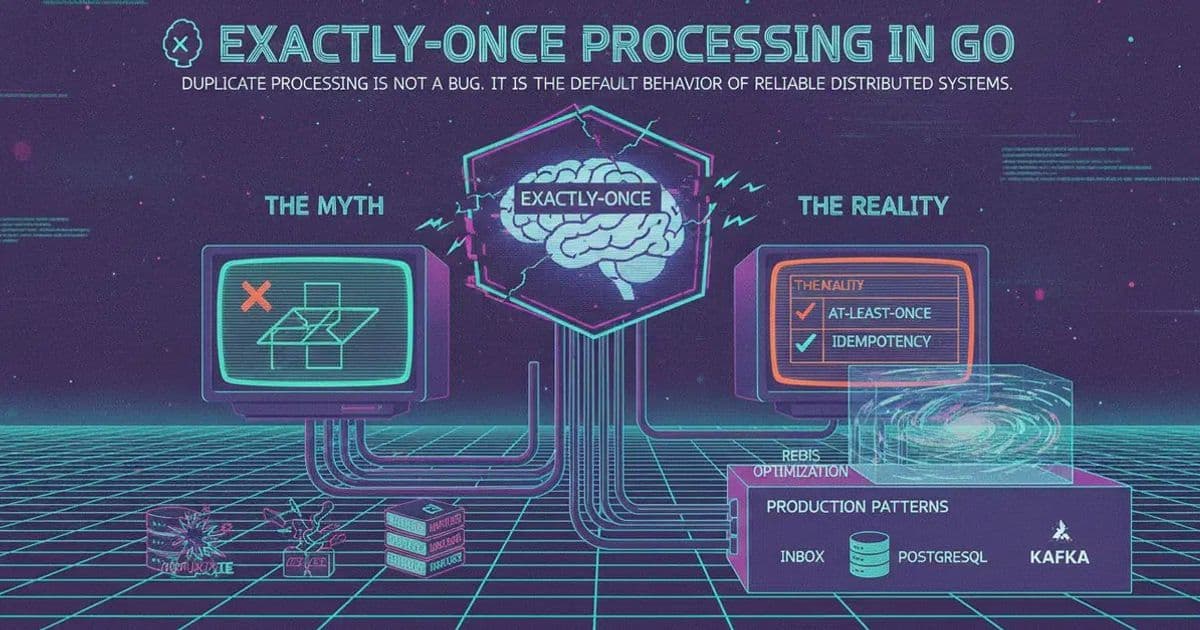
The article explains why exactly-once message delivery is a myth in distributed systems, argues that at-least-once delivery is the realistic guarantee, and shows how idempotency makes duplicate processing safe. It walks through concrete Go patterns using PostgreSQL unique constraints, Redis as a fast lock layer, Kafka transactional outbox, and proper shutdown handling, concluding with a reliable architecture that embraces duplicates rather than trying to eliminate them.
🧠 Exactly-Once Processing in Go: The Myth, Reality, and Production Patterns - DEV Community

Duplicate processing is not a bug. It is the default behavior of reliable distributed systems. Every distributed system eventually faces the same uncomfortable truth: The moment you introduce: Retries Failovers Message brokers Network partitions Service crashes duplicates become inevitable. Yet many engineers still believe that "exactly-once processing" is something a broker can magically provide. It isn't. In this article we'll explore: Why exactly-once delivery is mostly a myth Why at-least-once is the real-world standard How idempotency actually works How to build Inbox and Outbox patterns in Go How Kafka, PostgreSQL, and Redis fit together in production 🧨 Exactly-Once Is Not a Transport Property A message broker cannot guarantee exactly-once processing across your entire system. Exactly-once delivery requires a Single Point of Truth (SPoT) capable of enforcing uniqueness. Why? Because delivery, processing, and persistence are separate failure domains. Even if a broker behaves perfectly: Your service can crash after processing Your database can commit while ACK fails Your consumer can retry unknowingly This creates unavoidable duplication scenarios. 📊 Delivery Semantics in Real Systems Model Meaning Reality At-most-once Message may be lost Common in fire-and-forget systems At-least-once Message may be duplicated Kafka, SQS, RabbitMQ Exactly-once Message processed once Only possible inside bounded systems 👉 In practice, everything is at-least-once. 💥 Why Duplicates Happen Consumer Crash After Processing func handle(msg Message) error { if err := process(msg); err != nil { return err } return ack(msg) } Failure window: text Process Message ✅ Commit Database ✅ Crash Service ❌ ACK Never Sent ❌ Result: text Broker thinks processing failed ↓ Message redelivered ↓ Duplicate processing Network Timeout After Successgo err := process(msg) if err != nil { return err } return broker.Ack(msg) What happens if: text ACK sent ↓ Network timeout ↓ Broker never receives ACK The broker retries. The operation runs again. Retry Storms A temporary latency spike can trigger: text Client Retry ↓ Gateway Retry ↓ Service Retry ↓ Consumer Retry Result: text 1 failure ↓ 50 duplicate executions 🧠 The Real Solution: Idempotency Instead of preventing duplicates: text Wrong Question: How do I prevent duplicates? Ask: text Correct Question: How do I make duplicates harmless? That's where idempotency comes in. An idempotent operation produces the same final state no matter how many times it executes. 🚨 Naive Payment Service Let's start with a broken implementation.go func Charge( ctx context.Context, req PaymentRequest, ) error { _, err := db.Exec(ctx, INSERT INTO payments ( id, amount ) VALUES ($1, $2), req.ID, req.Amount, ) return err } Now imagine: text Request arrives ↓ Payment inserted ↓ Response lost ↓ Client retries ↓ Payment inserted again Customer charged twice. ✅ Production Solution #1: Database Unique Constraints Create an Inbox table. sql CREATE TABLE idempotency_keys ( event_id TEXT PRIMARY KEY, created_at TIMESTAMP DEFAULT now() ); Attempt to claim the key first. go _, err := tx.Exec(ctx, INSERT INTO idempotency_keys(event_id) VALUES($1), eventID) if err != nil { var pgErr *pgconn.PgError if errors.As(err, &pgErr) && pgErr.Code == "23505" { return nil } return err } The database becomes the source of truth. ⚠️ Common pgx Pitfall This subtle bug catches many Go teams. Wrong: go import "github.com/jackc/pgconn" Correct: go import "github.com/jackc/pgx/v5/pgconn" Otherwise: go errors.As(err, &pgErr) silently fails. Your duplicate protection stops working. 🧪 Testing Duplicate Safety Let's simulate 100 concurrent requests.go func TestIdempotency( t *testing.T, ) { var wg sync.WaitGroup for i := 0; i < 100; i++ { wg.Add(1) go func() { defer wg.Done() processOrder( context.Background(), "same-event-id", ) }() } wg.Wait() } Expected outcome: text 100 requests ↓ 1 insert succeeds ↓ 99 rejected safely ⚡ Redis Optimization Postgres guarantees correctness. Redis improves performance. Use Redis only as: text Fast Lock Layer Not as: text Source of Truth Atomic Lua Guard:lua local key = KEYS[1] if redis.call("GET", key) then return 1 end redis.call( "SET", key, "PENDING", "EX", 60 ) return 0 This protects the database from thundering herds. 📦 Kafka Exactly-Once: What It Actually Means Many engineers believe:text Kafka Exactly Once Business Logic Executes Once Wrong. Kafka guarantees: text Producer ↓ Kafka ↓ Consumer Kafka does NOT guarantee: text Producer ↓ Kafka ↓ Consumer ↓ Postgres The moment you touch an external database: exactly-once disappears. ⚠️ Disable Auto Commit Never rely on Kafka auto commits. Bad: go enable.auto.commit=true Good: go consumer, _ := kafka.NewConsumer( &kafka.ConfigMap{ "enable.auto.commit": false}, ) Process first. Commit later.go err := handleOrder( ctx, db, msg, ) if err == nil { consumer.CommitMessage(msg) } 📤 Solving the Dual-Write Problem This architecture is broken: text Insert Order ↓ Publish Event What if Kafka is down? text Order exists ↓ Event lost forever That's the Dual Write Problem. 0 Transactional Outbox Pattern Store event publishing intent in the same transaction. sql CREATE TABLE outbox ( id UUID PRIMARY KEY, payload JSONB, status TEXT DEFAULT 'PENDING' ); go _, err = tx.Exec(ctx, INSERT INTO orders(...) VALUES(...)) _, err = tx.Exec(ctx, INSERT INTO outbox(...) VALUES(...) ) Commit both together. 🔄 Outbox Workergo type OutboxWorker struct { db *pgxpool.Pool broker Broker } func (w *OutboxWorker) Run( ctx context.Context, ) { ticker := time.NewTicker( time.Second, ) defer ticker.Stop() for { select { case <-ctx.Done(): return case <-ticker.C: w.processBatch(ctx) } } } ⚡ Scaling Workers Safely Use PostgreSQL native locking. sql SELECT * FROM outbox WHERE status = 'PENDING' FOR UPDATE SKIP LOCKED LIMIT 10; Benefits: No deadlocks No duplicate workers Infinite horizontal scaling 💳 The Hardest Part: External Side Effects Database writes are easy. External systems are not. Examples: Stripe Twilio SendGrid Payment Gateways Without idempotency: text Duplicate Message ↓ Duplicate Payment ↓ Real Money Lost Always verify external APIs support idempotency keys. 🛡️ Graceful Shutdown Kubernetes gives you roughly: text 30 seconds before SIGKILL. Handle shutdown properly.go ctx, stop := signal.NotifyContext( context.Background(), syscall.SIGTERM, ) defer stop() Allow in-flight transactions to finish. 📈 Structured Observability Track duplicates explicitly. go slog.Info( "duplicate detected", "event_id", eventID ) If you can't measure duplicates: you can't prove idempotency works. 🏗️ Final Production Architecture text Kafka │ ▼ Inbox Pattern (Idempotency) │ ▼ PostgreSQL │ ▼ Outbox Pattern │ ▼ Kafka / RabbitMQ This architecture embraces reality:text At-Least-Once Delivery + Idempotency + Recovery Production Reliability ` 🚀 Key Takeaways Exactly-once delivery does not exist across distributed systems. At-least-once delivery is the industry standard. Idempotency transforms duplicates into harmless events. PostgreSQL UNIQUE constraints should be the source of truth. Redis is an optimization layer, not a consistency layer. Kafka auto commits can cause data loss. Inbox + Outbox patterns form the backbone of reliable event-driven systems. Reliability is not about preventing failures. Reliability is about remaining correct despite failures. MongoDB PROMOTED Build reliably, securely, and flexibly with MongoDB Atlas. Try free.  MongoDB Atlas lets you build and run modern apps in 125+ regions across AWS, Azure, and Google Cloud. Multi-cloud clusters distribute data reliably and auto-failover between providers for high availability and flexibility. Start free! Learn More
Comments
Please log in or register to join the discussion