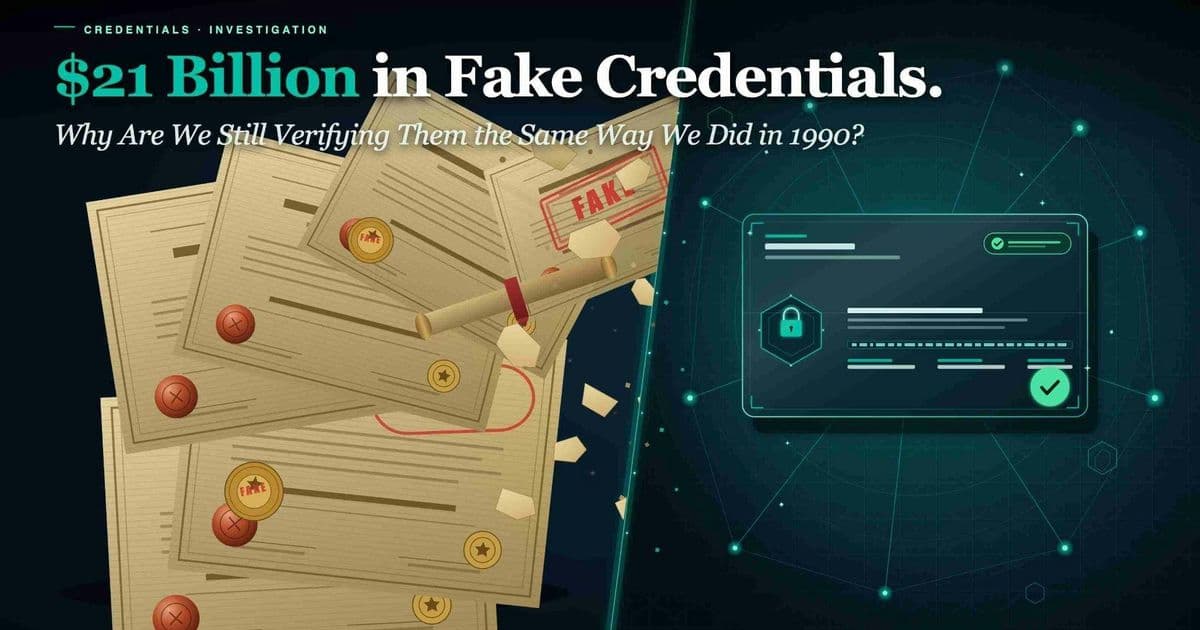
The global market for forged academic credentials is worth billions, driven by organized operations in India, Pakistan and beyond. Current background‑check services react too late, costing employers time and money while fraud keeps growing. Cryptographically signed, verifiable credentials—already deployed in Singapore and mandated in the EU—offer a preventative solution, but adoption stalls in India due to misaligned incentives, institutional inertia, and fragmented governance.
The Scale of the Problem
In December 2025 Kerala police busted one of India’s largest fake‑certificate rings. The operation had produced over one million forged academic documents linked to 22 universities, spanning medicine, nursing and engineering. The forgeries were printed in Tamil Nadu, routed through a hub in Bengaluru and sold across multiple states for as little as ₹7,500 each.
A similar pattern repeats elsewhere. In Himachal Pradesh, Manav Bharti University issued 41,000 degrees over eleven years, of which 36,000 (87 %) were fraudulent. The Enforcement Directorate seized assets worth ₹220 crore from that network.
Globally, the picture is no better. Axact, a Pakistan‑based operation, sold over 8 million fake diplomas in 190 countries before the FBI shut it down, generating more than $1 billion in revenue.
These scandals are not isolated incidents; they form a $21 billion market that includes diploma mills, contract‑cheating services and credential forgery. Digital diploma forgery alone accounted for 57 % of all document fraud in 2024, a 244 % jump from the previous year, driven by AI‑powered design tools and deep‑fake techniques.
Why Background Checks Aren’t Solving Anything
The current verification model is fundamentally reactive. An employer receives a candidate’s résumé, then sends the credentials to a third‑party verifier. That verifier contacts universities, previous employers and government databases, a process that typically takes 7‑10 business days domestically and months for international records. For Indian students applying abroad, services like World Education Services (WES) often require 3‑5 months.
The industry’s size reflects its inefficiency. AuthBridge reported that employment‑verification discrepancies rose to 14.26 % in FY24, up 44 % from FY21. In IT, 32 % of candidates submitted documents from non‑existent companies; in healthcare, 75 % of fraudulent applicants forged employment records. In FY24‑25, 360,000 individuals failed at least one background check in India alone—only the tip of the iceberg.
The cost to honest candidates is steep. Employers lose 30‑40 % of qualified applicants during the verification window, and each additional day of delay increases candidate dropout by 5‑8 %. The verification industry, worth billions, profits from these delays and from the very fraud it is supposed to prevent.
Verification at the Point of Issuance: How It Works
A more effective approach is to authenticate credentials when they are created. The process involves three steps:
- Cryptographic Signing – When a university awards a degree, the institution adds a digital signature that uniquely ties the credential to both the issuer and the content.
- Distributed Ledger Recording – The signed credential is stored on a decentralized ledger (e.g., a blockchain), ensuring an immutable, tamper‑proof record.
- Instant Verification – Anyone—employers, other universities, licensing bodies—can validate the credential in seconds using the public key of the issuer.
The W3C Verifiable Credentials specification already defines the data model, signing methods and verification protocols. It is the same standards body that created HTML and CSS, so the technology is open, interoperable and battle‑tested.
Early Results
- A pilot university reduced verification time from 2‑3 weeks to under 2 minutes.
- Organizations that switched to cryptographic verification reported up to 80 % lower verification costs by cutting out third‑party intermediaries.
- Fraud attempts dropped by up to 97 % in early deployments because the credential itself became impossible to forge.
Real‑World Deployments
- Singapore’s OpenCerts: A government‑backed, blockchain‑native platform that has issued over 5 million certificates across 18 institutions. Verification is instantaneous, and the project is recognized as a Digital Public Good.
- EU Digital Identity Wallet: Legislation requires all 27 member states to provide digital wallets with verifiable educational and professional credentials by December 2026. This is not a pilot; it is law.
- MIT, ACCA, Microsoft: Each has launched blockchain‑verified diplomas or certifications, demonstrating that top‑tier institutions can integrate the technology.
India’s Paradox: Advanced Infrastructure, Outdated Credential Layer
India boasts the world’s most extensive digital public infrastructure:
- Aadhaar covers 1.3 billion residents.
- UPI processes over 14 billion transactions per month.
- DigiLocker stores more than 6 billion documents.
- The Academic Bank of Credits has onboarded 20 million students.
Yet DigiLocker only stores PDFs; it does not verify authenticity. A student applying abroad still faces a 3‑5 month wait for WES, while Singapore completes the same check in seconds.
Why Adoption Stalls
- Incentive Misalignment – Background‑check firms generate revenue from delays and fraud detection. Making verification instant would undercut their business model.
- Institutional Inertia – Universities have issued paper credentials for centuries. Switching to digital, signed credentials requires technical integration, staff training and a cultural shift.
- Coordination Gap – Credential verification touches education, employment, and government bodies. In India, agencies like UGC, AICTE, NSDC and state boards operate independently, with no shared verification standard or governing authority.
The pattern mirrors the evolution of payments (pre‑UPI) and identity (pre‑Aadhaar). A neutral, government‑backed coordination layer—built on open standards—can align incentives and drive nationwide adoption.
The Path Forward
- Policy Intervention: Mandate the use of verifiable credentials for all publicly funded institutions, similar to Singapore’s OpenCerts model.
- Public‑Private Partnerships: Encourage fintech and blockchain firms to provide turnkey solutions, reducing integration costs for universities.
- Standardization Body: Establish a national credential‑verification council that adopts the W3C Verifiable Credentials spec and oversees a shared ledger.
When a credential is cryptographically signed at issuance, recorded on an immutable ledger, and instantly verifiable, the entire market for fake degrees collapses. The technology and standards exist; the challenge is political and organizational.
{{IMAGE:2}}
The image illustrates the scale of fake‑degree operations and the need for a systemic fix.
Comments
Please log in or register to join the discussion