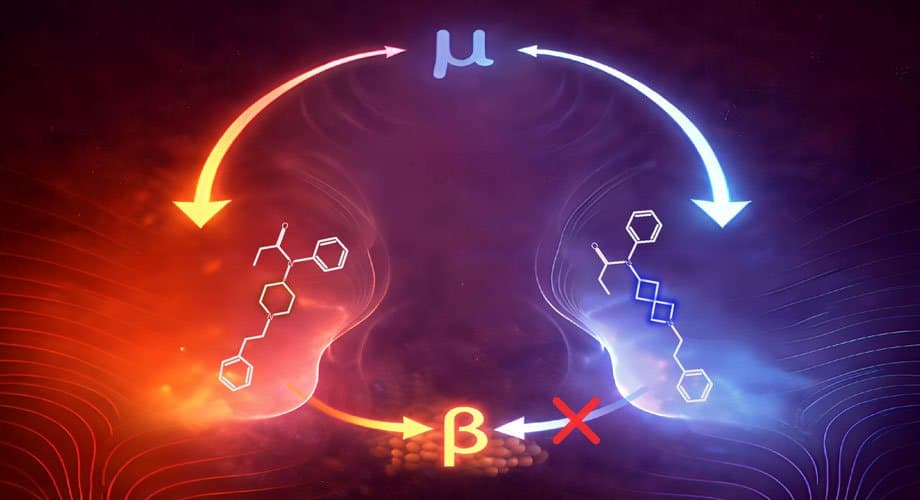
Chemists at Scripps Research have redesigned fentanyl's molecular structure to reduce respiratory depression while maintaining pain relief, potentially paving the way for safer opioid therapies.
Chemists at Scripps Research have achieved a significant breakthrough in opioid safety by redesigning fentanyl's molecular structure to reduce its dangerous side effects while preserving its powerful pain-relieving properties.
The research, published in ACS Medicinal Chemistry Letters on January 22, 2026, addresses one of the most pressing challenges in pain management: how to maintain the effectiveness of potent opioids while minimizing their risks of addiction and fatal respiratory depression.
The Problem with Traditional Fentanyl
Fentanyl remains one of the most effective drugs for managing severe pain, but its use has been severely limited by substantial risks. The drug's ability to cause respiratory depression—dangerously slowed breathing—has made it a leading contributor to the opioid overdose epidemic. In 2023 alone, more than 70,000 U.S. lives were lost to opioid overdoses, many involving fentanyl.
Traditionally, pharmaceutical approaches to opioid safety have focused on minor modifications to existing molecules, operating under the assumption that major structural changes would eliminate the drug's pain-relieving properties. This constraint has hampered the development of safer alternatives.
The Structural Redesign
Led by Kim D. Janda, the Ely R. Callaway Jr. Professor of Chemistry at Scripps Research, the team employed a strategy called "bioisosteric replacement" to fundamentally alter fentanyl's structure. Rather than making incremental changes, they replaced the drug's central ring structure with an entirely different geometry: a structure called 2-azaspiro[3.3]heptane.
This new "spirocyclic" shape consists of two small, four-sided rings connected at a single point—a dramatic departure from fentanyl's original construction that resembles the links of paper chains. Despite this significant structural shift, the redesigned molecule maintained fentanyl's essential pain-blocking capability.
How It Works
The key to the redesign's success lies in preserving the drug's binding affinity to mu-opioid receptors. Opioid drugs attach to these receptors through an electrical attraction between a positively charged part of the drug and a negatively charged amino acid inside the receptor's binding pocket. This critical anchor point allows the receptor to recognize and respond to the drug.
While the new structure changes many of the molecular contacts, it maintains this essential anchor, preserving enough receptor activation to produce pain relief. The redesigned molecule shows a different overall binding pattern than fentanyl but achieves the same therapeutic effect.
Reduced Respiratory Depression
Most significantly, the new compound showed no detectable recruitment of the beta-arrestin pathway, a cellular signaling corridor that scientists believe contributes to respiratory depression and other dangerous side effects. When respiratory depression did occur, it was only at very high doses and proved temporary, with breathing returning to normal within 25-30 minutes.
The analog also demonstrated a short half-life of approximately 27 minutes, which could be beneficial in controlled medical settings where rapid clearance is desirable.
Future Implications
This structural redesign represents a new chemical approach in Janda's broader strategy to address opioid overdose and adverse effects. The team plans to leverage this discovery to develop new opioid patent-free vaccines that train the immune system to recognize and neutralize fentanyl molecules before they reach the brain.
"Finding ways to preserve the analgesic properties of the synthetic opioids without encumbering the perils of respiratory depression could help derisk the toxicity associated with synthetic opioid use while providing a new conduit for pain management," says Janda.
The research team included Arran Stewart (first author), Lisa Eubanks, and Mingliang Lin, all from Scripps Research. The work was supported by the Shadek Family Foundation.
This breakthrough suggests that fundamental structural redesign, rather than incremental modification, may hold the key to developing next-generation opioid therapies that maintain their essential pain-relieving properties while significantly reducing the risk of addiction, overdose, and death.
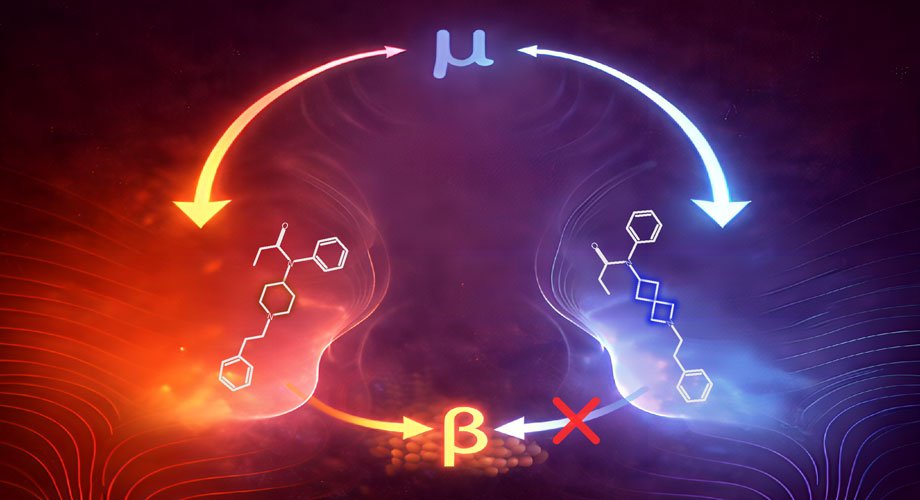
The featured image shows fentanyl's traditional molecular structure (left) alongside the redesigned version (right), illustrating the dramatic structural changes that maintain pain relief while reducing respiratory depression.
Comments
Please log in or register to join the discussion