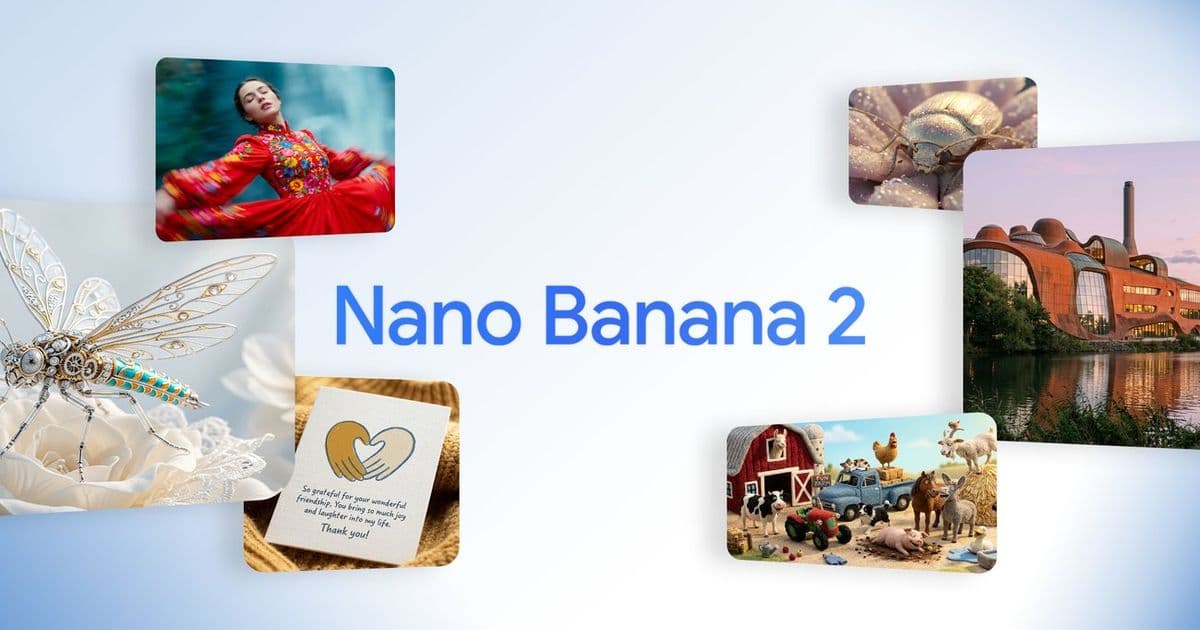
Google has unveiled Nano Banana 2, officially known as Gemini 3.1 Flash Image, a cutting-edge image generation model that promises advanced world knowledge, precision text rendering, and translation capabilities across its product ecosystem.
Google has officially rolled out Nano Banana 2, the codename for its latest image generation model Gemini 3.1 Flash Image, marking a significant advancement in AI-powered visual content creation. The new model brings enhanced world knowledge, production-ready specifications, and improved subject consistency to Google's ecosystem of products.
Advanced Capabilities and Features
The Gemini 3.1 Flash Image model represents Google's continued push to compete in the rapidly evolving AI image generation space. According to the official announcement, the model offers "advanced world knowledge" that allows it to generate images with greater contextual understanding and accuracy. This improvement addresses one of the key challenges in AI image generation: creating visuals that accurately reflect real-world concepts and relationships.
One of the standout features of Nano Banana 2 is its precision text rendering capability. Previous AI image generators have struggled with accurately rendering text within images, often producing garbled or nonsensical characters. Google claims that this new model significantly improves text clarity and readability, making it more suitable for creating marketing materials, social media content, and other applications where text is an integral part of the visual composition.
The model also introduces enhanced translation capabilities, allowing users to generate images with text in multiple languages while maintaining accuracy and cultural appropriateness. This feature could be particularly valuable for global brands and content creators who need to produce localized visual content at scale.
Production-Ready Specifications
Google has emphasized that Nano Banana 2 is designed with production-ready specifications, meaning it's optimized for real-world deployment rather than just research demonstrations. The model is built to handle high-volume image generation tasks while maintaining consistent quality and performance.
Subject consistency has been another area of focus for the development team. The model can maintain character and object consistency across multiple images, which is crucial for creating coherent visual narratives or maintaining brand identity across different marketing assets. This improvement addresses a common frustration with earlier image generation models, where characters or objects would appear differently across related images.
Integration Across Google Products
The rollout of Nano Banana 2 is being implemented across Google's product ecosystem, though specific details about which products will receive the update first haven't been fully disclosed. Given Google's extensive portfolio of creative and productivity tools, the new model could enhance applications ranging from Google Photos and Google Slides to more specialized tools like Google's AI Studio and various developer platforms.
This integration strategy aligns with Google's broader approach to AI development, where new capabilities are gradually introduced across its product lineup to maximize user impact and gather real-world feedback for continuous improvement.
Competitive Landscape
The launch of Nano Banana 2 comes amid intense competition in the AI image generation space. OpenAI's DALL-E, Midjourney, and Stability AI's Stable Diffusion have all established strong positions in the market, each with their own strengths and user bases. Google's entry with Gemini 3.1 Flash Image represents a significant investment in catching up and potentially surpassing these competitors.
The timing of this release is particularly interesting given the recent advancements in AI coding agents and the broader AI ecosystem. As noted in recent industry analysis, AI coding agents have made "a huge leap forward" in recent months, completing complex projects with minimal oversight. This technological progress in one area of AI often catalyzes advancements in related fields, including image generation.
Technical Implementation
While Google hasn't released detailed technical specifications, the "Flash" designation suggests that the model is optimized for speed and efficiency. This could indicate the use of techniques like model distillation, quantization, or other optimization methods that allow for faster inference without significantly compromising quality.
The production-ready nature of the model also suggests that Google has invested heavily in infrastructure to support large-scale deployment. This likely includes optimized serving infrastructure, caching mechanisms, and possibly even specialized hardware acceleration to handle the computational demands of image generation at scale.
User Experience and Accessibility
Google has historically emphasized user accessibility in its AI products, and Nano Banana 2 appears to follow this pattern. The model is being integrated into existing Google products rather than being released as a standalone tool, which should make it accessible to millions of existing users without requiring them to learn new interfaces or workflows.
For developers and power users, Google typically provides API access to its latest AI models, allowing for custom integration into third-party applications and services. This approach enables the broader developer community to build innovative applications on top of Google's AI infrastructure while maintaining Google's position as a platform provider.
Implications for Content Creation
The enhanced capabilities of Nano Banana 2 could have significant implications for digital content creation. The combination of improved world knowledge, text rendering, and subject consistency makes the model suitable for a wider range of professional applications, from marketing and advertising to educational content and entertainment.
The translation capabilities are particularly noteworthy in an increasingly globalized digital landscape. Content creators can now generate visually consistent content across multiple languages without the need for separate image generation processes for each language variant.
Challenges and Considerations
Despite the impressive capabilities, AI image generation still faces several challenges. Issues around copyright, ethical use, and the potential for misuse remain ongoing concerns for the industry. Google will need to implement appropriate safeguards and usage policies to ensure responsible deployment of the technology.
There's also the question of how this technology will impact creative professionals. While AI image generation tools can significantly enhance productivity and enable new forms of creativity, they also raise concerns about the future of certain creative roles and the value of human artistic expression.
Looking Ahead
The launch of Nano Banana 2 represents another step in the rapid evolution of AI image generation technology. As these models continue to improve in quality, speed, and capability, we can expect to see even more innovative applications emerge across various industries.
Google's investment in this technology signals its commitment to remaining competitive in the AI space, particularly as other tech giants like OpenAI, Microsoft, and Meta continue to push the boundaries of what's possible with artificial intelligence. The integration of these advanced capabilities across Google's product ecosystem could provide a significant competitive advantage, especially if the company can successfully leverage its existing user base and infrastructure.
The coming months will likely reveal more about how Nano Banana 2 performs in real-world applications and how users and developers choose to leverage its capabilities. As with previous AI advancements, the true impact of this technology will be determined not just by its technical capabilities, but by how creatively and responsibly it's deployed by the broader community.
For now, Nano Banana 2 stands as a testament to the rapid progress being made in AI image generation and the increasing sophistication of these models in understanding and representing the visual world.
Comments
Please log in or register to join the discussion