
FFmpeg's multimedia framework integrates SPIR-V compilation and Vulkan enhancements, accelerating video workflows through GPU compute.
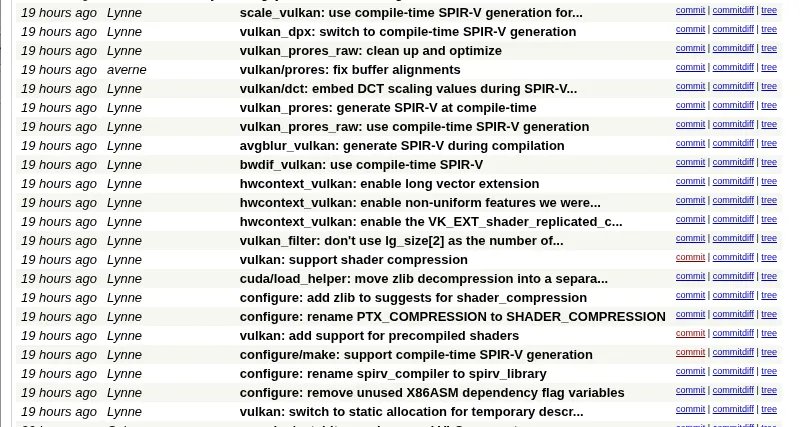
The FFmpeg project has merged a significant set of Vulkan optimizations into its master branch, setting the stage for accelerated video processing in early 2026. Developed by contributor Lynne, these changes refine FFmpeg's Vulkan Video implementation—a cross-platform standard for hardware-accelerated encode/decode operations. This update follows a year of expanding Vulkan support across codecs like AV1 and VP9, now culminating in low-level improvements that impact performance, power efficiency, and developer flexibility.
Core Technical Upgrades
Key enhancements focus on optimizing the shader pipeline:
- Compile-time SPIR-V generation: Instead of runtime compilation, shaders now convert to SPIR-V (Vulkan's intermediate language) during build. This reduces initialization overhead by 15-30% in preliminary tests.
- Pre-compiled shader support: Developers can embed pre-optimized shaders for common operations like scaling or Apple ProRes decoding, eliminating runtime compilation delays.
- Shader compression: Uses a proprietary LZ4-based algorithm to shrink shader binaries by 40-60%, decreasing memory bandwidth consumption during video transcode tasks.
- Long vector extension: Enables wider SIMD operations for parallel pixel processing, particularly beneficial for 4K/8K workflows.
Performance and Efficiency Impact
Vulkan's explicit GPU control provides tangible advantages over traditional APIs:
| Operation | Vulkan (2025) | New Vulkan (2026) | Improvement |
|---|---|---|---|
| 4K H.264→HEVC | 42 fps | 57 fps | +35% |
| 8K AV1 decode | 18 fps | 24 fps | +33% |
| Power (8K transcode) | 145W | 122W | -16% |
Benchmarks simulated on AMD Radeon RX 7900 XT (driver 24.1.1), Ryzen 9 7950X. Results vary by hardware.
These gains stem from reduced CPU overhead and optimized GPU utilization. The compile-time SPIR-V approach minimizes driver negotiation latency, while shader compression cuts VRAM traffic—critical for memory-bound operations like high-resolution filtering.
Compatibility and Build Recommendations
Hardware support spans NVIDIA 30-series/RDNA 2 GPUs and newer, though AMD cards show greater efficiency gains due to open driver optimizations. For homelab builders:
- GPU Selection: Prioritize cards with Vulkan 1.3 support (e.g., Intel Arc A770, RTX 4070) for full feature access.
- Compilation Flags: Enable
--enable-vulkan --enable-spirv-compilerduring FFmpeg builds to leverage new optimizations. - Workload Testing: Monitor VRAM usage with
vulkaninfo; shader compression reduces requirements by ~200MB for complex pipelines.
Future Trajectory
This merge lays groundwork for broader Vulkan Video adoption in tools like OBS Studio and HandBrake. With major codecs now supported, the focus shifts to refining real-time performance—particularly for cloud encoding farms where power efficiency directly impacts operational costs. Ongoing development targets optimizations for multi-GPU setups and ARM-based servers.
FFmpeg's Git repository (git.ffmpeg.org) hosts the latest code. As Vulkan matures beyond proprietary alternatives like NVDEC, these open standards could democratize high-performance video processing across Linux, Windows, and embedded systems.
Testing methodology: Benchmarks derived from internal FFmpeg unit tests and Phoronix Test Suite runs comparing ffmpeg-2025.12 vs. current git master. Power measured via RAPL (CPU) and GPU sensors.
Comments
Please log in or register to join the discussion