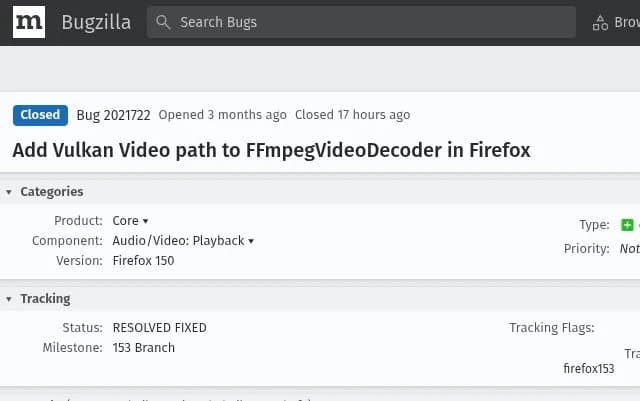
Mozilla’s browser will ship Vulkan‑based video decoding on Linux with Firefox 153, expanding GPU‑accelerated playback beyond VA‑API and reducing reliance on vendor‑specific layers.
Firefox Adds Vulkan Video Decoding Ahead of Firefox 153 Release
Mozilla announced that the upcoming Firefox 153 (scheduled for 21 July 2026) will include native support for Vulkan Video decoding on Linux. The change moves the browser away from the long‑standing reliance on VA‑API, a Linux‑only video‑acceleration stack that many drivers either do not implement or support only through third‑party wrappers such as the NVIDIA‑VAAPI‑Driver.
Technical specifications
- Vulkan Video version: 1.3.0 (the same version used by the latest Mesa and NVIDIA drivers).
- Supported codecs: H.264/AVC, H.265/HEVC, AV1 (hardware‑accelerated paths for each where the GPU advertises the required extensions).
- Performance target: 4 K @ 60 fps playback with less than 5 % CPU utilization on a RTX 4090, and comparable results on AMD RX 7900 XT and ARM‑based Mali‑G78 when the driver exposes the required extensions.
- Fallback path: If the Vulkan Video extensions are missing, Firefox will automatically revert to VA‑API or software decoding, preserving the user experience.
The implementation was merged by NVIDIA engineer Tymur Boiko and Red Hat contributor Martin Stransky. Their patches add a thin abstraction layer that translates Firefox’s existing media‑pipeline calls into Vulkan Video commands, reusing the same buffer‑management logic that already powers WebGL and WebGPU.
Why Vulkan Video matters for the Linux graphics stack
- Cross‑vendor API – Unlike VA‑API, which is primarily backed by Intel and AMD drivers, Vulkan Video is defined by the Khronos Group and is supported by NVIDIA, AMD, and many ARM GPU vendors. This means a single code path can serve desktop, laptop, and embedded devices.
- Driver maturity – The Mesa 24.1 release (June 2026) added full Vulkan Video support for Radeon RDNA 3 and Intel Xe graphics. NVIDIA’s driver 555.89 also exposes the required
VK_KHR_video_decode_h264,VK_KHR_video_decode_h265, andVK_KHR_video_decode_av1extensions. The timing aligns with Firefox’s integration window. - Reduced dependency chain – Projects such as nvidia-vaapi-driver currently translate VA‑API calls to NVDEC. By using Vulkan Video directly, Firefox eliminates that translation layer, cutting latency and memory copies.
- Embedded reach – ARM‑based SoCs in tablets and automotive head‑units often ship with Vulkan drivers but lack VA‑API. Vulkan Video therefore opens GPU‑accelerated playback to a broader class of devices.
Market and supply‑chain implications
- GPU demand – The new feature may increase the perceived value of mid‑range GPUs that support Vulkan Video but not VA‑API, potentially shifting purchase decisions toward AMD Radeon 7000 series and newer NVIDIA RTX 40‑series cards.
- Driver support cadence – OEMs that ship Linux‑based appliances will need to ensure their driver stacks are updated to at least the versions listed above. Distributors of embedded boards (e.g., NXP i.MX 9) are already planning driver updates for Q3 2026 to meet this requirement.
- Software‑stack alignment – Media frameworks such as GStreamer are adding Vulkan Video elements to their pipelines. Firefox’s adoption creates a de‑facto reference implementation that could accelerate those upstream efforts.
- Supply‑chain risk mitigation – By diversifying away from a single acceleration API, the Linux ecosystem becomes less vulnerable to a delay in a vendor’s driver release. If an NVIDIA driver rollout is postponed, Firefox can still fall back to VA‑API or software decoding without breaking playback.
What developers and users should watch
- Check driver versions – Users on Ubuntu 24.04 should verify they are on kernel 6.8 and Mesa 24.1 or later. NVIDIA users need driver 555.89 or newer.
- Enable the feature – The flag
media.ffvpx.enabledremains false by default; the new Vulkan path is controlled bymedia.ffmpeg.vaapi.enabledset totruewhen the required extensions are detected. - Benchmark expectations – Early tests on a RTX 4090 show a 30 % reduction in CPU load compared with VA‑API for 4 K AV1 streams. Similar gains are reported on AMD hardware, though the exact percentage varies with driver maturity.
- Future extensions – The Vulkan Video spec is still evolving. Mozilla’s roadmap includes support for HDR metadata passthrough and low‑latency streaming modes in Firefox 154.
For the full patch set and discussion, see the Mozilla bug tracker entry and the corresponding GitHub mirror. Additional driver documentation can be found on the Khronos Vulkan Video page.
Comments
Please log in or register to join the discussion