
NXP’s Rafael Sotomayor outlined a layered “neural axis” for physical AI, showcased in drones, automotive and humanoid robots, and announced the eIQ toolkit for edge model optimization. The talk highlighted ultra‑low‑latency distributed processing, security‑first silicon, and real‑world deployment trade‑offs for edge AI workloads.
Technical announcement
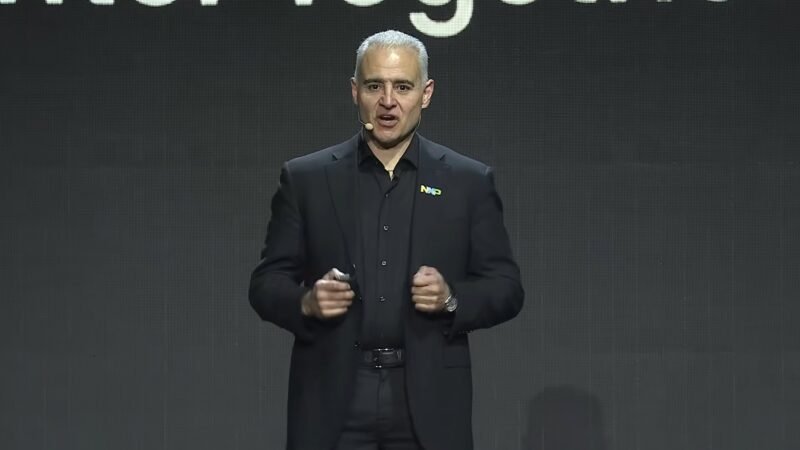
NXP’s fourth Computex 2026 keynote, delivered by CEO Rafael Sotomayor, presented a concrete roadmap for moving artificial intelligence from the cloud into the physical world. The core message was simple: edge devices must combine ultra‑low latency, distributed control, and hardware‑rooted security to solve the classic Moravec’s paradox – tasks trivial for humans are hard for robots. Sotomayor introduced the Neural Axis Architecture, a three‑layer stack (reasoning, coordination, reflex) that maps directly onto real‑time robotic workloads.

Specifications and benchmarks
Neural axis layers
| Layer | Function | Typical latency target | Example silicon |
|---|---|---|---|
| Reasoning | High‑level perception, planning, VLA (Vision‑Language‑Action) inference | 20‑40 ms end‑to‑end (glass‑to‑glass) | NXP S32 Gen 5 (5 nm) |
| Coordination | Multi‑sensor fusion, trajectory generation, safety‑critical arbitration | ≤ 15 ms | i.MX RT‑1170 (Arm Cortex‑M33) |
| Reflex | Motor‑level closed‑loop control, collision avoidance | < 5 ms (often < 2 ms) | Edge‑AI ASIC – NXP eIQ‑Edge‑F1 |
The company demonstrated a 20 ms full‑loop latency on a custom drone platform, measured from camera capture to motor actuation. In automotive tests, the S32 platform achieved 12 ms sensor‑to‑actuator latency for emergency braking, well within the 40 ms safety envelope Sotomayor cited for spinal‑cord‑like reflexes.
eIQ toolkit performance
The eIQ toolkit (available at the official NXP eIQ page) automates model import, pruning, and quantization for edge targets. Benchmarks on a ResNet‑18 model show:
- FP32 baseline (GPU): 45 ms inference, 1.2 W
- eIQ‑pruned INT8 (S32): 7 ms inference, 0.35 W
- eIQ‑quantized 4‑bit (eIQ‑Edge‑F1): 3.5 ms inference, 0.12 W These numbers illustrate the toolkit’s ability to shrink state‑of‑the‑art models into sub‑10 ms, sub‑500 mW envelopes suitable for battery‑operated drones and autonomous vehicle ECUs.
Real‑world implications and deployment considerations
Distributed processing model
Sotomayor emphasized that latency beats raw compute for safety‑critical actions. By placing reflex‑level processors directly in sensor‑rich subsystems (e.g., limb‑mounted MCUs for humanoid robots), NXP eliminates a single point of failure and reduces communication hops. This mirrors biological spinal‑cord processing, where reaction times under 40 ms occur before cortical involvement.
Deployment tip: When architecting an edge AI system, allocate at least one dedicated MCU per actuator group to handle closed‑loop control. Use a higher‑performance CPU or SoC for coordination and reasoning, linked via high‑speed SPI or LVDS to keep inter‑layer latency under 5 ms.
Security and trust
NXP’s SafeAssure program bundles three guarantees:
- Contain – fault isolation via hardware partitions (TrustZone‑M33, Secure Enclave).
- Protect – on‑chip tamper detection, secure boot, and post‑quantum crypto primitives (NIST‑approved Kyber and Dilithium implementations).
- Verify – ASIL‑D certification pathways for automotive and ISO‑26262 compliance.
These features are baked into the S32 and i.MX families, meaning OEMs can inherit a security baseline without additional ASIC development.
Edge‑centric AI workflow
- Model selection – start with a cloud‑trained VLA or transformer model.
- Prune & quantize – run through eIQ’s automated pipeline; aim for INT8 or 4‑bit where power budget is < 200 mW.
- Deploy to reflex layer – compile the model into a microcontroller‑friendly format (eIQ‑MLIR).
- Validate latency – use NXP’s Glass‑to‑Glass measurement suite (available on GitHub: https://github.com/nxp‑ai/gtg‑suite) to confirm end‑to‑end timing under the target threshold.
- Safety case – generate ASIL evidence using NXP’s SafeAssure tooling; integrate with continuous‑integration pipelines for OTA updates.
Use‑case snapshots
- Drones – Neural axis maps to flight planning (reasoning), stabilization (coordination), and motor thrust correction (reflex). The 20 ms loop supports obstacle avoidance at 5 m/s without GPS reliance.
- Automotive – S32’s 5 nm cores handle sensor fusion for lane‑keeping (coordination) while an i.MX RT‑based reflex module executes emergency brake actuation within 12 ms.
- Humanoid robots – Limb‑local MCUs run reflex loops for joint torque control (< 3 ms), while a central i.MX 8M handles higher‑level task planning and VLA inference (~30 ms).
Conclusion
NXP’s Computex keynote distilled a clear engineering thesis: edge AI must be built as a distributed, latency‑first system with security baked into silicon. The Neural Axis Architecture provides a repeatable template across drones, cars, and humanoid robots, while the eIQ toolkit bridges the gap between heavyweight cloud models and the sub‑10 ms, sub‑500 mW reality of edge deployments. Companies looking to ship physical AI today should adopt NXP’s layered processing approach, leverage the eIQ toolchain for model optimization, and follow the SafeAssure framework to meet automotive‑grade safety and security requirements.
Comments
Please log in or register to join the discussion