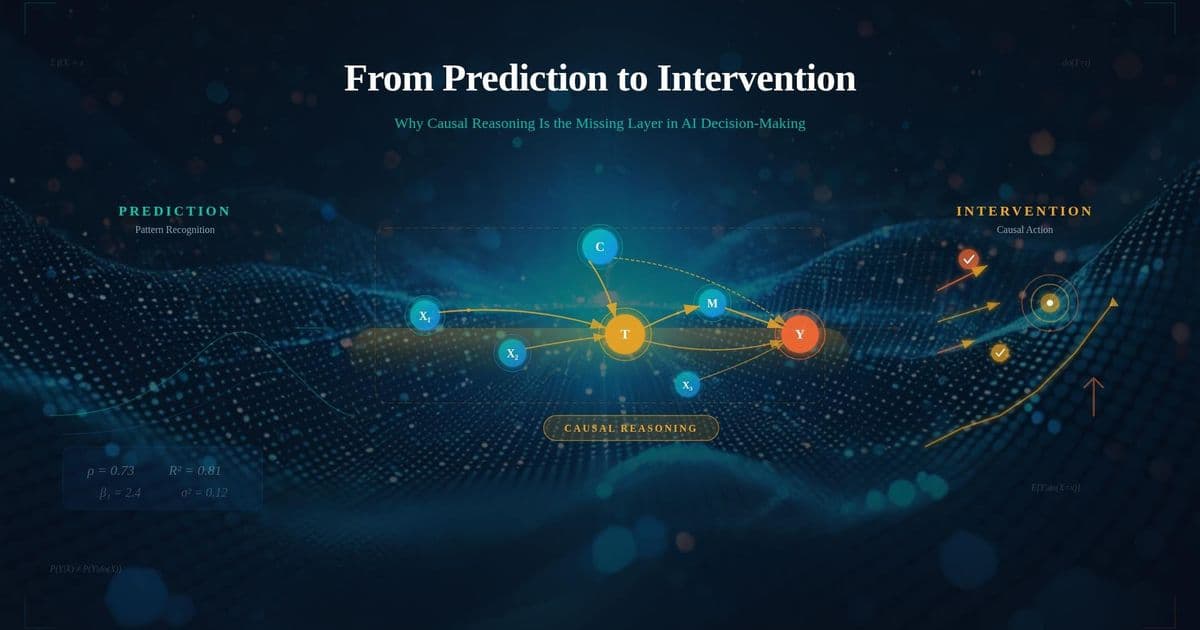
An exploration of why enterprises are turning to causal inference and counterfactual reasoning to make AI predictions more trustworthy, the technical trade‑offs involved, and what this shift means for product roadmaps and risk management.
How Causal Reasoning Could Improve Enterprise AI Adoption

Enterprises have spent billions building predictive models that churn out forecasts, churn scores, and demand estimates. The outputs look impressive, but when a model’s recommendation leads to a costly misstep, the blame often lands on the “black box” nature of the system. Causal reasoning offers a way to move from "what will happen" to "why it will happen" and, crucially, "what would happen if we changed X".
The problem with pure prediction
Most production‑grade AI pipelines lean on supervised learning: a dataset of historical inputs and outcomes is fed to a model, which learns statistical regularities. This works well when the future resembles the past, but three issues surface in real‑world deployments:
- Spurious correlations – A model may latch onto a feature that happens to correlate with the target in the training data but has no causal link. When the environment shifts, the correlation breaks and the model’s accuracy collapses.
- Policy brittleness – Decision makers need to know how a recommendation will change if they intervene (e.g., raising a price, altering a credit limit). Predictive models cannot answer "what‑if" questions without additional machinery.
- Regulatory pressure – Regulations such as the EU AI Act and emerging U.S. AI accountability rules demand explanations that go beyond feature importance scores. Stakeholders are asking for evidence that a model’s recommendation is grounded in a causal mechanism.
Causal inference as a bridge
Causal inference, long the domain of econometrics and epidemiology, is now being packaged into tools that integrate with existing ML stacks. The core idea is to model the data‑generating process with a structural causal model (SCM)—a directed acyclic graph (DAG) that encodes assumed cause‑effect relationships. From this graph, two operations become possible:
- Identification of the causal effect of a variable (e.g., the lift in conversion when a marketing spend increases by 10 %).
- Counterfactual simulation – estimating what the outcome would have been for a specific unit under an alternative intervention.
When an enterprise couples an SCM with a predictive engine (often a deep neural net that estimates conditional distributions), it can answer both "what will happen" and "what would happen if". This hybrid approach is sometimes called causal‑enhanced prediction.
Practical implementation steps
- Domain mapping – Business analysts, data scientists, and subject‑matter experts collaboratively sketch a DAG that captures known mechanisms (e.g., price → demand, ad spend → brand awareness → demand). Tools like DoWhy or CausalNex help formalize the graph.
- Data alignment – Identify variables needed for the graph that may be missing from the existing data lake. This often triggers new data‑collection initiatives (e.g., logging exposure to a specific campaign).
- Model selection – Choose a base predictive model (gradient‑boosted trees, transformer‑based time series, etc.) to estimate the conditional distributions required for the SCM.
- Causal estimation – Apply methods such as back‑door adjustment, instrumental variables, or front‑door adjustment to compute the causal effect. Libraries like EconML provide ready‑made estimators.
- Counterfactual engine – Build a service that, given a unit’s observed features, returns the predicted outcome under a set of hypothetical interventions. This can be exposed via an API for product managers to test pricing strategies or for compliance teams to audit decisions.
Trade‑offs and challenges
| Aspect | Benefit | Drawback |
|---|---|---|
| Interpretability | Provides a narrative linking cause and effect, satisfying auditors. | Requires a correct causal graph; misspecifications can mislead. |
| Data requirements | Forces collection of variables that are true confounders, improving data quality. | May need expensive instrumentation or third‑party data sources. |
| Model complexity | Allows reuse of high‑performance predictive models while adding causal logic. | Adds a layer of computation; inference latency can increase. |
| Risk management | Enables scenario analysis, reducing exposure to unexpected policy changes. | Counterfactual estimates are probabilistic; over‑reliance can give a false sense of certainty. |
Enterprises that ignore these trade‑offs risk building brittle AI pipelines that fail under distribution shift. Those that invest in causal reasoning gain a more resilient decision‑making framework.
Early adopters and market signals
A handful of mid‑size tech firms have already raised capital to commercialize causal AI platforms. For example, Causalytics secured $45 M in a Series A round led by Accel to integrate SCMs with large‑language‑model (LLM) explainability tools. Their flagship product lets product managers query an LLM about the causal impact of a feature flag change, returning a quantified lift estimate.
Large cloud providers are also moving in this direction. AWS announced a preview of Amazon SageMaker Causal Insights, a managed service that automatically infers causal graphs from tabular data and plugs them into existing SageMaker pipelines. The service is priced per‑hour of compute, signalling that the market expects causal reasoning to become a commodity rather than a niche research tool.
What this means for AI roadmaps
- Shift from "predict‑first" to "causal‑first" – Product teams should allocate sprint capacity to validate causal assumptions before scaling a model.
- Cross‑functional ownership – Causal graphs sit at the intersection of data engineering, domain expertise, and compliance. Governance frameworks need to reflect that shared responsibility.
- Toolchain integration – Expect to see more SDKs that wrap popular ML libraries with causal layers, reducing the friction of adding counterfactual capabilities.
- Talent pipeline – Hiring will increasingly favor candidates who can bridge statistics, econometrics, and software engineering, rather than pure deep‑learning specialists.
Conclusion
Causal reasoning does not replace predictive modeling; it augments it with a language for intervention. For enterprises wrestling with regulatory scrutiny, volatile markets, and the need for trustworthy AI, the ability to ask "what if" in a mathematically sound way is becoming a competitive necessity. As tooling matures and cloud providers bake causal services into their portfolios, the barrier to entry will drop, and we can expect a steady rise in AI systems that are not only accurate but also accountable.
Author: Dharmateja Priyadarshi Uddandarao, Senior Data Scientist – Statistician at Amazon
Comments
Please log in or register to join the discussion